Manage Promotions Centrally
Learning Objectives
After completing this unit, you’ll be able to:
- Examine how Real-Time Offer Management unifies the setup, distribution, and performance tracking of promotions.
- Explain how Global Promotions Management delivers a unified omnichannel experience while offering rewards.
- Describe how Offer Management helps you activate promotions by delivering targeted communications across channels.
Unify Your Promotions Strategy
Think about a time you offered a good deal to your customers—maybe 50% off on your most popular jacket. Now imagine running that same promotion across different regions, currencies, and a mix of online and in-store channels. Sounds messy, doesn’t it?
A jacket is 50% off on the website, has a different markdown in stores, and uses different dates and currencies in another region. Customers see different offers, and marketers find it hard to determine which promotion drove the sale.
That's where Salesforce Real-Time Offer Management (RTOM) comes in. It brings together Global Promotions Management (GPM) and Offer Management so you can define the deal once and get the right message to customers on each channel. With real-time capabilities, those messages can change with what a customer is doing now, rather than relying only on a campaign planned in advance.
In this badge, you get an overview of how the two capabilities work together, and the app you use to manage them.
Meet Your App
The Real-Time Offer Management app brings promotion setup, planning, management, and analytics into one workspace. Marketing managers manage promotions and offers, while admins configure GPM and Offer Management through Salesforce Go or manual setup.
Access these activities through the tabs:
-
Overview: Get quick access to everything in RTOM and take action on items assigned to you.
-
Planning: Brainstorm promotions or offers by using briefs, track promotional budgets, and plan your activities with an intuitive calendar view.
-
Definition: Create and manage promotions, personalized promotions, offers, the reward catalog, and approvals.
-
Analytics: Monitor offer performance by using dashboards.
-
Setup: Configure the components to design and deliver personalized promotions and offers, including how overlapping promotions are evaluated and applied.
Next, explore the capabilities of GPM.
Explore Global Promotions Management
GPM is where you create and manage promotion rules in one place.
Use a guided setup flow to define the audience, products, channels, triggers, and rewards, starting with a template or by creating custom rules. From the same tool, plan, schedule, and monitor the promotion.

A cart can qualify for more than one promotion at once, such as a product discount, a sitewide sale, and a bundle. GPM uses evaluation rules to determine which promotions apply.
The evaluation engine classifies promotions into three subgroups.
- Cart rewards
- Line rewards
- Cross-line rewards
For example, a discount on total cart value is a cart reward, a discount on one product is a line reward, and 'buy shoes, get socks free' is a cross-line reward.
For each subgroup, choose how the engine evaluates eligible promotions.
-
Stacked: Applies all eligible promotions together
-
Highest Discount: Applies the promotion with the biggest discount
-
First Eligible Promotion: Applies the first eligible promotion based on priority
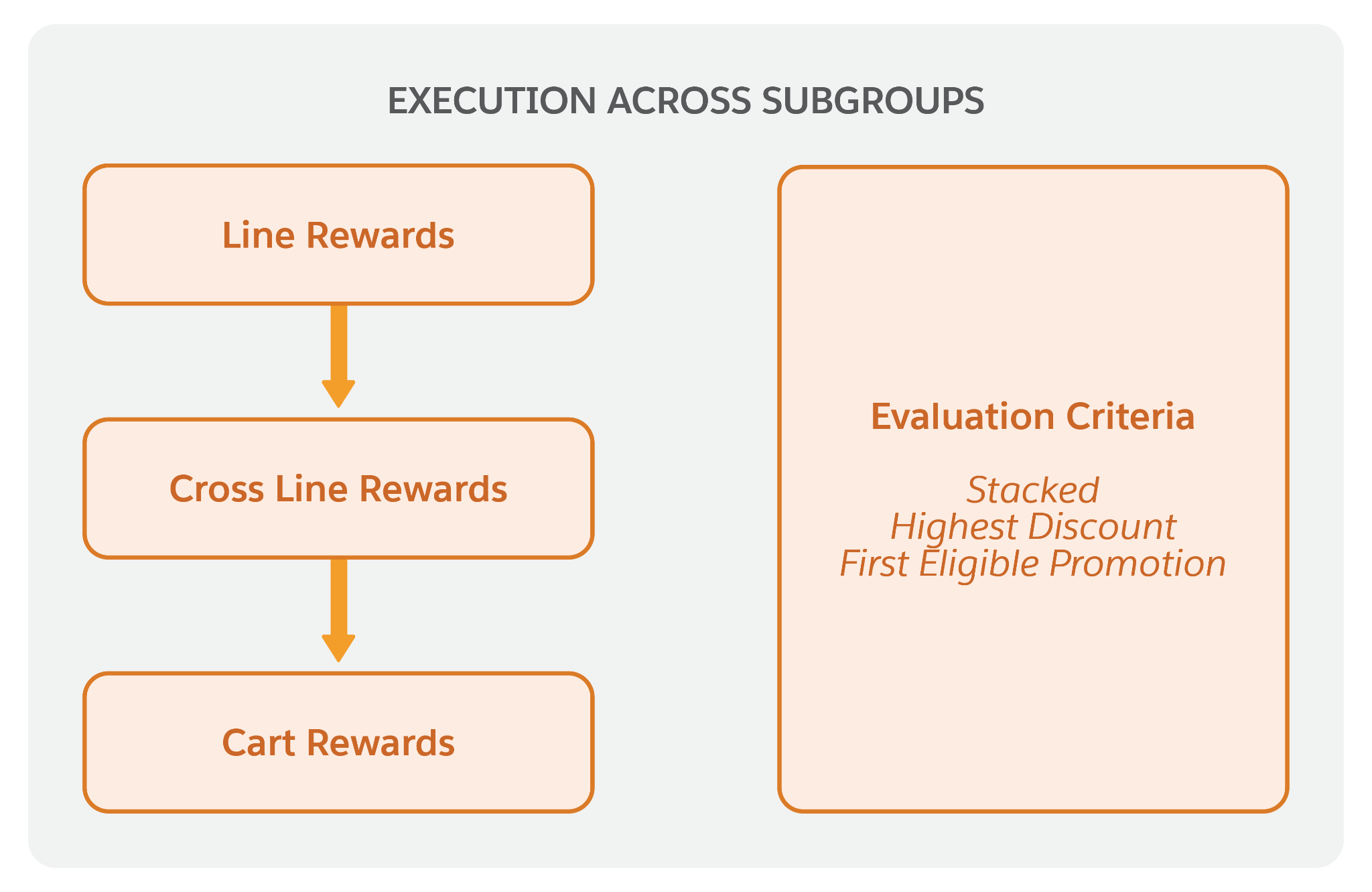
These evaluation rules help control discount stacking, deliver a consistent customer experience, and align promotions with business goals.
Promotions are effective only when they reach the right audience. Offer Management bridges the gap between promotion creation and distribution.
Meet Offer Management
Offers are how you present a promotion on a channel, such as email, text, a website widget, or a banner. In Offer Management, create the content, such as images, URLs, and text, target a segment of the promotion’s audience, and then deliver the promotion.
The offer lifecycle consists of three phases.
-
Offer creation: Add details such as images, videos, start and end dates, and offer codes.
-
Offer execution: Decide which eligible offers a customer sees and how to make the offer live through messages, emails, web personalization, and so on. And with Salesforce Personalization, you can keep that decision flexible in real time based on a customer's browsing and purchase history.
-
Offer tracking: Analyze conversion rates, click-through rates, and channel performance down to the order level, since RTOM links each purchase back to the offer and the customer that drove it.
You can ask Agentforce to create or update a promotion, or draft offer content, by using a simple prompt.
Here’s a look at an example to further understand promotions and offers.
Distinguish Between Promotions and Offers
A retail company uses GPM to manage its promotions. The marketing team sets up a 10% Off Activewear promotion. The goal is to deepen engagement with specific customer groups by showing them the incentive that’s most relevant to them.
The team uses Offer Management to tailor the promotion into distinct offers distributed through different channels.
- A customer browsing outdoor gear on the mobile app sees Exclusive! Get 10% Off Jacket.
- A fitness enthusiast on the website sees Stay Cool While You Train—10% Off Performance Tees
- An inactive customer receives a push notification: Fresh Looks for Your Next Adventure! 10% off Joggers — Tap to Shop Now.
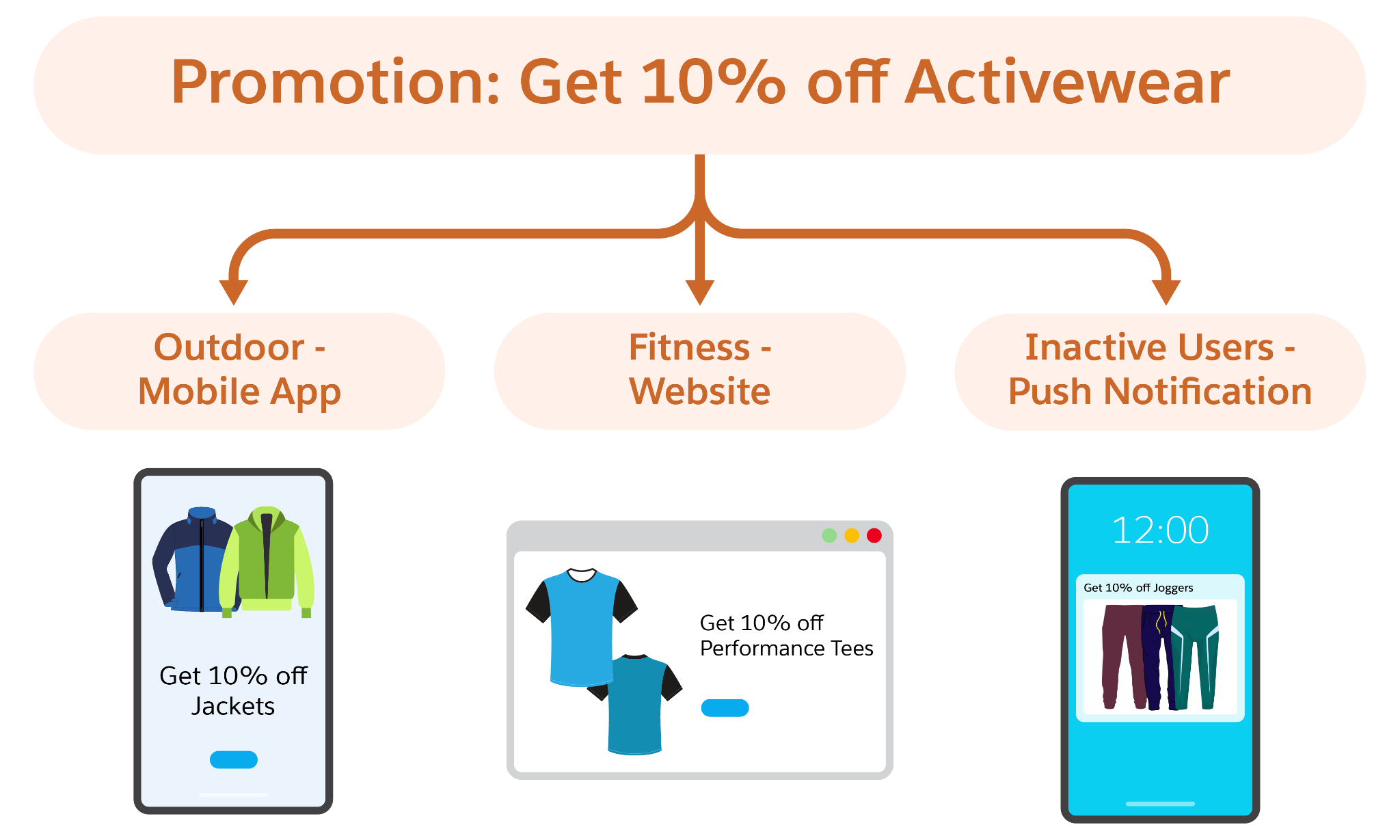
The promotion reaches customers through different offers based on their interests and the channels they’re engaging in. When a customer makes a purchase, the promotion rules run and apply the discount on the cart. This way, you can use promotions and offers to deliver personalized incentives to the correct set of customers.
Wrap Up
RTOM brings GPM and Offer Management together. Create the promotion once in GPM and apply it consistently. Then turn it into a distinct offer for each channel and audience. When a customer makes a purchase, you can trace the sale back to the offer. Next, think about how you’d set up a promotion in GPM and deliver it with Offer Management.