Get Started with CLAIRE GPT
Learning Objectives
After completing this unit, you'll be able to:
- Define CLAIRE GPT and explain its role in the Intelligent Data Management Cloud.
- Describe the agentic workflow phases: Plan, Discover, Insights, Generate, and Adapt.
- Distinguish between CLAIRE GPT and CLAIRE Copilot use cases.
Find Trusted Data in One Place
Finding the right dataset, checking whether you can trust it, and pulling out an answer usually means hopping between several tools before you even start your analysis. You might open a data catalog to search for a table, switch to a lineage tool to determine where that data came from, check a quality dashboard to confirm whether you can trust it, and only then open a BI tool to build the report you actually needed. Each hop costs time, and each hop is a place where you can miss something important, like a data quality issue that quietly skews your results.
CLAIRE GPT solves that by putting a conversational AI assistant directly in Intelligent Data Management Cloud (IDMC), so you can ask a question in plain language and get an answer grounded in your organization's data. Rather than learning the interface of four different tools, you learn one conversation pattern—ask, review, refine.
For example, the footwear company Cloud Kicks adopted CLAIRE GPT to cut down the time its analysts spent searching for data before they could start analyzing it. Cloud Kicks runs a sprawling set of systems across retail, ecommerce, and manufacturing, and its analysts were spending a large share of every week simply locating and validating data rather than analyzing it. In this badge, follow along with Ana, a data analyst at Cloud Kicks, as she learns to use CLAIRE GPT for her day-to-day analysis.
What Is CLAIRE GPT?
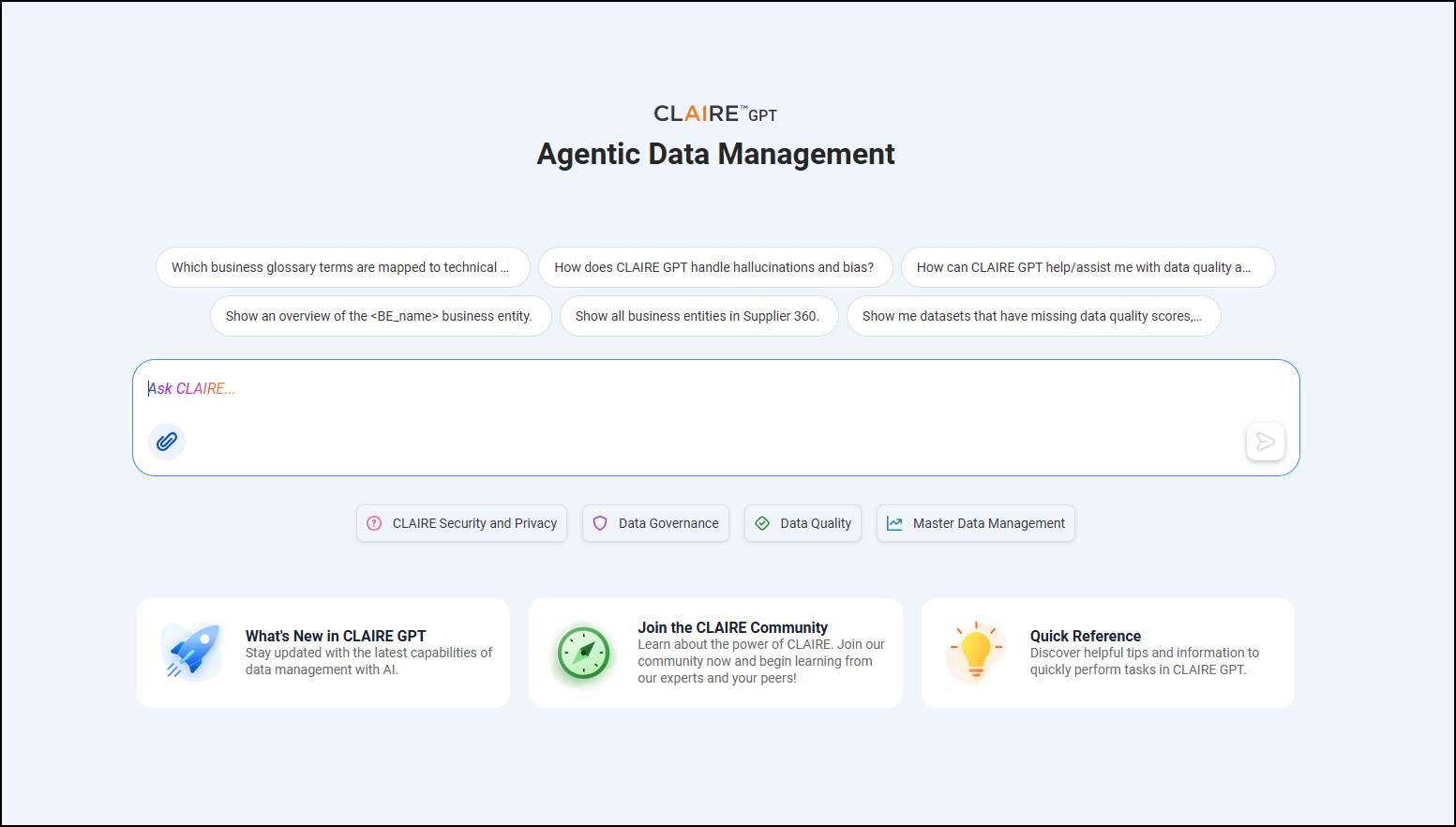
CLAIRE GPT is a conversational, agentic AI assistant embedded in IDMC. Instead of navigating through multiple screens to find a dataset, check its lineage, or assess its quality, you enter a natural-language question. CLAIRE GPT's agents search metadata, run analysis, and return an answer along with the reasoning behind it, so you're getting stats and the context behind them.
CLAIRE GPT sits on top of the CLAIRE engine, the Informatica AI layer that already powers automation across IDMC services such as data integration, governance, and quality. What CLAIRE GPT adds is a chat-based front end. You ask, it plans, it acts, and it responds, without you needing to know which underlying service holds the data you need.
Ana used to start every analysis by pinging a data engineer to ask where a particular sales dataset lived, and then waiting for a reply before she could even begin her work. That back-and-forth could take a day or more if the engineer was busy. Now she asks CLAIRE GPT directly and gets pointed to the right source in seconds, along with a note on how recently it was refreshed and whether any quality issues have been flagged. That single change freed up several hours of her week for actual analysis instead of searching for data.
The Agentic Workflow
CLAIRE GPT works through a multi-phase process, similar to how an analyst would approach an unfamiliar question. Understanding these phases helps you interpret what CLAIRE GPT is doing at each step of a conversation, and helps you ask better follow-up questions.
-
Plan: CLAIRE GPT interprets your question and breaks it into a sequence of steps needed to answer it. If you ask a broad question, it decides what needs to happen first, such as identifying which datasets are relevant, before it can move forward.
-
Discover: It searches across connected metadata and data sources to find what's relevant. This is the phase most similar to what a human analyst would do by hand—searching a catalog, checking which tables are current, and ruling out irrelevant sources.
-
Insights and Answers: It synthesizes findings into a direct answer, often with supporting detail such as lineage or data quality context. It goes beyond a simple number—it contextualizes where that number came from and how confident you should be in it.
-
Generate: For some requests, it produces an artifact, such as a summary, a mapping, or a suggested transformation. This phase turns an answer into something reusable, rather than something you have to write yourself from scratch.
-
Adapt: It adjusts its approach based on feedback or follow-up questions, and refines the answer in the conversation. This interaction makes CLAIRE GPT feel conversational rather than transactional. Your first question starts a conversation that you can steer, and it doesn't lock you into a specific path.
For example, when Ana asks which regions had declining shoe sales last quarter, CLAIRE GPT plans out what data it needs, discovers the relevant sales tables, and returns an answer highlighting the two underperforming regions. It then adapts when Ana follows up asking to narrow the answer to just online sales. It adjusts its answer without Ana needing to restate her entire original question or start a new search from scratch.
When to Use CLAIRE GPT or CLAIRE Copilot
CLAIRE GPT and CLAIRE Copilot are both part of the CLAIRE AI capabilities in IDMC, but they serve different moments in your workflow. You can save time when you know which approach to use.
|
CLAIRE GPT |
CLAIRE Copilot |
|---|---|---|
Best for |
Open-ended questions, exploration, and analysis across your data landscape |
In-context help while you're actively building, such as inside a mapping or integration task |
Interaction style |
Conversational chat, ask-and-answer |
Embedded assistance tied to the task at hand |
Typical user |
Data analyst investigating data, lineage, or quality |
Developer or integration user building a pipeline |
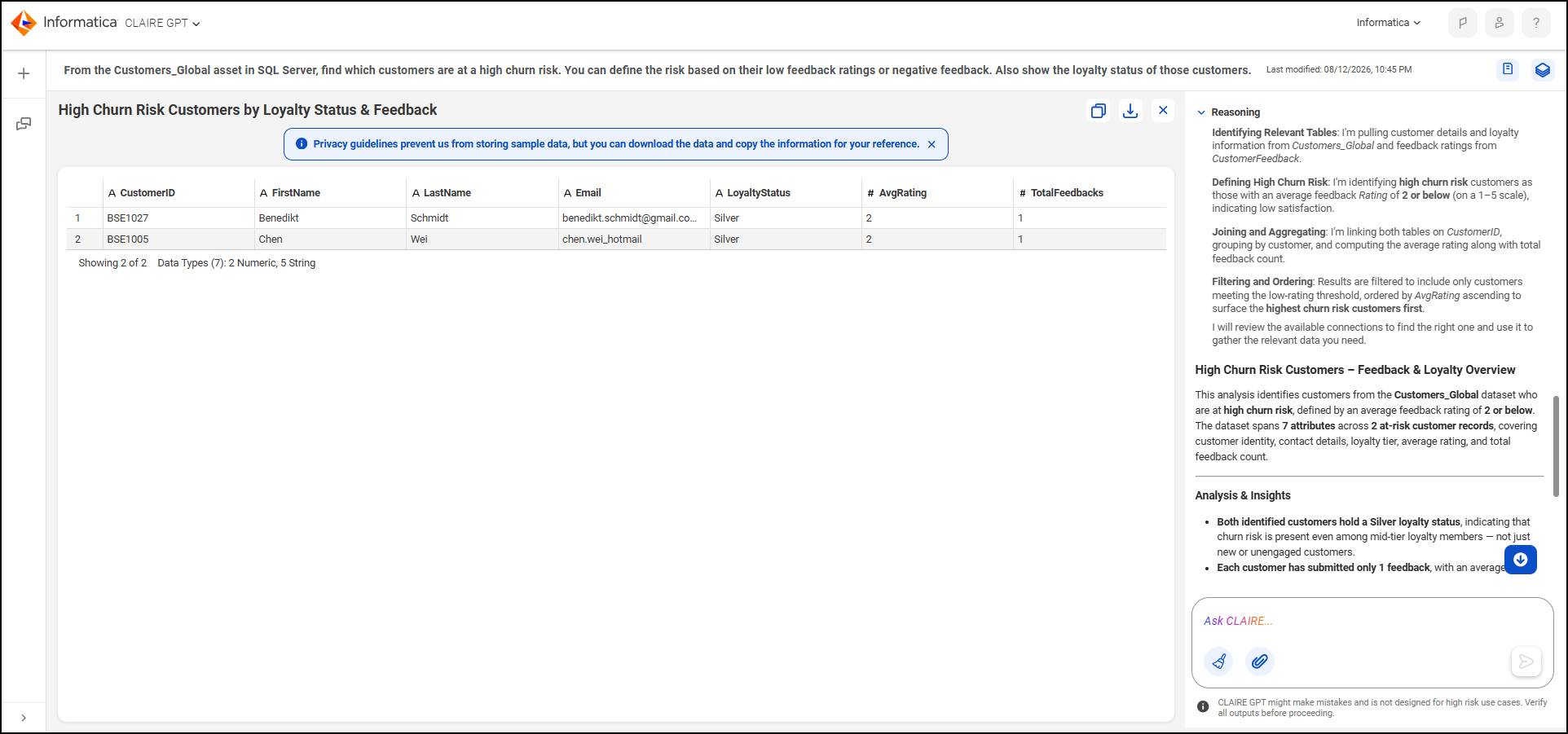
Here’s a response from CLAIRE GPT. It includes the raw data within a table and a reasoning panel with insights.
Here’s CLAIRE Copilot embedded in a mapping. It includes in-context suggestions as the user builds a pipeline.
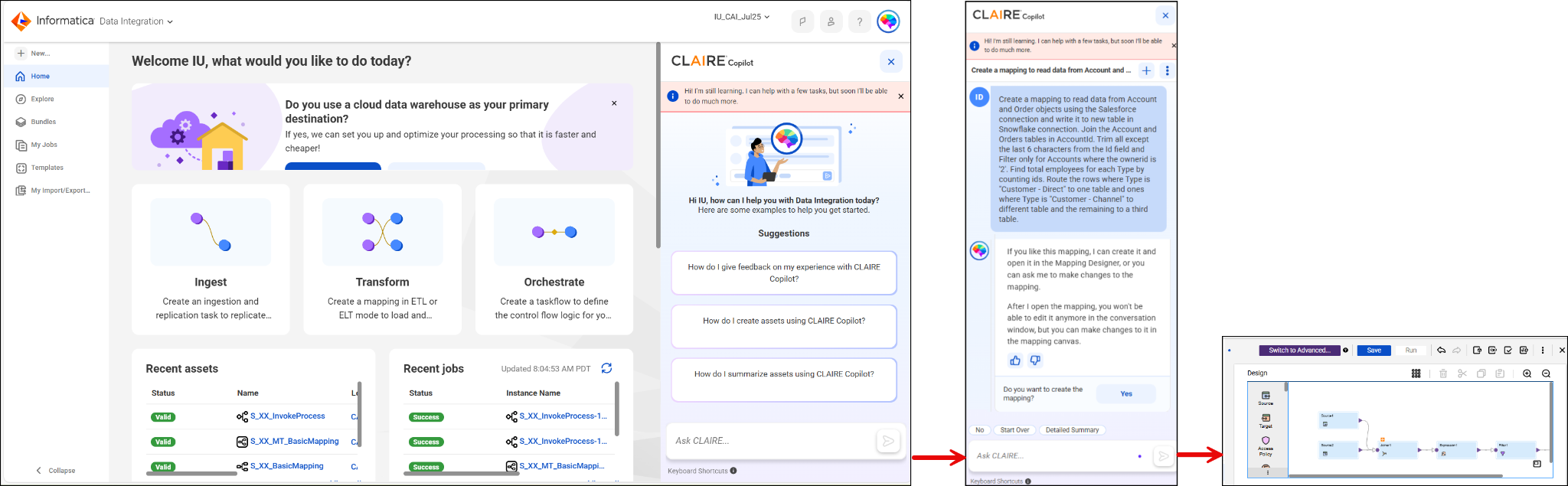
Ana relies on CLAIRE GPT to investigate and answer questions about Cloud Kicks sales data, since her work is fundamentally about exploring new data. When her colleague on the integration team builds a new data pipeline, he instead turns to CLAIRE Copilot. CLAIRE Copilot provides in-context suggestions while he works, since his task is about building something specific rather than exploring broadly. Neither tool replaces the other. They’re built for different stages of working with data. Recognizing which stage you are in helps you choose when to use each tool.
Wrap Up
Now that you know what CLAIRE GPT is and how its five-phase agentic workflow turns a simple question into a trusted insight, you're ready to meet the agents that make it all happen. In the next unit, you explore each agent's role, what your organization needs to set up before you can start querying, and how Ana puts it all together in her day-to-day work.