Get to Know Agentforce for Automotive Cloud
Learning Objectives
After completing this unit, you’ll be able to:
- Define Agentforce for Automotive Cloud and its core purpose.
- Identify the key business challenges that Agentforce for Automotive Cloud is designed to address.
- Describe the relationship between templates, subagents, and actions.
- Explain how the Einstein Trust Layer supports secure, auditable agent interactions.
Before You Start
Before you start this badge, make sure you complete this content. The work you do here builds on the concepts and work you do in that content.
From Connected to Intelligent
Imagine a service advisor trying to update a customer on a vehicle repair. The advisor jumps between systems to check repair progress, confirm parts availability, and verify warranty coverage. Although the information exists, it’s often spread across multiple systems, so even simple updates take longer than expected.
This challenge extends beyond the service department. Automotive organizations coordinate work across stakeholders and departments such as dealerships, finance, and service, and need a constant flow of customer and product information from different applications. As a result, teams spend a majority of their time searching for information, switching between systems, and completing routine tasks instead of helping customers.
In the Automotive Cloud Foundations badge, you learned how Automotive Cloud addresses this by providing a unified, purpose-built platform that brings vehicle, driver, and financial data together. But connected data alone isn’t enough. Teams still navigate cumbersome workflows, update records manually, and pull information that should already be at their fingertips.
Automotive organizations need a more connected and intelligent way to manage workflows across sales, service, finance, and operations. In this badge, you learn what Agentforce for Automotive Cloud is and how templates, subagents, and actions give every agent its shape. That same architecture powers prebuilt agents across sales, service, finance, and channel operations.
Meet Agentforce for Automotive Cloud
Agentforce for Automotive Cloud is a suite of AI-powered agents built into Salesforce for original equipment manufacturers (OEMs), dealerships, and captive finance teams. Built on Automotive Cloud’s industry-specific data foundation and prebuilt workflows, these agents work with the customer, vehicle, financial, inventory, and warranty data already in Salesforce.
Users interact with the agents in natural language. A sales rep can find an available SUV that matches a customer’s budget and preferences. A service advisor can review warranty coverage before preparing a repair estimate. A finance specialist can calculate a payment deferral, while a collections agent can summarize an overdue account and identify the next best action.
These capabilities help automotive organizations improve work across several areas.
-
More informed customer interactions: Sales, service, and finance teams retrieve relevant information and complete routine tasks within the flow of a conversation.
-
Stronger dealer and partner support: Partner-facing agents extend selected capabilities through Experience Cloud, connecting internal teams with dealer and distribution networks.
-
Less manual work: Agents handle recurring tasks across sales, service, finance, and operations, giving teams more time for customer relationships and complex decisions.
The agent’s role depends on how its templates, subagents, and actions work together. Next, explore each of these building blocks.
Building Blocks of Agents
You don’t need to build each automotive agent from scratch. Agentforce for Automotive Cloud organizes its capabilities through three connected building blocks: a template, one or more subagents, and a set of actions. Think of an agent like a specialist on your team. The template defines the agent’s role, subagents provide focused expertise, and actions help the agent complete specific tasks.
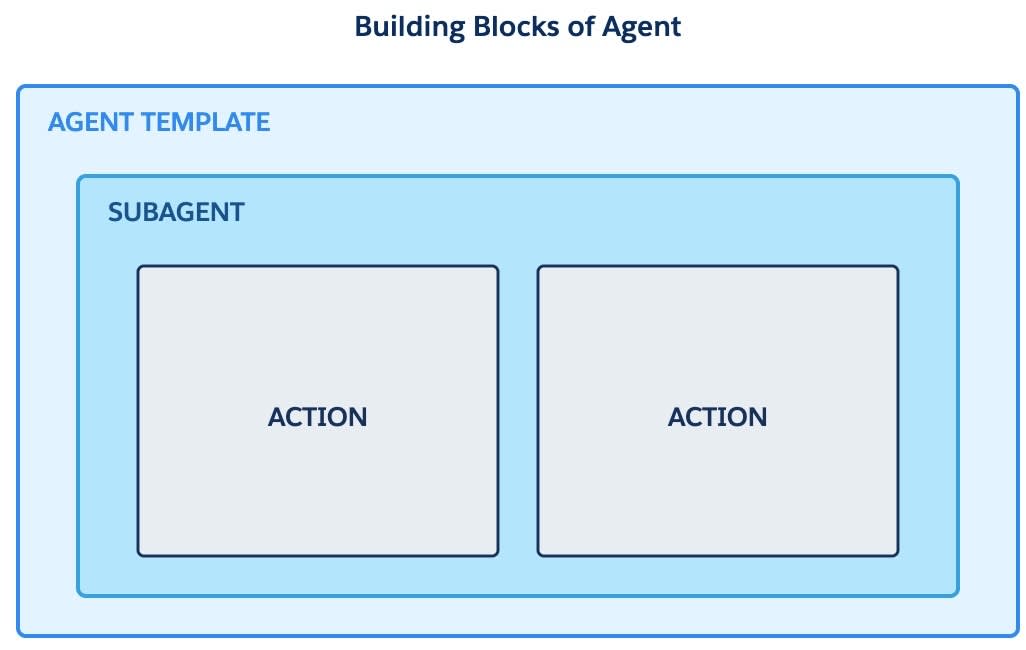
Template
A template defines an agent’s role and the business processes it supports. It includes recommended subagents, actions, and workflows for a specific automotive use case.
For example, the Automotive Asset Service Management template supports vehicle service work. Its configuration brings together capabilities for service estimates, work orders, warranty coverage, and customer communications.
Subagent
A subagent handles a focused area of work within the template. It interprets the user’s request and identifies the relevant actions.
The Asset Service Estimation subagent, for example, focuses on service history, telemetry, coverage, and repair estimates. Another subagent manages the work order after the customer approves the quote.
Action
An action performs a specific task in Salesforce. Actions retrieve records, check eligibility, create quotes or cases, update information, and draft communications.
For example, the Create Service Quote action turns vehicle information, service requirements, and applicable coverage into a repair quote.
These components work as one system. When a service advisor requests a repair estimate, the template establishes the agent’s role. The subagent interprets the request, and the appropriate actions retrieve information and create the quote. Because these components are modular, teams can start with one use case and extend the agent as business needs change. Additional subagents and actions expand the work it handles while preserving its defined role.
Secure Every Interaction
Automotive organizations handle sensitive customer and financial information, from vehicle records and warranty claims to loan applications and payment histories. Agents require that context to act, but every interaction still follows your organization’s security and governance controls.
The Einstein Trust Layer applies safeguards throughout each Cloud interaction.
-
Sensitive data stays protected: Data masking obscures information such as Social Security numbers, loan amounts, financing terms, and payment details in prompts sent to AI models.
-
Customer data remains private: External models don’t retain Salesforce customer data or use it for model training.
-
Agent activity stays visible: An audit trail records each request, the context used, and the actions the agent takes.
These safeguards support customer privacy, internal governance, and financial-services compliance. A captive finance team, for example, can use agents for payment deferrals and collections while maintaining a traceable record of each interaction.
Explore the Agents
Agentforce for Automotive Cloud includes prebuilt agent templates for distinct roles and workflows. These templates pair AI assistance with human expertise. Agents handle the information gathering, the system navigation, and the routine task execution. Your teams focus on judgment, relationships, and decisions.
Five agents help your sales and service teams win and support customers.
Agent Template |
Primary User |
Key Capabilities |
|---|---|---|
Automotive Sales Concierge |
Sales rep, dealer |
Generate vehicle summaries, search inventory and dealers, create opportunities and quotes, initiate appraisals, schedule test drives, and draft emails. |
Sales Planning |
Sales manager |
Generate performance summaries, track sales agreements, and assist with sales planning tasks. |
Driver Profile Summary |
Sales rep, service rep |
Summarize a customer account and associated vehicles; create a related to-do. |
Driver Finance Profile Summary |
Sales rep, service rep |
Summarize a customer account and associated financial accounts; create a related to-do. |
Dealership Navigator |
Sales rep, dealer |
Natural-language dealer search (contact/hours), book test drives, book service appointments. |
Three agents keep vehicles serviced and parts on hand.
Agent Template |
Primary User |
Key Capabilities |
|---|---|---|
Automotive Asset Service Management |
Service advisor |
Summarize asset telemetry, identify maintenance needs, and create service quotes and work orders. Also, identify applicable warranties, service contracts, or entitlements. |
Automotive Warranty Claims Assistance |
Service advisor |
Summarize claims, check claim status, and validate warranty coverage. |
Inventory Management |
Inventory manager |
Monitor and manage inventory by locating products and vehicles, summarizing stock levels, and supporting replenishment requests. |
Three agents manage money moving through the business.
Agent Template |
Primary User |
Key Capabilities |
|---|---|---|
Asset Finance Management |
Finance specialist |
Manage loan and lease operations such as payment deferrals, due date changes, balance inquiries, and transaction requests. |
Collections and Recovery Assistance |
Collections agent |
Streamline recovery workflows and support customer interactions. |
Channel Revenue Management |
Channel managers |
Manage rebate programs and payout processes by tracking calculations, reviewing program details, and resolving payout-related issues. |
Next Up
In this unit, you learned what Agentforce for Automotive Cloud is, and how agents solve the challenge of disconnected systems. In the next unit, you explore the sales-focused agent templates.