Get to Know Agentic Commerce Search
Learning Objectives
After completing this unit, you'll be able to:
- Explain why keyword search fails to meet modern shopper expectations.
- Describe how Agentic Commerce Search intent-aware ranking improves conversion and reduces operational overhead.
- Identify how the 10X data advantage solves the cold-start problem for retailers.
- Identify the business outcomes that Agentic Commerce Search delivers.
Recognize Why Keyword Search Falls Short
Picture this: A shopper types “Summer Dresses” into your search bar. Their keyword search returns three results where either “Summer” or “Dress” appear in the product title or description, even though you carry 120 sundresses perfect for summer. The shopper doesn’t find what they want. Another lost sale.
This scenario plays out millions of times across ecommerce sites. The problem isn’t the shopper, it’s the search technology. Keyword search matches terms, not shopper intent. It doesn’t understand what the shopper actually wants to buy.
What Keyword Search Gets Wrong
When a shopper’s keyword search matches terms, not shopper intent, here’s what goes wrong.
-
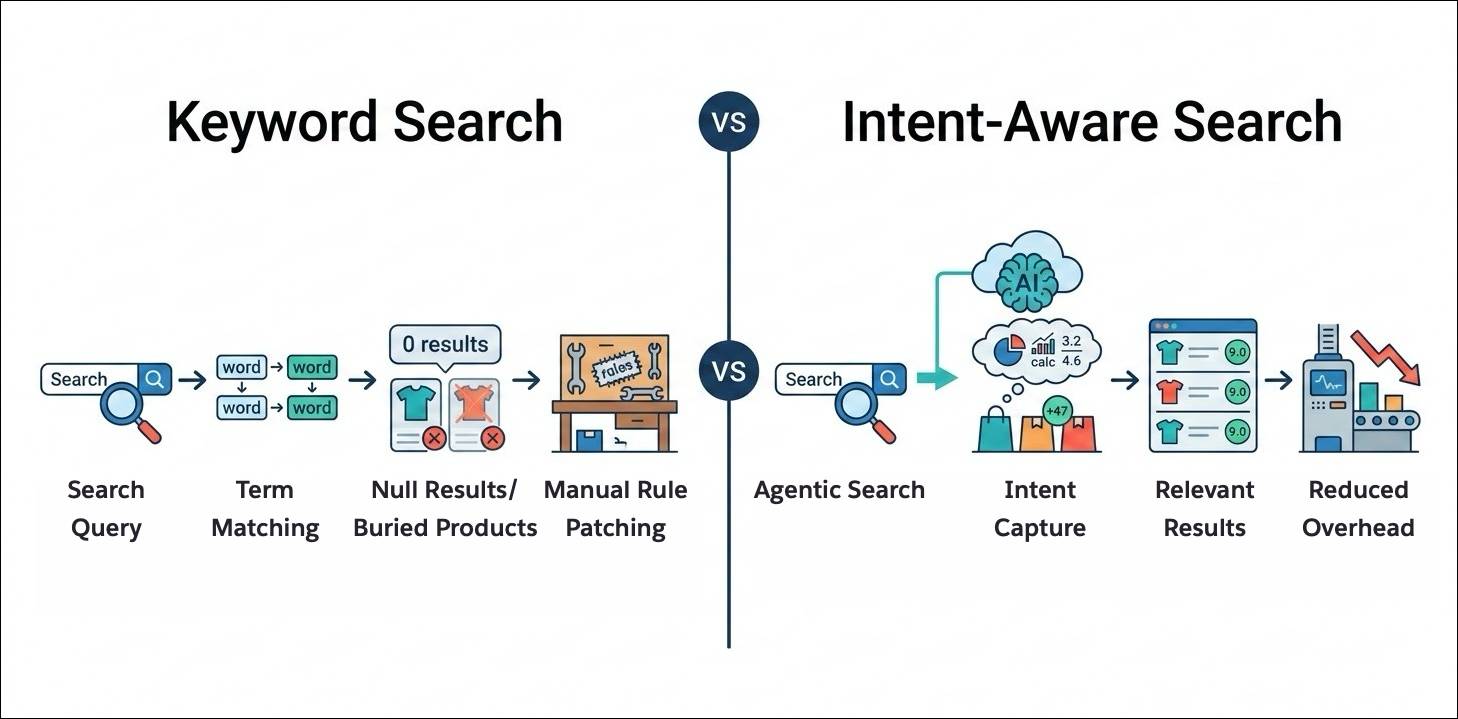
Null results: Shoppers search for “cold weather running gear.” Your catalog calls them “fleece-lined athletic pants.” Zero matches. The shopper leaves your site and finds what they want at a competitor.
-
Mismatched relevance: Keyword search ranks products by term frequency, not purchase likelihood. Irrelevant items show up in the results while the right product isn't even surfaced.
-
Merchandising rule fatigue: Merchandisers patch keyword failures manually by adding synonyms, creating redirects, boosting specific products. Configuration grows into thousands of rules. Rules conflict. New gaps appear. The cycle never ends.
Traditional search systems learn too slowly because most retailers don’t generate enough behavioral data to train AI models effectively.
Enter the Era of Agentic Search
Introducing Agentic Commerce Search: the evolution of product discovery. Unlike keyword search, which merely matches search terms and often fails to capture the shopper’s true goal, Agentic Commerce Search uses AI and natural language processing to determine shopper intent. By understanding exactly what shoppers mean, not just what they type, it brings together natural language queries and your product catalog. This transition from basic matching to deep intent recognition directly fuels higher conversion rates and increased revenue, ensuring shoppers find exactly what they want every time.
Respond to Shopper Intent with Agentic Commerce Search
Agentic Commerce Search understands shopper intent, not just the words shoppers type.
Discover the 10X Data Advantage
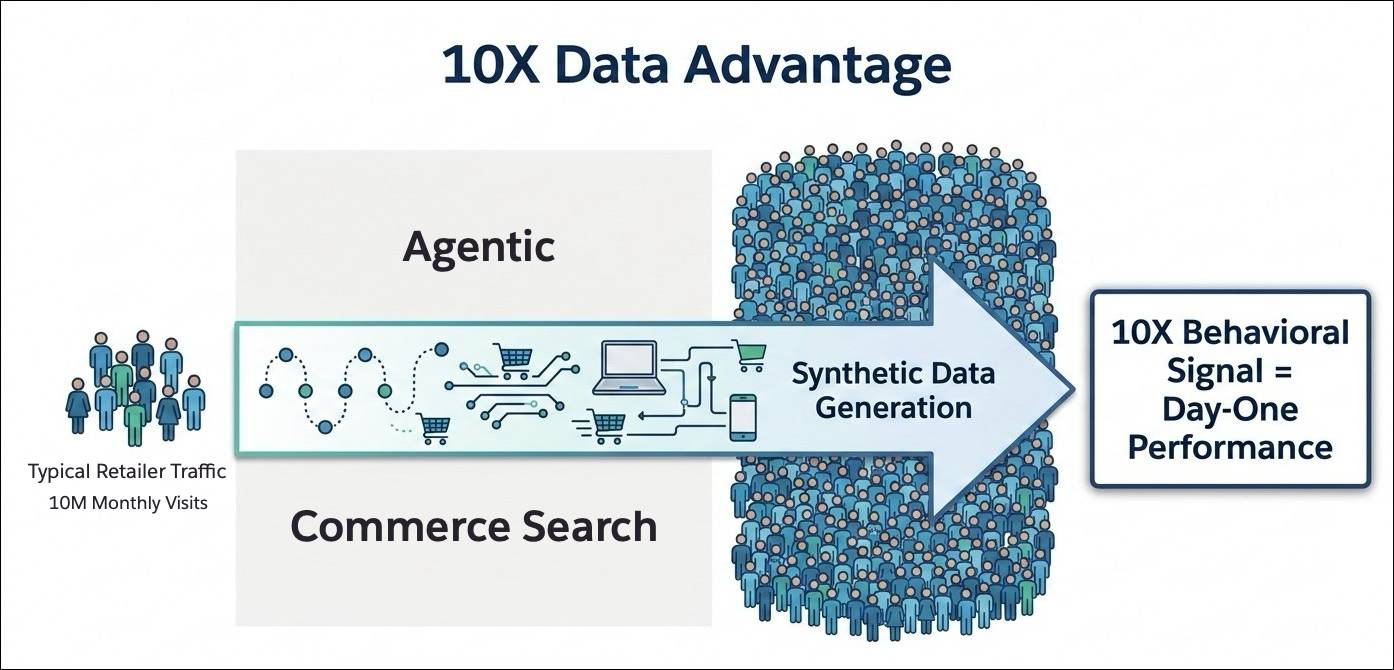
Most retailers face a massive training data problem. The world’s leading global retailers get billions of site visits per month. The typical retail site probably gets around 10 million visits. That’s nowhere near enough behavioral signal—clicks, add-to-carts, purchases—for traditional AI to learn from.
Agentic Commerce Search uses synthetic data generation to address limited behavioral data by simulating millions of shopping journeys. By applying general-purpose large language models (LLMs), the system creates 10–20 times more commerce-specific training data, which is then used to build a custom, compact small language model (SLM) tailored to your unique catalog and customer behavior.
The result: You get 10 times more behavioral signals than your historical traffic alone would provide. The AI arrives with working intent understanding on day one. No need to wait months or years to accumulate enough data.
Benefit from the Intent-Aware Search That Works Immediately
Because Agentic Commerce Search uses both your real data and simulated behavioral data, the system understands shopper intent from the start. When someone searches for Summer Dresses, the AI predicts what they actually want to buy and ranks products by conversion, not keyword frequency.
The system includes integrated capabilities:
-
AI-Native Search: Transforms your search bar into an AI-native search engine that understands shopper intent.
-
Browse: Continuously optimizes product rankings based on shopper behavior, catalog changes, and business objectives.
-
Recommendations: Keeps customers engaged with a deep understanding of match and related products.
-
Merchandising Rules: Turns real-time shopper insights into revenue-driving actions with a robust toolset.
-
Guided Discovery: Delivers rich, conversational shopping experiences within your Agentforce Shopper Agent. (Requires Agentforce Shopper Agent.)
-
Human-in-the-loop optimization: Integrates human intelligence, judgment, and feedback to improve output continuously.
Improve Queries with Agentic Query Rewrite
The system automatically detects weak result sets in real time and rewrites queries to improve relevance. No manual rules required. This proves particularly valuable for emerging trends, foreign language queries, and niche terminology.
Generate Business Outcomes That Matter
Agentic Commerce Search delivers measurable business impact from day one.
Proven Results from Retailers
Real retailers using Agentic Commerce Search report:
-
+13% conversion rate: Shoppers find the right products faster and complete more purchases.
-
85% reduction in manual merchandising rules: Teams go from thousands of rules to dozens, freeing merchandisers to focus on strategic initiatives instead of patching keyword failures.
Operational Efficiency Gains
Your merchandising team stops fighting fires. Instead of maintaining thousands of synonym lists, redirect rules, and product boosts, they focus on high-impact strategic work. The AI handles the heavy lifting.
A Competitive Advantage
Shoppers expect search intelligence everywhere they shop. Agentic Commerce Search gives you that capability regardless of your site traffic. You compete on product discovery, not just product assortment.
Summary
Keyword search forces shoppers to adapt their language to fit your catalog. Agentic Commerce Search understands what shoppers mean—not just what they type. The shift: from search box to shopping intelligence.