Get Started with Conversational Marketing
Learning Objectives
After completing this unit, you’ll be able to:
- Differentiate traditional broadcasting with conversational marketing.
- Identify the channels that support conversational marketing.
- Explain how agents interact with channels to process customer intent.
Before You Start
Before you start this badge, consider completing this recommended content.

The Engagement Gap
For the past two decades, digital marketing has largely operated on a broadcast model. Brands have become experts at pushing content out—sending millions of email messages, SMS blasts, and push notifications. While this strategy is effective for announcing sales or delivering newsletters, it creates a fundamental disconnection. It talks at the customer, not with them.
Consider the typical consumer experience: You receive a promotional SMS about a flash sale. You’re interested, but you have a quick question: “Does this promo code work on clearance items?” You reply to the text, only to receive an immediate, automated bounce-back: “This is an automated message. Replies are not monitored.”
In that split second, the engagement dies. The friction of having to find a support number or open a ticket is too high, so you simply ignore the sale. This is the do-not-reply era of marketing, and it’s costing businesses millions in lost opportunities.
The conversational or two-way communication model shifts the focus from a simple delivery of information to a dynamic exchange where brands and customers act as both senders and receivers. The two-way communication approach is designed to proactively solve user problems, recommend relevant products, and assist users based on their requirement and direct inquiries. In this framework, the success of the exchange depends on how efficiently the brand can adapt to the user's context in real-time to provide immediate value. This is the model where conversational marketing comes into the picture.
Introduction to Conversational Marketing
Marketing Cloud Next brings the power of Agentforce to conversational marketing. There are no new or separate AI agents to manage; instead, Marketing Cloud Next seamlessly uses Agentforce. You can easily create new agents in Agentforce or use existing ones for your marketing campaigns. Unlike a basic chatbot that follows a rigid decision tree (if X, then Y), an Agentforce agent uses large language models (LLMs) and your business data to understand natural language.
The agents turn the do-not-reply impasse into an open door. When a customer asks, “Does this promo code work on clearance?” the agent understands the context of the promotion, checks the rules, and replies, “No, this specific code is for full-price items only, but here’s a link to our clearance section, which is already marked down 40%!”
Here’s a graphic that shows the two-way communication between the channels and Agentforce.
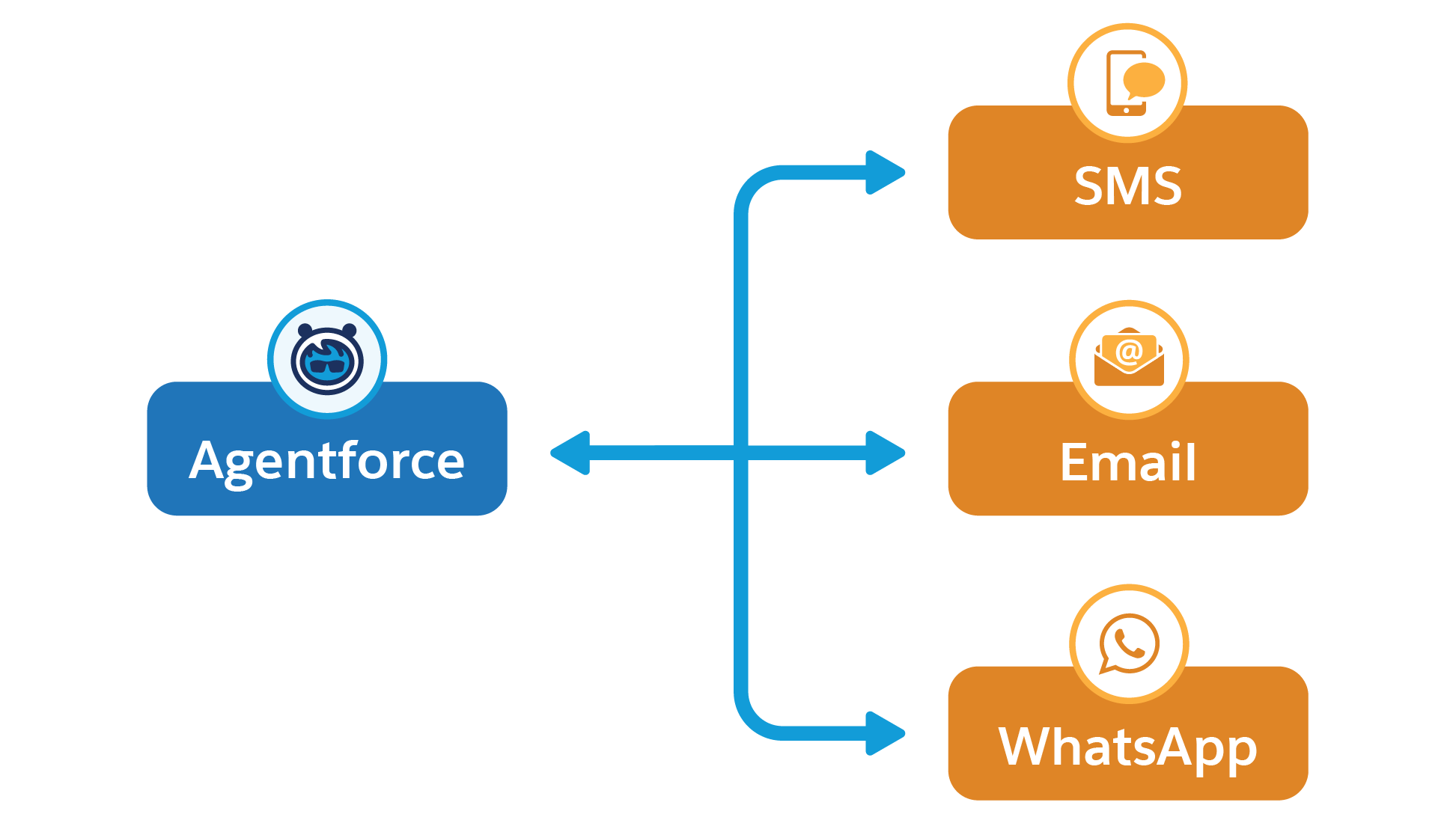
With Agentforce, AI agents turn one-way broadcasts into interactive, contextual conversations across various media. Agents act as a scalable, always-on first line of defense for marketing and service teams. These conversational agents are not limited to a single medium. They’re capable of handling complex requests and providing immediate support across SMS, email, and WhatsApp.
Supported Channels
In Marketing Cloud Next, you can deploy agents across the channels where your customers are most active.
-
SMS (Short Message Service): SMS is no longer just for short alerts. With conversational agents, an SMS thread becomes a service window. Customers can reply to appointment reminders or flash sale alerts just as they would text a friend.
-
Email: Email is not just a static billboard anymore. Conversational email transforms one-way email blasts into two-way conversations. When a customer replies to a promotional email directly in their inbox, an AI agent provides a contextual response in the same threaded conversation. You can use it for long-form content, receipts, and complex digests.
-
WhatsApp: WhatsApp is a rich media channel. Agents here can handle longer messages, send images, and use button interactions. This is ideal for global markets where WhatsApp is the primary mode of communication.
The primary advantage of these agents is immediacy. A human marketing team cannot monitor replies to a promotional blast sent to thousands of people. An agent can.
By enabling these channels with AI, you ensure that every customer feels heard. You move from talking to your audience to talking with them. This shift builds trust, increases engagement rates, and ultimately drives more conversions.
How Agents Work with Channels
It’s important to know that the agent and the channel are distinct components that work together.
The channel acts as the “pipe”: It handles the delivery of the message through SMS, WhatsApp, or email and the receipt of the customer's reply.
The agent acts as the “brain”: When a reply comes into the channel, it’s routed to the agent. The agent uses large language models (LLMs) and Data 360 to analyze the text.
-
Intent recognition: The agent determines what the customer wants such as, check order status or book appointment.
-
Context retrieval: It looks up the customer’s data, campaigns, previous conversations, and outbound messages to ensure the answer is relevant to them.
-
Response generation: It drafts a natural language response and sends it back through the channel.
This separation means you can build one robust agent with specific subagents and instructions, and then deploy that same agent across multiple channels (SMS, WhatsApp, and email) without having to rebuild the logic for each one.
What’s Next
In this unit, you learned where the conversations can happen and the difference between the channel and the agent. Now it’s time to look under the hood. In the next unit, explore the ecosystem that powers these interactions and the logical lifecycle of a conversation.