Simplify Catalog Management
Learning Objectives
After completing this unit, you’ll be able to:
- Describe common challenges that institutions face when managing academic curriculum.
- Explain how the Agentforce Education data model supports flexible and scalable catalog management.
- Identify key tools that help streamline curriculum creation and maintenance.
Discover Catalog Management Challenges
Curriculum is more than just a list of courses. It’s a structured framework that defines what students learn, how they progress, and how their achievements align with institutional goals. Effective curriculum management ensures that students are engaging with meaningful, up-to-date content that prepares them for graduation and beyond.
Curriculum management can be a daunting task, especially when existing systems aren’t built to support modern academic models. At many institutions, curriculum data is scattered across spreadsheets, siloed databases, and static catalogs, making it challenging to manage consistently. Creating or modifying academic programs often involves long approval chains, manual edits, and multiple handoffs between teams.
Traditional systems with outdated processes obstruct institutions from offering new offerings, such as microcredentials, certificates, and hybrid formats. This limits the institution’s ability to innovate or respond quickly to changing market needs.
Agentforce Education addresses these issues by offering a unified data model and intuitive tools that streamline curriculum creation, maintenance, and delivery.
In this unit, you explore how Agentforce Education supports flexible, scalable curriculum management, and how it directly impacts student success. You follow Juan, a registrar at Astro University, and Sophia, a student navigating her academic journey. You see how Juan and his team use Academic Operations to support Sophia, from managing her records and course registration to helping her stay on track for graduation.
First, dive into the common entities that you use to model your curriculum.
Explore Curriculum Modeling in Agentforce Education
In Agentforce Education, curriculum is represented through a flexible, structured set of objects that mirror the way institutions plan, deliver, and maintain academic offerings. These objects work together to provide clarity and consistency across programs, courses, and terms.
Here are just a few of the key objects used to model curriculum in Agentforce Education.
-
Learning programs are top-level structures that define a collection of learning experiences tied to an academic goal, such as a degree, certificate, or skills-based credential. A learning program, which can have one or several learning program plans, serves as the anchor for all related courses, requirements, and term planning.
-
Learning program plans outline the course requirements and sequencing for a learning program in a specific catalog year, including tracks, or concentrations, and act as the academic contract between the student and institution. Institutions can version and manage curriculum changes over time by creating new plans for each year without affecting the requirements of currently enrolled students.
-
Learning courses represent the individual units of instruction, each with a title, learning objectives, and credit value, that make up a learning program. Learning courses are shared across programs and reused within multiple program plans, making it easier to maintain consistency and eliminate curriculum duplication.
-
Course offerings are the specific, term-based instances of a learning course that include details such as the section number, delivery modality, schedule instructor, and maximum enrollment. Students register for course offerings that match their plan and eligibility from the learner portal.
Here’s a model of a Computer Science undergraduate degree program that Juan creates at Astro University.
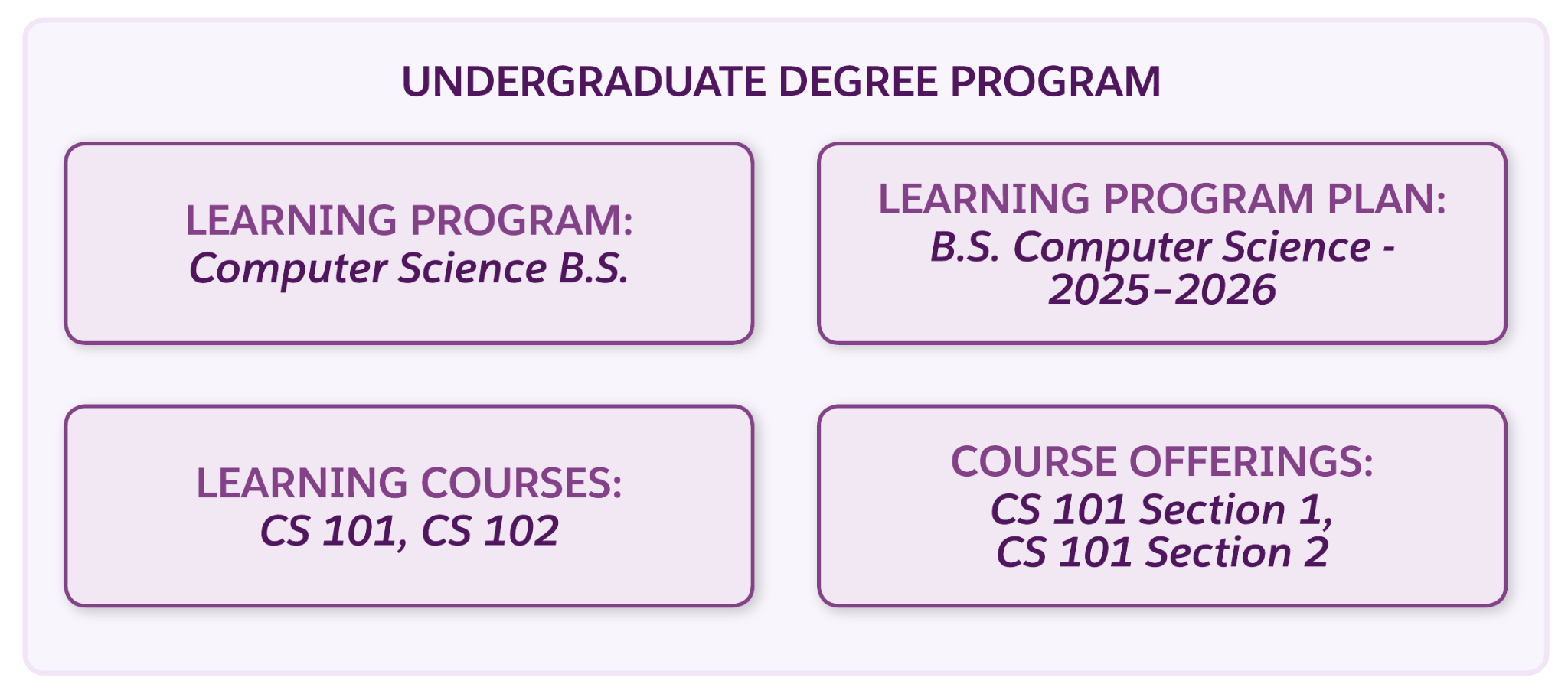
The Computer BS learning program includes a learning program plan, which outlines the requirements for students who enroll in the program during the 2025–2026 academic year. These requirements include completing the CS 101 and CS 102 learning courses. Course offerings define each section of the learning courses. For example, CS 101 includes a course offering for Section 1 and Section 2.

Meet Agentforce Education Curriculum Management Tools
As Juan and his team prepare for the upcoming academic year, they’re working to launch new interdisciplinary programs, update existing course offerings, and adjust prerequisites based on recent curriculum reviews. In the past, this kind of work required a tangled web of spreadsheets, emails, and endless back-and-forth between departments.
With Agentforce Education, Juan manages everything in one place, from learning programs to course offerings, and ensures the curriculum is accurate, consistent, and ready for students to plan their academic paths with confidence.
Take a look at the tools that simplify this curriculum setup and management.
Learning Wizard
The Learning Wizard helps registrars and staff to quickly build and edit learning programs and courses. It provides a guided interface for defining prerequisites, corequisites, recommended courses, and learning outcomes.
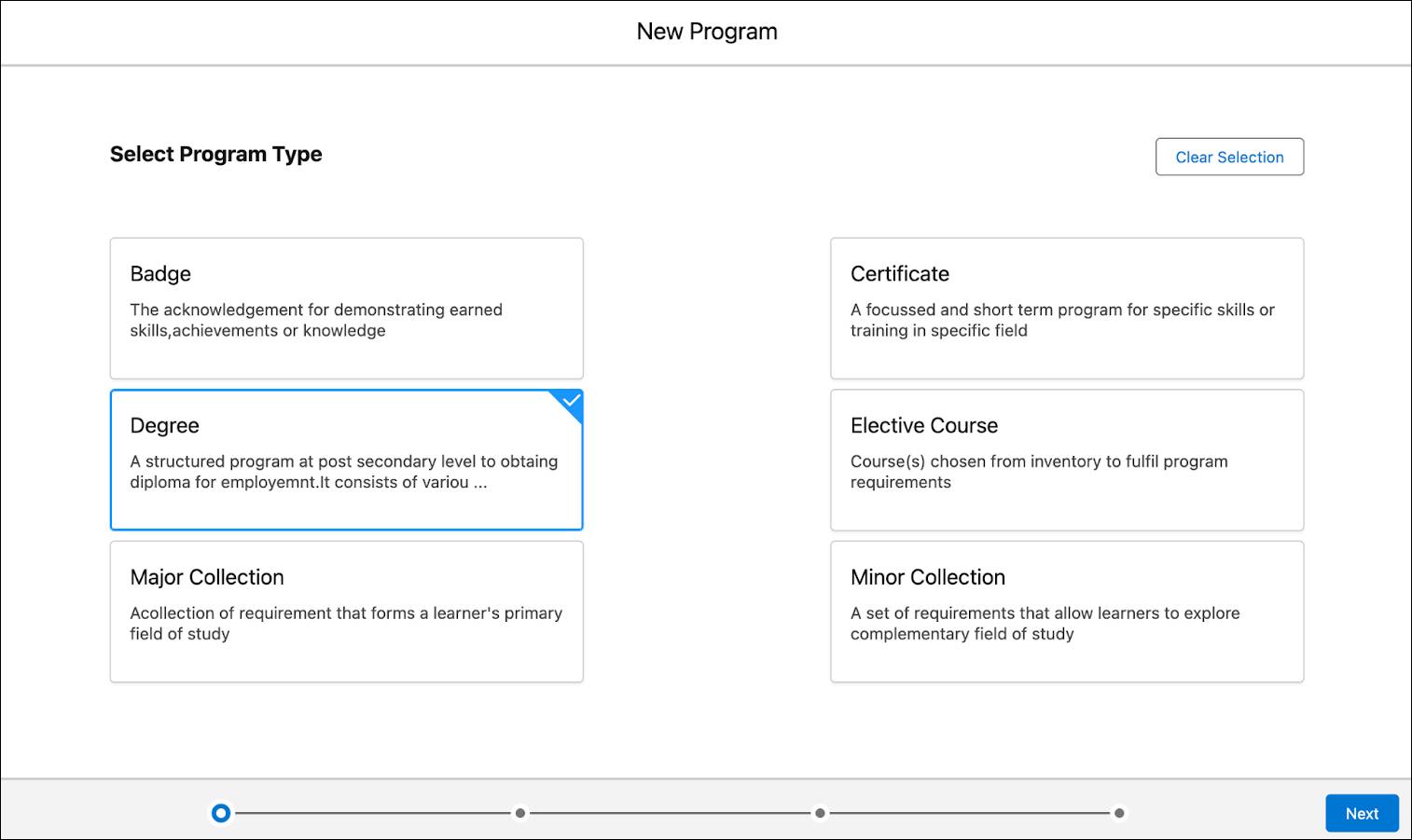
With the wizard, Juan can make changes efficiently, ensure alignment with accreditation requirements, and publish updates in time for registration, all without relying on IT teams.
Learning Program Plan Builder
The Learning Program Plan Builder offers a visual, drag-and-drop interface for mapping out required and elective course requirements. Use it to standardize academic paths while adapting plans for different student types, modalities, or cohorts. You can also create new program plans as requirements change for the next catalog year.

The Program Plan Builder makes it easy to define general education requirements, concentration tracks, electives, and other components of a degree program. As Sophia, an Astro U student, progresses through her plan, requirements configured in the program plan builder show up in her Degree Planner, helping her see what she’s already fulfilled and what’s next.
Linked Sections
For institutions that offer complex course structures, Linked Sections make it easy to manage connected Course Offerings, such as Astro University’s new Linguistic Field Methods course and associated research lab. Juan can link related sections, ensuring students are enrolled in the correct combination of courses.
For example, Juan links section A of Linguistic Field Methods with Research Lab sections 1, 2, and 3, and Linguistic Field Methods section B to lab sections 2 and 3.

Sophia is interested in section A of Linguistic Field Methods because it fits better with her schedule, so she plans to register for Lab 1, 2, or 3 as well.
Bring Clarity to Curriculum
After you configure all of your programs, courses, and sections, students can then browse and register for courses via the student portal. Students and other guest users without an active Academic Term Enrollment can browse for courses even before registration opens for the term, while actively enrolled students can also add sections to the cart and register.
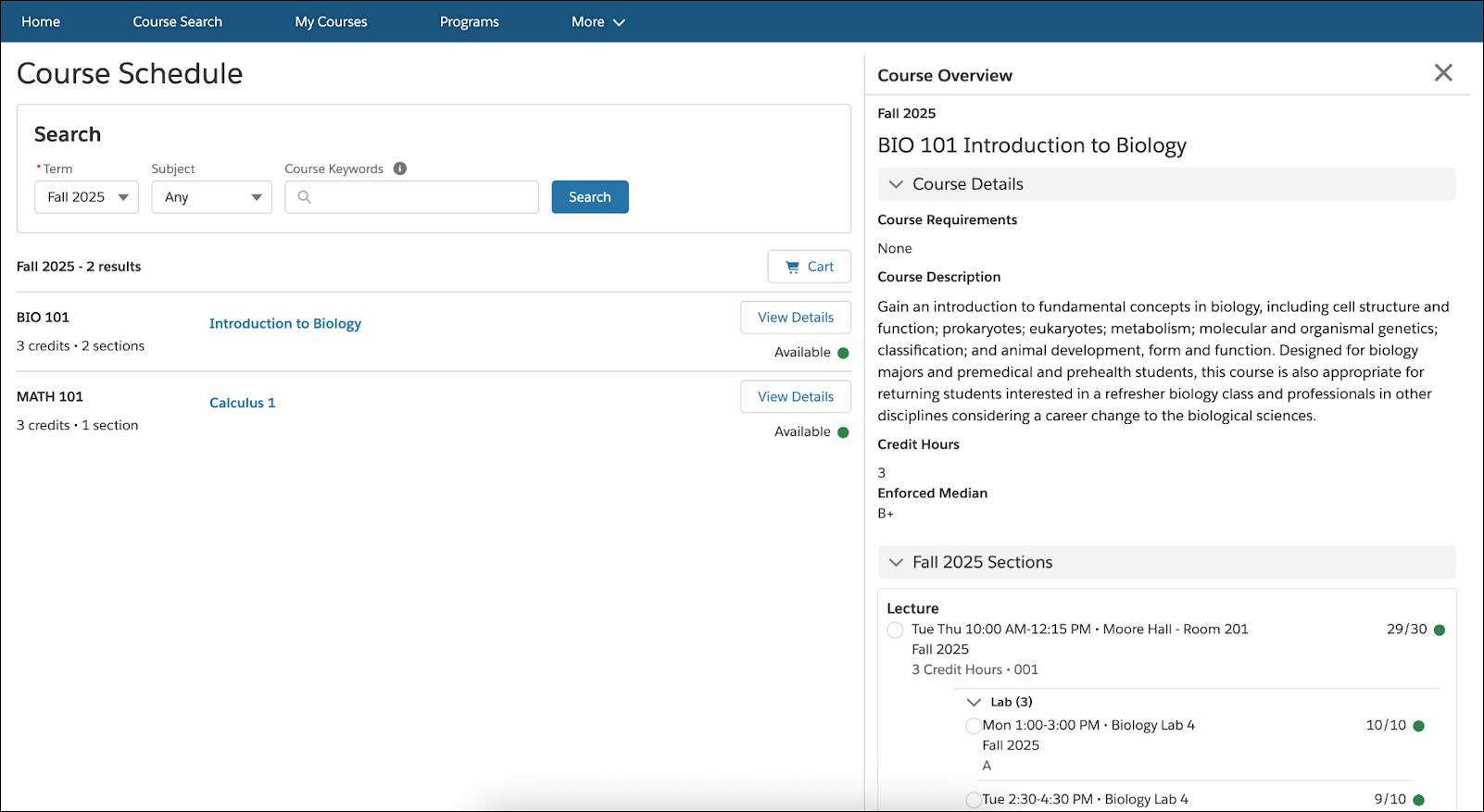
Juan’s curriculum management directly improves the student experience. Because course requirements are clearly defined, plans are up-to-date, and schedules are reliable, Sophia can navigate her education with greater confidence and fewer surprises.
Agentforce Education connects curriculum management to the rest of the academic operations ecosystem.
- Updates to a program plan automatically reflect in a student’s Degree Planner.
- Term offerings tie directly to course registration tools.
- Curriculum changes are governed by business rules that ensure compliance and consistency.
By centralizing curriculum data and offering intuitive tools to manage it, Agentforce Education makes it easier to scale academic offerings, serve diverse students, and respond quickly to evolving educational needs.
Curriculum is the foundation of every academic experience. In this unit, you learned how registrars and staff can use Agentforce Education to manage curriculum with speed, structure, and confidence.
Up next, explore how to govern academic processes using Student Information System Policy Rules, GPA calculations, and tools for managing holds, blocks, and course equivalencies.
Resources
- Trailhead: Manage Your Learning Catalog in Agentforce Education
- Salesforce Help: Academic Operations App
- Salesforce Help: Model Courses and Curricula
- Salesforce Help: Model Learning Program Offerings
- Salesforce Help: Modify Your Learning Offerings in the Learning Wizard
- Trailhead: Learning Data Model Fundamentals