Govern Academic Processes
Learning Objectives
After completing this unit, you’ll be able to:
- Explain the importance of academic governance.
- Describe how institutions automate and enforce academic policies using Student Information System Policy Rules.
- Identify how holds and blocks manage student eligibility and guide next steps.
- Explain how course equivalencies help to evaluate and apply prior learning to a student's academic progress.
Explore Academic Governance
Academic governance refers to the policies, rules, and systems that ensure consistency, equity, and accountability in academic decision-making. Many day-to-day academic processes rely on governance to function smoothly. For example, students complete foundational coursework before progressing to more advanced topics.
Governance also plays a critical role in managing credit limits, such as capping the number of credits a student can take in a given term or requiring approval for overloads. When governance processes are clear and automated, students stay on track, staff focus on advising rather than exception processing, and institutions reduce the risk of errors or policy misapplication.
Without the appropriate systems, academic policy enforcement becomes reactive and inconsistent. Institutions often rely on manual checklists, static spreadsheets, or disconnected tools to monitor compliance, track student standing, and manage exceptions. This leads to a number of challenges.
- Staff interpret and apply rules manually, increasing the risk of human error.
- Students receive delayed or conflicting information about their eligibility or status.
- Holds and notifications are missed or triggered too late to prevent issues.
Agentforce Education addresses these challenges with intuitive, low-code tools that automate policy enforcement, improve visibility, and simplify student management. This unit explores how you can bring clarity and control to academic governance, ensuring the correct policies are applied to the relevant students at the appropriate time.
Automate Academic Policies with Student Information System Policy Rules
It’s mid-semester at Astro University, and registration period is coming up. Juan notices that a few students are at risk of falling below the minimum grade point average (GPA) required to stay in their programs, and others have registration holds due to unresolved advising sessions. Sophia recently completed a summer semester at her local community college and wants to make sure her credits transfer correctly. Juan needs to act quickly, and consistently, to support these students while upholding institutional policy.
With Agentforce Education, Juan doesn’t need to manage these tasks manually. Business rules, GPA automation, holds, and course equivalency tools give him the structure and flexibility to govern academic processes efficiently and fairly.
Academic policies shape a student's path, from what courses they can take to how they progress toward graduation. With Student Information System Policy Rules in Agentforce Education, institutions can automate and tailor these policies across degree planning and registration experiences in a scalable and auditable manner.
Course Dependencies and Sequencing
Student Information System Policy Rules make it easy for staff to create custom, low-code rules that reflect their institution’s unique academic requirements. While Agentforce Education offers built-in checks for prerequisites, corequisites, and capacity limits during course registration, Student Information System Policy Rules extend this functionality even further. Institutions can configure additional policies such as anti-requisites or courses that can't be taken together, maximum credit limits per term, or restrictions based on academic standing or GPA.
These rules are applied in real time, ensuring that students receive immediate feedback when planning or registering for courses. For example, if Sophia tries to register for a course she’s already completed under a different code, she sees clear guidance about the issue before completing registration. This reduces confusion and helps her make informed choices that align with her academic plan.
Student Information System Policy Rules also appear within the Degree Planner, helping institutions to shape long-term course sequencing and guide students through complex program paths. By automating policy enforcement, Student Information System Policy Rules reduce manual oversight, minimize registration errors, and ensure every student experience is consistent, compliant, and personalized.
Academic Score Calculations
GPA is one of the most important academic indicators, but accurately calculating it for large student populations can be complex. Agentforce Education simplifies this process with automated GPA calculation tools that work directly with your academic data model. This is just one example of Student Information System Policy Rules in action, and you can use them as a template for your institution’s various business processes.
Juan can generate GPA results for any group of students, filtered by academic term, program, or other criteria.
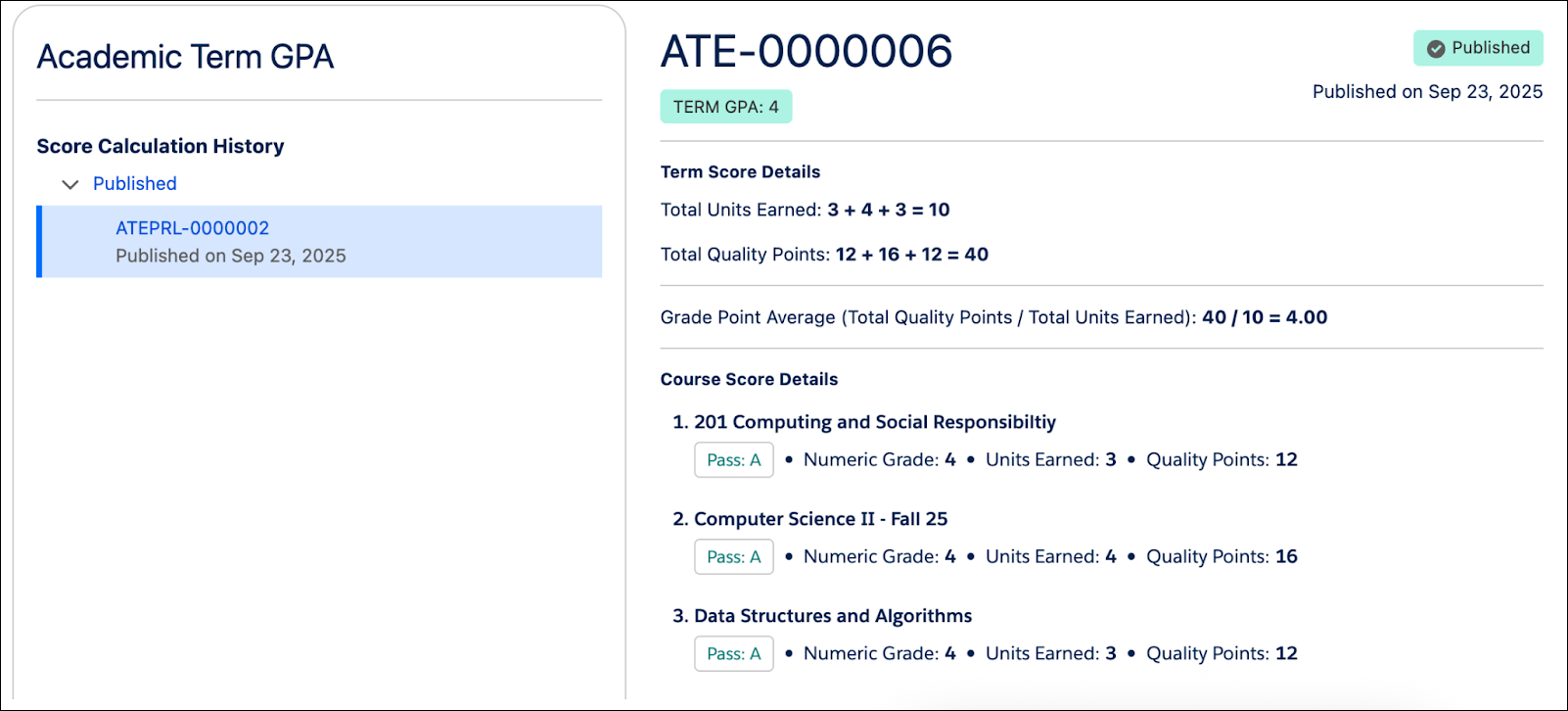
Each GPA result includes a detailed explanation of how it was calculated, referencing the specific courses, grades, and credit values that contributed to the outcome.
Once calculated, you can publish GPA results for student view so that students can track their academic standing in real time. This level of transparency empowers students to take ownership of their performance and plan accordingly. Automated GPA calculations reduce administrative overhead and ensure consistent, defensible outcomes for academic standing reviews, honors eligibility, and progression decisions.
Next, explore another important aspect of academic governance: holds and blocks.
Holds and Blocks
Academic holds and blocks are mechanisms that institutions use to restrict certain student actions, such as registering for courses, until a specific condition is met. Holds can be triggered for a variety of reasons, including:
- Outstanding advising sessions
- Financial or administrative issues
- Academic probation
In Agentforce Education, Juan can manage holds with ease. Each hold is tied to a defined business rule or staff action, ensuring that it reflects a consistent policy. Students see the reason for the hold and the steps to resolve it directly in their student portal.
For example, on the learner portal, Sophia sees an alert about an academic standing hold that was placed automatically when she missed a required advising session.

When Sophia tries to register for a course, a message informs her of the account hold preventing her registration.

After she meets with her advisor, the hold is cleared and she regains access to course registration. This system ensures accountability while guiding students toward the actions they need to take.
Holds are not just administrative barriers, they're communication tools. When used effectively, they help students engage more intentionally with their academic journey and avoid delays or surprises during key milestones such as registration or graduation.
Course Equivalencies
As transfer pathways, study abroad programs, and nontraditional learning options expand, institutions need a reliable way to recognize and apply prior learning. Agentforce Education offers a structured approach through course equivalencies.
When Sophia applies for admission, she submits documentation for the courses she completed at her community college. Juan and his team can compare Sophia's external coursework to internal Learning Courses offered by Astro University, and once a match is identified, Sophia receives credit that counts toward her degree.
Each equivalency decision is recorded, providing a clear audit trail of what was approved, by whom, and why. This helps ensure consistency across departments and supports compliance with transfer credit policies. You can apply course equivalencies to a wide range of scenarios, including:
- Transfer credits
- Exam scores
- Work history and professional experience
By creating a transparent, student-centered credit evaluation process, Agentforce Education reduces administrative burden and helps students make the most of their prior achievements.
Use a Proactive Approach to Academic Success
Governance isn’t just about enforcing rules. It’s about setting students up for success. With Agentforce Education, registrars and staff can take a proactive approach to academic management. By automating policy checks, tracking student standing, and clearly communicating next steps, institutions ensure that students have the support to stay on track.
Juan now spends less time chasing down exceptions or processing holds manually. Instead, he uses Agentforce Education to monitor student progress, enforce policies with consistency, and support students such as Sophia with timely, data-driven decisions.
In this unit, you learned how academic governance is essential to maintaining fairness, compliance, and student momentum. In the next unit, explore how Agentforce Education helps students plan their academic journey with tools such as the Degree Planner, Intelligent Program Comparison, and Transfer Credit workflows.