Learn About Product Management for Agentforce Life Sciences
Learning Objectives
After completing this unit, you’ll be able to:
- Explain why an unstructured product catalog creates risk for life sciences field teams.
- Describe the core objects of the product model and how they connect product strategy to field execution.
- Identify the stages of the product management lifecycle and explain what each stage manages.
- Describe how the configured catalog shapes the field visit experience.
Before You Start
Before you start this badge, consider completing this recommended content.
-
Agentforce Life Sciences for Customer Engagement
-
Account Management Data Model for Agentforce Life Sciences
Shape the Portfolio for the Field
A life sciences commercial portfolio typically blends two very different things: strategic concepts and physical items.
The concepts form a hierarchy, from a therapeutic area such as immunology, to the brands beneath it and the indications each brand treats.
The physical items are what a representative hands to a healthcare provider, such as sample packs, promotional leave-behinds, or orderable goods. Concepts carry strategy and messaging. Physical items carry inventory, allocation, and chain-of-custody rules. A representative presents approved information about a concept to a provider, also called detailing, then physically transfers the item. The regulations governing each action differ.
Many life sciences organizations hold all of this in one massive catalog. Hand that raw catalog to a specialty representative, and two problems surface at once. The representative loses time hunting for relevant products among hundreds that don't apply. A flat catalog can't instruct a representative what they're cleared to discuss, sample, or present to a specific account today.
The compliance stakes are real. Federal rules govern how representatives distribute drug samples: each sample ties to a licensed prescriber's request, a signed receipt, and an inventory that reconciles. Promotion stays within a product's approved indications, and off-label questions belong with Medical Affairs, not the field. A hospital can also withhold approval for a product until its own review clears. A catalog that can't encode these boundaries pushes the judgment onto the representative, which is exactly where mistakes become violations.
Product Management in Agentforce Life Sciences closes that gap. It turns the raw portfolio into a curated, governed catalog. From one workspace, you model the product hierarchy, attach physical items, and publish approved messaging. You align products to territories and fence off accounts that aren't ready for them. What reaches the field is a focused, compliant set of options instead of an unfiltered list.
In this badge, you learn how to build that catalog from the ground up. You structure the core hierarchy, add product guidance, align products to territories, set territory priorities, and apply the account restrictions that enforce local engagement rules.
First, learn about the foundational concepts of Product Management for Agentforce Life Sciences in this unit.
Connect Product Data to Field Execution
In Agentforce Life Sciences for Customer Engagement, the strategic concepts and the physical items work as one connected structure, and that structure is where strategy reaches the field. Set it up once, and it holds for every interaction that follows.
Two objects form the foundation. Life Science Marketable Product holds everything the company markets, sells, or discusses, from a therapeutic area or brand down to an individual product. Product2, the standard Salesforce product record, holds the physical subset, the items a representative can sample, order, or leave behind. Salesforce labels Product2 as Product in the UI. This badge uses the API name Product2 to distinguish the physical product from Life Science Marketable Product.
Every product lives in Marketable Product, and only the physical ones also carry a Product2.
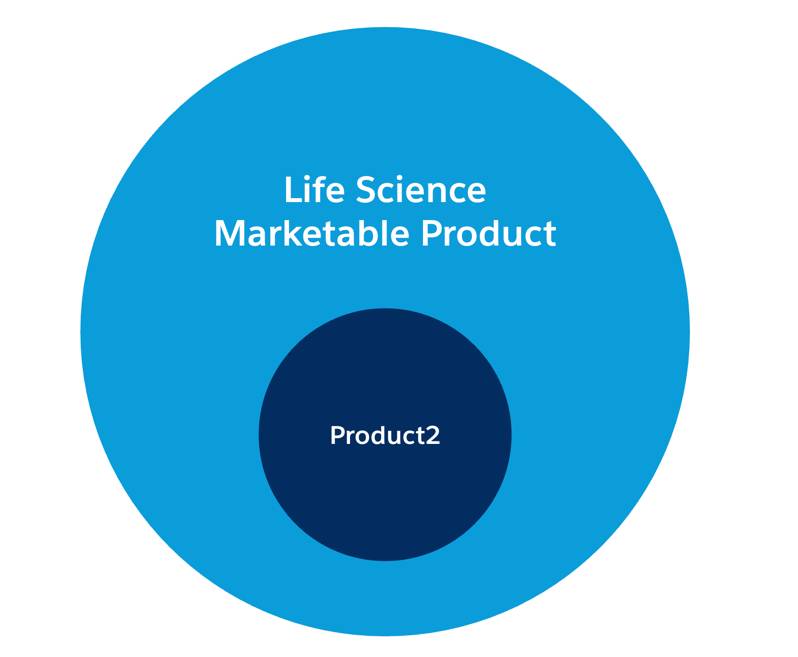
On that foundation, you add layers of control, each relating to the model at a different point.
-
Product guidance attaches to the concept records, so approved messages and objectives travel with a brand or therapeutic area wherever the field discusses it.
-
Territory alignment maps products and their guidance to the field teams that see them, so each representative works from a relevant set.
-
Account restrictions sit at the account level, holding a product back where a single facility isn't cleared for it.
Together they turn the foundation into a catalog that carries its own strategy and limits.
That payoff reaches the field wherever a product appears. The same configured model feeds the core engagement processes across Agentforce Life Sciences, from visits and sampling to intelligent content, inquiries, and orders. In a visit, a product carries its approved message the moment a representative details it, and a recorded sample drop applies the allocation and distribution rules of the linked physical item. Other processes read the same relationships, so the work you configure once holds everywhere a product surfaces.
Follow the Product Management Lifecycle
Building that model follows an order, because each control depends on the one before it. Four stages carry the work from a defined product to a governed field experience.
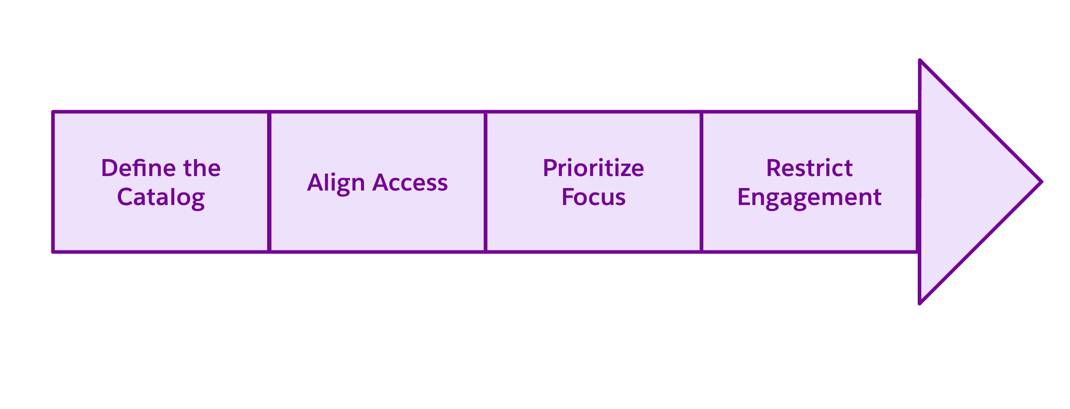
Here’s what you do in each stage.
-
Define the Catalog: Build the hierarchy and author its guidance, which carries over into downstream workflows.
-
Align Access: Open each product, with its guidance, to the territories that carry it.
-
Prioritize Focus: Order the aligned products so the ones that matter most in a territory surface first.
-
Restrict Engagement: Close the exceptions, holding a product back at an individual account when local rules require it.
Together, the stages hand a commercial organization direct control over what reaches the field. The catalog carries the boundaries a representative once held in mind. So strategy and compliance travel with the product itself, and every team works from a portfolio already focused on its role.
Explore the Impact on Field Execution
A governed product catalog earns its value downstream. It's the shared foundation that the rest of Agentforce Life Sciences builds on, because one product record is the common thread through the field's work. With an ungoverned catalog, every place a product appears inherits the raw list and leaves compliance judgment to the representative. Configure the catalog once, and every place a product appears draws from that one source.
That reach runs across the platform.
-
Engagement planning: An Activity Plan sets product-specific targets, such as a defined mix of visits and digital messages for a brand across a cycle, so managers track attainment by product instead of raw activity.
-
Visits: Aligned products appear in priority order, each carrying its approved message, validated sample limits, account restrictions, and any logged provider inquiries during the visit.
-
Sampling and inventory: Sample limits and territory allocations attach to the product, and field inventory tracks the physical item down to its batch through counts and reconciliation.
-
Intelligent content and email: The approved messages and content tied to a product reach providers through eDetailing and compliant email, so the language stays consistent across channels.
-
Account and territory planning: Key account plans and territory business plans anchor their strategic goals to a specific product or therapy, keeping long-range strategy tied to the same catalog.
The impact reaches every role. Commercial leaders steer attention for each product and territory. Operations teams adjust access centrally as a launch expands. Compliance teams lower the risk of unapproved promotion or sampling. And the representative works from a focused, ordered set, with the account, the objective, and the approved message already in view.
What’s Next?
In this unit, you saw why a governed product model matters. A foundation of Life Science Marketable Product and Product2 carries the layers of guidance, alignment, and restriction that decide what reaches the field, and a four-stage lifecycle orders the work.
In the next unit, you start with the core catalog. You learn how to model the commercial hierarchy, classify the physical products that behave as samples or promotional items, and link each to its product record.