Improve Customer Understanding with Third-Party Enrichment
Learning Objectives
After completing this unit, you’ll be able to:
- Describe the benefits of using authoritative third-party reference data to enrich individual and organizational records.
- Explain how third-party data supports identity resolution and customer profile unification.
- Distinguish between missing and stale data, and why enriched attributes can decay over time.
Why Organizations Use Third-Party Enrichment
As you evaluate your data, you might discover that your existing systems do not contain enough reliable information to fully understand customers, businesses, locations, or risk.
For example:
- Important information can be missing entirely.
- Data can become outdated over time.
- Different internal systems can contain conflicting values.
- Teams might need more detailed context than CRM systems were originally designed to store.
To address these challenges, you can use third-party enrichment providers that curate, maintain, and continuously update authoritative reference datasets.
These providers specialize in maintaining information such as:
- Customer and household details.
- Company and organizational data.
- Geographic and address information.
- Industry and professional classifications.
- Risk and compliance indicators.
Because this information is maintained independently and refreshed regularly, you can use it to validate existing records, improve data completeness, resolve conflicting information, and add business context. These improvements help support more effective segmentation, analytics, automation, and AI experiences.
For example, if multiple systems contain different addresses for the same customer, a trusted third-party provider can help determine which address is most likely current.
Similarly, a business can use external firmographic data to better understand company size, ownership structure, industry classification, or regional operations.
Third-party enrichment is especially valuable when organizations need trusted, independently maintained reference information that internal systems alone cannot reliably provide.
Third-Party Data Providers Are Specialized
Third-party enrichment providers often specialize in specific types of reference data.
Enrichment Focus |
What’s Added |
Business Value |
|---|---|---|
Individuals |
Demographic and household details |
Improve segmentation and audience targeting |
Individuals |
Title and job details, business contact information, credentials |
Support industry-specific targeting and compliance |
Individuals or Organizations |
Risk indicators |
Make risk-aware operational decisions |
Organizations |
Firmographic details |
Prioritize and route accounts more effectively |
Organizations |
Organizational hierarchy data |
Understand relationships and coordinate engagement across locations or entities |
Third-Party Data Improves NTO’s Customer Understanding
Northern Trail Outfitters (NTO) uses third-party enrichment to improve both consumer and business customer understanding.
For consumer interactions, NTO wants service teams, marketers, and AI agents to more accurately recognize customers across purchases, service interactions, and channels.
For business interactions, NTO needs a more complete understanding of retailers, franchise relationships, subsidiaries, and parent organizations so teams can coordinate sales, service, and partner engagement more effectively.
Example: Change-of-Address Indicates What’s Current
Address recency is difficult for organizations to maintain on their own, especially when customers move, and historical orders should not be modified. Third-party change-of-address data enrichment provides an independent way to verify whether an address is still current.
For example, in the United States, the National Change of Address (NCOA) service can be used to enrich a person’s physical address data by confirming the move and providing their new address. Similar services vary by region, and their coverage and update frequency depend on local rules and providers.
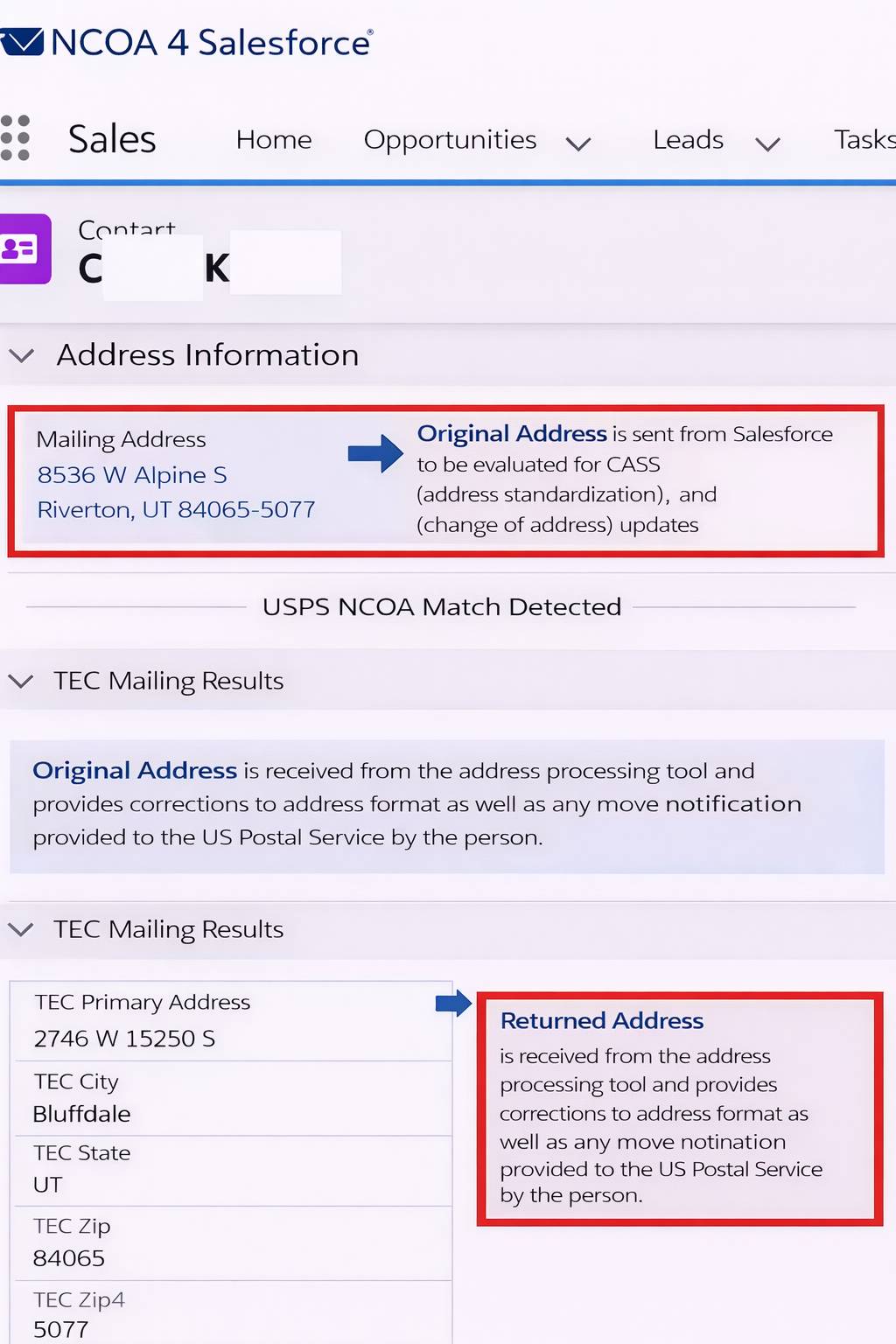
In the example shown, the mailing address stored in Salesforce is compared to USPS NCOA data. A match is detected, and NCOA provides a standardized address. The new address reflects both address standardization (Coding Accuracy Support System or CASS) and any confirmed move updates.
To maintain the customer’s historical address, NTO stores the new address along with a move indicator in fields separate from the historical address. By keeping past addresses on file for reference and using the current address for outreach and service, NTO can match records more accurately and maintain an accurate historical record.
NTO Needs a Holistic View of Business Customers
NTO sells directly to consumers and also through retail partners and franchise locations. Over time, NTO realized it had an incomplete understanding of how many of its business relationships are connected.
For example, NTO needed to answer questions such as:
- Are these two accounts part of the same company in different countries?
- Which locations are company-owned versus franchise-operated?
- How should revenue and relationship ownership roll up across regions?
- Are different business units interacting with the same organization separately?
Without this context, NTO cannot accurately estimate customer value, coordinate outreach, or fully understand its partner ecosystem.
To address this challenge, NTO uses third-party business reference data providers that maintain authoritative datasets about:
- Parent and subsidiary relationships
- Company ownership structures
- Geographic footprints
- Industry classifications
- Corporate hierarchies
Moody’s, a third-party business reference data provider, maintains business reference datasets that help organizations understand how companies are connected.
In the following example, NTO discovers that two local retail partners are both connected to an international partner through a parent company relationship.
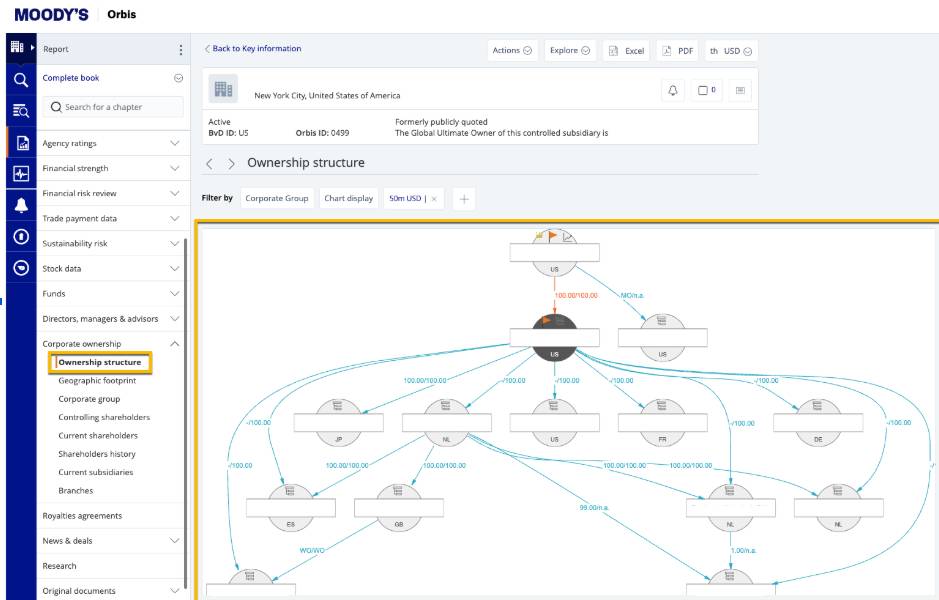
Even though the subsidiaries can be in different countries or have different names, enrichment can show account hierarchy relationships.
This helps NTO:
- Coordinate engagement across related accounts.
- Better understand partner relationships.
- Improve account planning and sales strategy.
- Deliver more consistent customer and partner experiences across regions.
Let’s Recap
Third-party enrichment helps organizations improve customer and business understanding using authoritative reference data maintained by specialized providers.
Organizations use this enrichment to:
- Validate and refresh existing records.
- Resolve conflicting information across systems.
- Add business, geographic, or risk context.
- Better understand both consumer and business relationships.
In the next unit, you explore how organizations collaborate directly with trusted business partners through second-party enrichment to improve shared customer understanding while maintaining governance and privacy controls.