Get to Know Ship and Debit
Learning Objectives
After completing this unit, you’ll be able to:
- Define the role of ship and debit in Channel Revenue Management.
- List the key challenges of manual incentive management.
- Describe how ship and debit incentives benefit manufacturers and their partners.
- List the ways ship and debit helps partners across Industries.
Before You Start
Before you start this badge, make sure you complete this content. The work you do here builds on the concepts and work you do in that content.
The High-Wire Act of Distribution
Imagine you’re a distributor. You buy products from a manufacturer at a set price and sell them to customers for a profit. But sometimes, to win a big deal or stay competitive, you have to sell a product for less than what you paid for it.
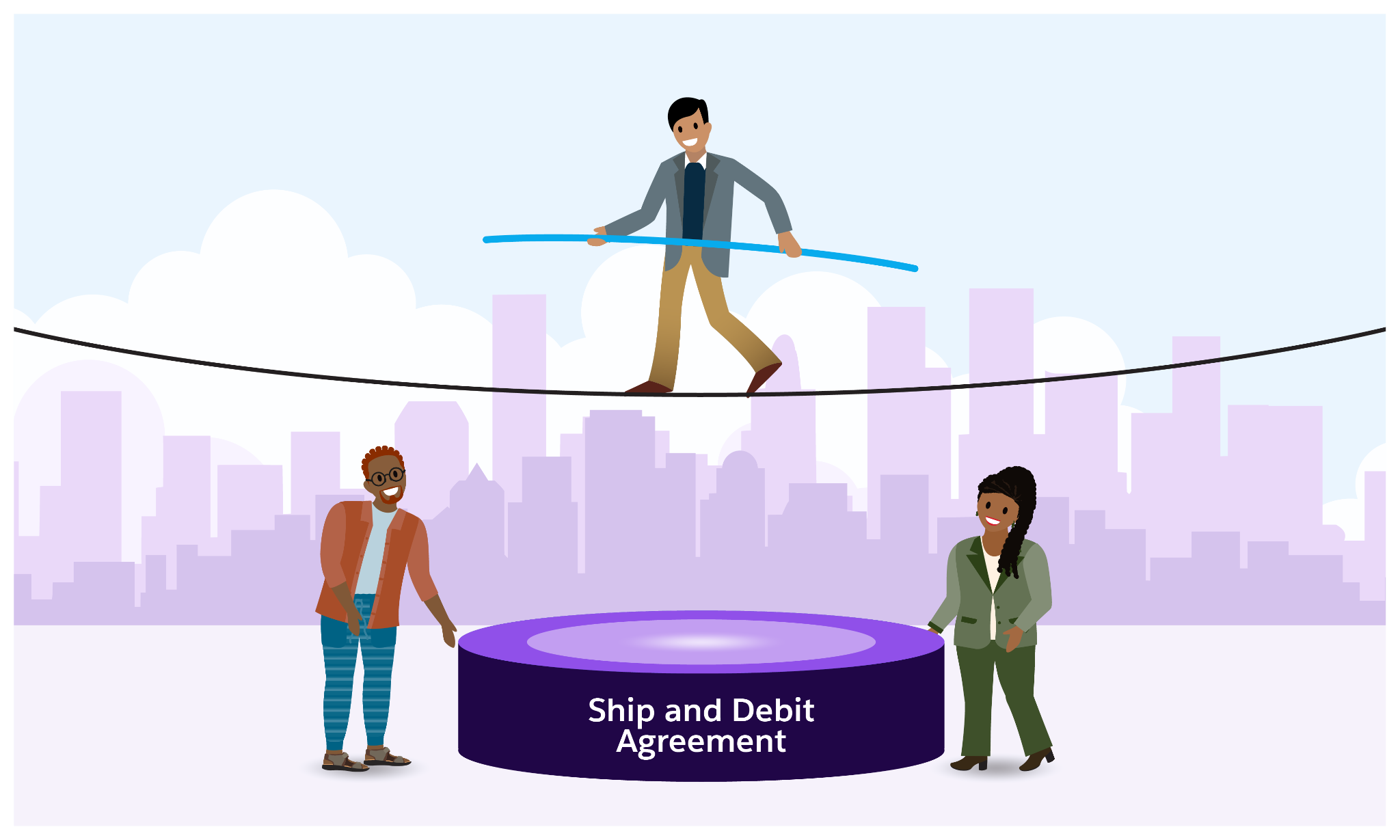
Without a safety net, you’re walking a financial high wire. If you fall, you lose money on the sale. That’s where Salesforce Channel Revenue Management comes in.
Ship and Debit Process Management is a feature within Channel Revenue Management that helps you create effective ship and debit incentives to compensate partners who price products competitively for end customers. It features a robust data model for designing nuanced incentives and capturing detailed claim data. It also includes predefined automation workflows for rapid claim validation setup, and CRM Analytics dashboards to help manufacturers optimize incentives for maximum return.
Also known as a special pricing agreement, ship and debit is a contract that defines the discounted price for a specific customer, the duration of the offer, and the products included. It enables the manufacturer to compensate a distributor for selling products at a lower price than the original purchase cost. So it acts as that safety net.
This mechanism is particularly vital in industries such as high-tech and manufacturing, where market dynamics often necessitate flexible pricing strategies.
Common Challenges Faced by a Manufacturer
Without a dedicated system such as Channel Revenue Management, managing these unique programs is difficult. Companies often face these challenges with manual incentive management.
-
Slow reimbursement: Partners can wait weeks or months for payments, which hurts their cash flow.
-
High error rates: Manual data entry leads to revenue leakage where manufacturers pay incorrect amounts.
-
Lack of visibility: Neither the manufacturer nor the partner can easily track outstanding claims or program performance.
-
Audit risks: Missing documentation or unverified claims make it hard to maintain accurate financial records.
-
Scale limitations: Manual processes make it nearly impossible to manage hundreds of unique pricing agreements simultaneously.
To overcome these challenges, Channel Revenue Management helps manufacturers and distributors automate ship and debit programs, validate claims against program rules, and gain real-time visibility into payouts. You get to offer competitive pricing to end customers, reimburse distributors accurately, and strengthen channel relationships without the manual overhead.
Standard Rebates Versus Ship and Debit Incentives
While both are manufacturer-paid incentives, standard rebates and ship and debit incentives serve different goals.
Standard rebates usually reward partners for meeting high-level volume or performance targets. In contrast, ship and debit incentives provide the flexibility to set special pricing terms for specific customers or market demands. Manufacturers use these incentives to:
-
Stay competitive: Respond quickly to market price changes without lowering the book price for everyone.
-
Build loyalty: Support partners so they can win deals they otherwise couldn't afford.
-
Gather data: Track exactly what is selling and at what price point in the field.
Each ship and debit program is unique, tailored to a specific distributor and end-customer combination to make sure the partner remains competitive while protecting their margins.
Ship and Debit Across Industries
Now that you’ve learned how manufacturers use ship and debit to help distributors stay competitive, let’s explore how different industries, in their unique contexts, benefit from this partner incentive program.
Manufacturing
In the manufacturing industry, ship and debit reimburses distributors for approved discounts. Integrated with Channel Revenue Management, it gives distributors the option to link claims to channel partner inventory and agreements for accurate and auditable processing. This helps manufacturers protect partner margins and understand pricing trends across the supply chain.
Automotive
In automotive, ship and debit protects dealer margins when vehicles, parts, or accessories are sold below list price. Dealers submit claims, and original equipment manufacturers (OEMs) validate them against sales and channel partner inventory data. This helps OEMs maintain dealer relationships and track market-driven discounts.
Consumer Goods
In consumer goods, ship and debit helps distributors and retailers recover discounts caused by market pressure. By linking claims to channel partner inventory and sales data, companies ensure accurate reimbursements and gain visibility into channel pricing.
Across industries, ship and debit streamlines approvals and reimbursements, strengthens partner relationships, and supports flexible pricing.
Next Up
Now that you understand the why behind these incentives, it’s time to look at the how. In the next unit, you walk through the ship and debit lifecycle: from creating a program to processing claims and getting partners paid.
Resources
- Salesforce Help: Get Started with Ship and Debit Process Management
- Salesforce Help: Comparison of Rebate Management and Ship and Debit Process Management
- Salesforce Help: Capabilities of Ship and Debit Process Management
- Salesforce Help: Ship and Debit Process Management Workflow
- Salesforce Help: Enable Ship and Debit Process Management
- Salesforce Help: Channel Revenue Management