Get to Know Marketing Planning and Operations
Learning Objectives
After completing this unit, you’ll be able to:
- Describe the key challenges marketing teams face that make a unified operations platform necessary.
- Identify how strategy, planning, execution, and analytics connect within a single system.
- Outline how governance is built into a program or campaign through a compliance review.
Marketing Operations Challenge
Most marketing teams use several separate systems. They plan in spreadsheets and run campaigns on one platform while they measure results on another. These systems don’t share data with each other. As a result, marketers lose 30 to 40 percent of their week moving data by hand between tools that were never built to connect.
The bigger problem is the disconnect between strategy and execution, not just wasted time. A campaign can launch on time and meet its delivery targets. But 3 months later, nobody can say whether it’s making progress on the goal it was meant to support. Without a clear line back to a business goal, teams can’t prove impact. Leaders can’t rely on the numbers they’re given either.
That challenge is exactly what Marketing Planning and Operations is designed to solve.
Strategy-to-Execution Connection
Marketing Planning and Operations ties strategy, planning, execution, and analytics together in a single system. The system organizes this work through a hierarchy of levels, and each level links to the one above it. For example:
- A CEO sets a business objective to grow annual revenue by 15%.
- The CMO turns that into a marketing directive to expand into new markets.
- A marketing director runs a program, the Q3 Product Launch, to generate qualified leads.
Each level’s results roll up, so the CEO can see whether that revenue goal is on track.
You define the hierarchy, so it can have as many or as few levels as your business needs. You also decide whether a level can roll up to a parent more than one level above it. For example, a plan can roll up straight to an initiative and skip the program level entirely.
Here’s one example hierarchy with five levels: corporate objective, initiative, program, plan, and campaign.

Marketing leaders set goals at each level of the hierarchy. Goals are measurable targets that define success, and their values cascade from one level to the next. This connected thread ties even the smallest piece of work back to the goal set at the top. Because every execution step links back to the original business target, you can track return on investment in real time. You can prove your impact and adjust a live campaign or program right away instead of waiting until it ends.
With the structure in place, here’s how governance and core capabilities keep every campaign or program aligned and compliant.
Governance and Core Capabilities
Governance is built into each program or campaign through a compliance review. A compliance review checks that the work follows brand and regulatory standards before it proceeds. A campaign manager submits the program or campaign for review, and a compliance reviewer signs off before it goes live. For example, a reviewer might confirm that a promotional email includes the required legal disclaimer.
An approval works differently. It routes work to a specific person for sign-off before it goes live. When a program or campaign needs broader approval, the request routes to the right approver automatically based on how your org configures approval routing.
Here’s how the planning and operations workspace looks on a campaign or program record.
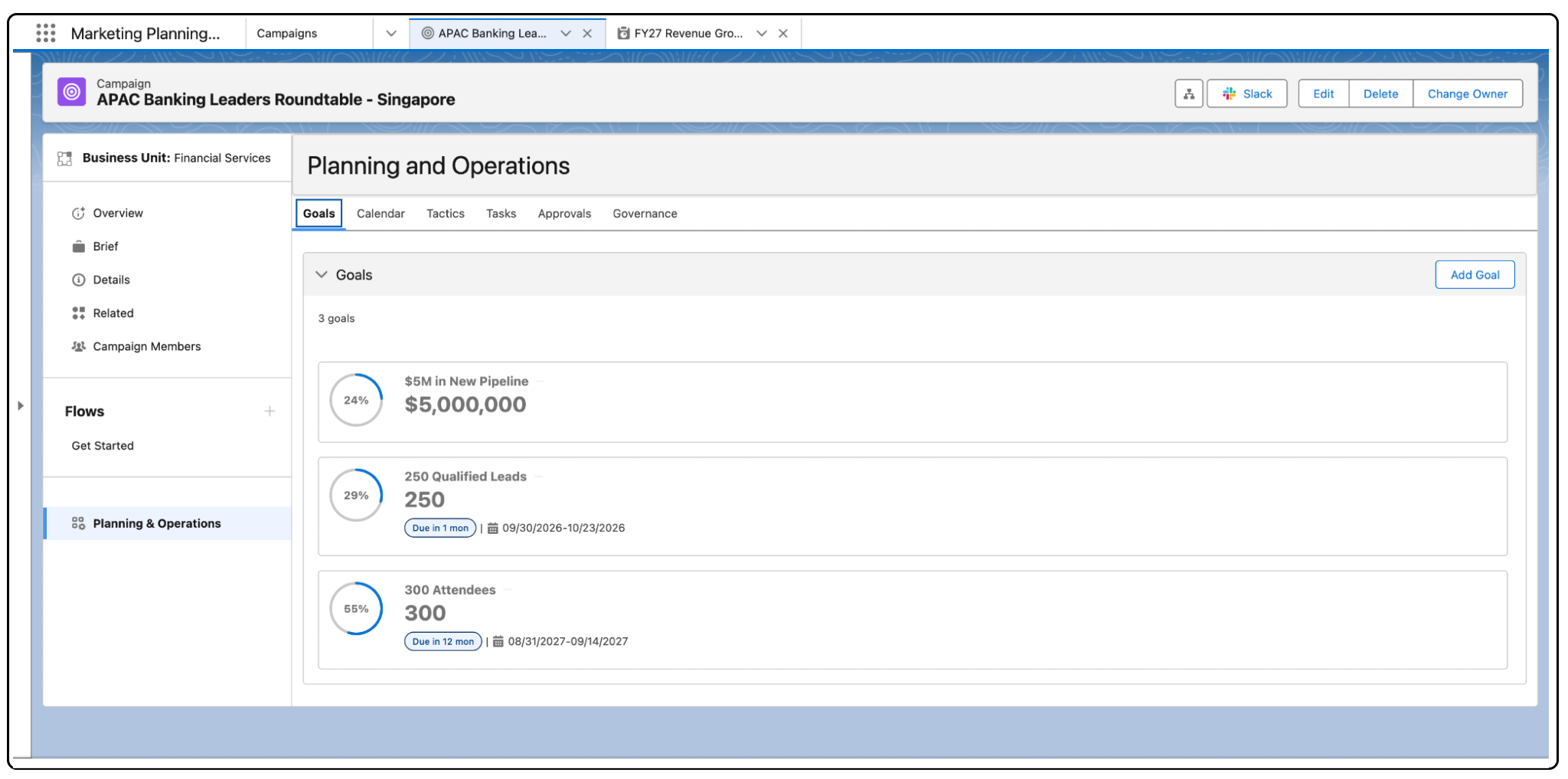
Along with governance, this connected structure gives you several core capabilities.
-
Tactics: Marketers add tactics to execute the work in a program or campaign. Tactics are concrete deliverables such as an email or a paid social ad.
-
Task orchestration: Marketers assign and track tasks across a program, campaign, or tactic. This keeps the team’s work visible in one place.
-
Slack collaboration: Your team can collaborate in Slack on any program, goal, tactic, or campaign. Messages sync in real time, so conversations stay linked to the work.
-
Marketing calendar: This view shows the whole plan on one page across the entire hierarchy.
-
Agentic support: Agentforce is designed to help leaders build out programs and goals. This frees teams to focus on creativity and strategy instead of manual coordination.
As a result, every campaign or program in your marketing org traces back to a business goal that you can point to.
In Summary
Marketing Planning and Operations brings the tools your team already uses together in a single platform. You can plan programs and campaigns and track its results in the same place. Every dollar spent and every task completed has a clear line back to the goal that started it. You spend less time reconciling spreadsheets and more time acting on real-time performance data. You can trust that your work stays aligned with strategy at every level of the organization.
Resources
- Trailhead: Marketing Cloud Next Basics
- Salesforce Help: Marketing Planning and Operations
- Salesforce Help: Planning Hierarchies in Marketing Planning and Operations
- Salesforce Help: Plan with Agentforce in Marketing Planning and Operations