Get Started with Incident and Problem Management
Learning Objectives
After completing this unit, you’ll be able to:
- Define incident management and its primary goal of restoring service quickly.
- Define problem management and its primary goal of identifying and resolving the root cause of recurring issues.
- Explain how Agentforce IT Service provides both reactive and proactive solutions.
Before You Start
Before you start this module, consider completing this recommended content.
Review the Basics
There’s a good chance you’re already familiar with the fundamentals of information technology service management (ITSM) and IT infrastructure library (ITIL) best practices. While Agentforce IT Service covers the entire service lifecycle—this module focuses on the top two processes in the stack: incident management and problem management.
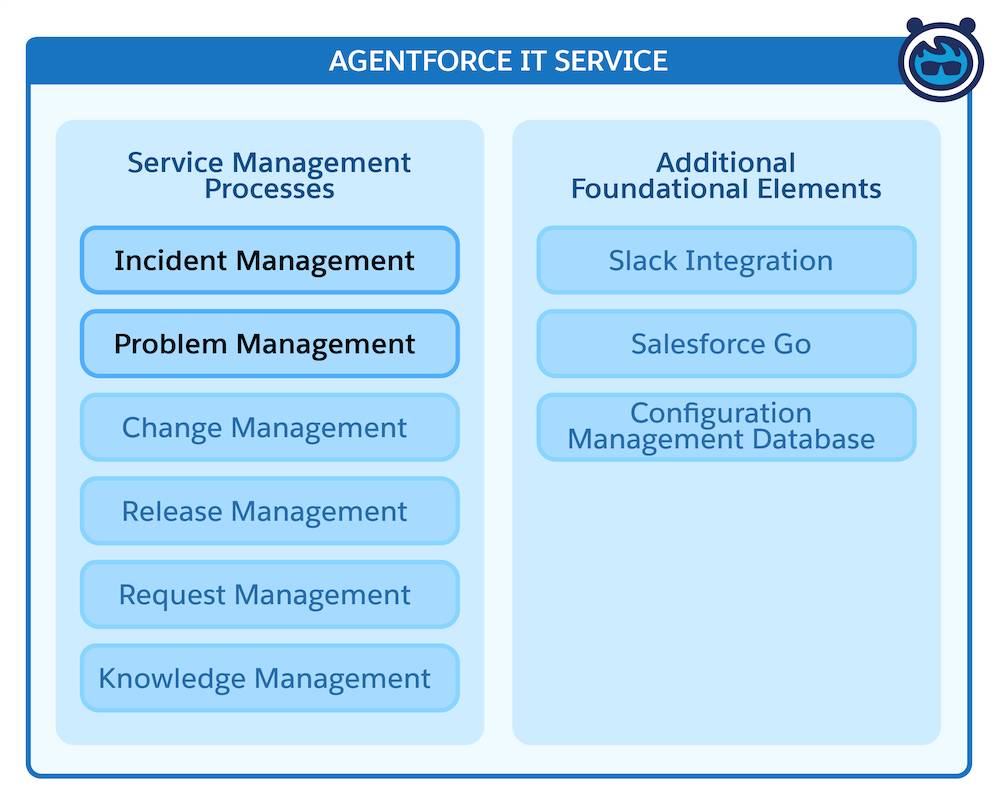
These two processes work in tandem, but they have different goals.
-
Incident management: An incident is an unplanned interruption to a service. The goal here is speed: Restore normal service operation as quickly as possible to minimize the impact on the business. Think of this as putting out the fire. Incident management is often reactive in nature.
-
Problem management: A problem is the underlying cause of one or more incidents. The goal here is stability: Identify the root cause of recurring incidents to prevent them from happening again. Think of this as fireproofing the building so the fire doesn't restart. Problem management is often, but not always, proactive.
Now that you’ve reviewed definitions, let’s look at how Agentforce IT Service helps you move from “firefighting” to “fireproofing.”
Common Challenges Facing IT
Incident and problem management are at the front end of any comprehensive ITSM solution. They’re where service issues first appear. And they’re where you learn what’s happening across your environment, so you can resolve disruptions quickly and keep them from recurring.
Here are a few common challenges that small, medium, and large enterprises (SMLE) face when it comes to IT.
Process |
Challenge |
Solution |
|---|---|---|
Incident management |
Unplanned downtime that stalls work |
Keep things moving by resolving issues quickly and consistently. |
Unstructured firefighting |
Replace ad-hoc responses with a clear, repeatable process everyone can follow. |
|
Lack of visibility into what’s broken |
Provide a single place to report issues and track progress. |
|
Problem management |
Recurring issues that waste time |
Break the cycle of fixing the same problem again and again. |
Unpredictable service reliability |
Strengthen stability by addressing what causes disruptions—not just the symptoms. |
|
Limited IT bandwidth |
Free your IT team from constant “break/fix” work so they can focus on higher-value improvements. |
Agentforce IT Service simplifies these challenges with intelligent automation. But while regular employees don’t need to understand how the automated troubleshooting happens, incident and problem fulfillers absolutely do. As an IT worker, you need to understand the manual workflows first in order to manage the intelligent solution even better.
Go Under the Hood
Think about the computer you use every day. Most of the time, you navigate using a sleek graphical interface. It’s fast, visual, and easy. But when things get tricky—or when you need total control—power users drop into the command line or advanced settings to get things done. Understanding what happens at a foundational level makes you better at troubleshooting the surface level. The same logic applies to Agentforce IT Service.
Agentforce IT Service offers incredible automation tools. Employees can report issues via self-service portals, and AI agents can automatically triage tickets and draft resolution summaries. However, sometimes the best way to understand the data is to fire up the app, point, click, and fill out the fields yourself. Agentforce IT Service empowers you to do both.
What to Expect Next
You’ve reviewed the basics of incident and problem management and how they work together to move IT teams from reactive firefighting to proactive fireproofing. Now that you understand the strategy, let’s focus on the execution.
In the following units, you focus on the manual methodology of incident and problem management with Agentforce IT Service. To learn about AI automations in Agentforce IT Service, check out AI for Agentforce IT Service.
Ready to get started? Let’s go!