Choose Your Migration Path
Learning Objectives
After completing this unit, you’ll be able to:
- Distinguish the four Voice migration paths.
- Select the Voice migration path that matches a given organization's requirements.
Your Four Migration Paths
Salesforce supports four Voice solutions, each designed for a different Open CTI starting point. All four paths bring you to the same place—a phone channel natively integrated with Omni-Channel, your CRM data, and AI.
Here’s an overview comparison of each solution.
Path |
Product |
Best For |
Who Manages the Telephony Backend |
|---|---|---|---|
1 |
Partner Contact Center |
Your existing telephony vendor has a managed package on AgentExchange (formerly AppExchange) |
Your existing vendor |
2 |
Partner Contact Center with Telephony from Amazon Connect |
You already operate your own Amazon Connect instance and want to bring it into Salesforce |
You, through your AWS account |
3 |
Partner Contact Center with Amazon Connect |
You want Amazon Connect telephony without managing AWS infrastructure yourself |
Salesforce through a managed AWS account |
4 |
Agentforce Contact Center |
You want a fully native, end-to-end Salesforce telephony solution with no third-party vendor required |
Salesforce |
Voice Product Names
You might have noticed that Salesforce likes to keep things fresh with its product names. We’ve recently updated our Voice naming. While you might notice outdated names in help content and in the app, we’re working on updating them soon. Here’s a quick reference for the purpose of this badge.
-
Partner Contact Center: Formerly Salesforce Voice with Partner Telephony and Service Cloud Voice with Partner Telephony.
-
Partner Contact Center with Telephony from Amazon Connect: Formerly Salesforce Voice with Partner Telephony from Amazon Connect and Service Cloud Voice with Partner Telephony from Amazon Connect.
-
Partner Contact Center with Amazon Connect: Formerly Salesforce Voice with Amazon Connect and Service Cloud Voice with Amazon Connect.
-
Agentforce Contact Center: The unified contact center offering from Salesforce that brings together channels (including native telephony, formerly called Salesforce Voice Native Telephony in help and release notes), AI, and CRM in one solution.
How to Choose Your Path
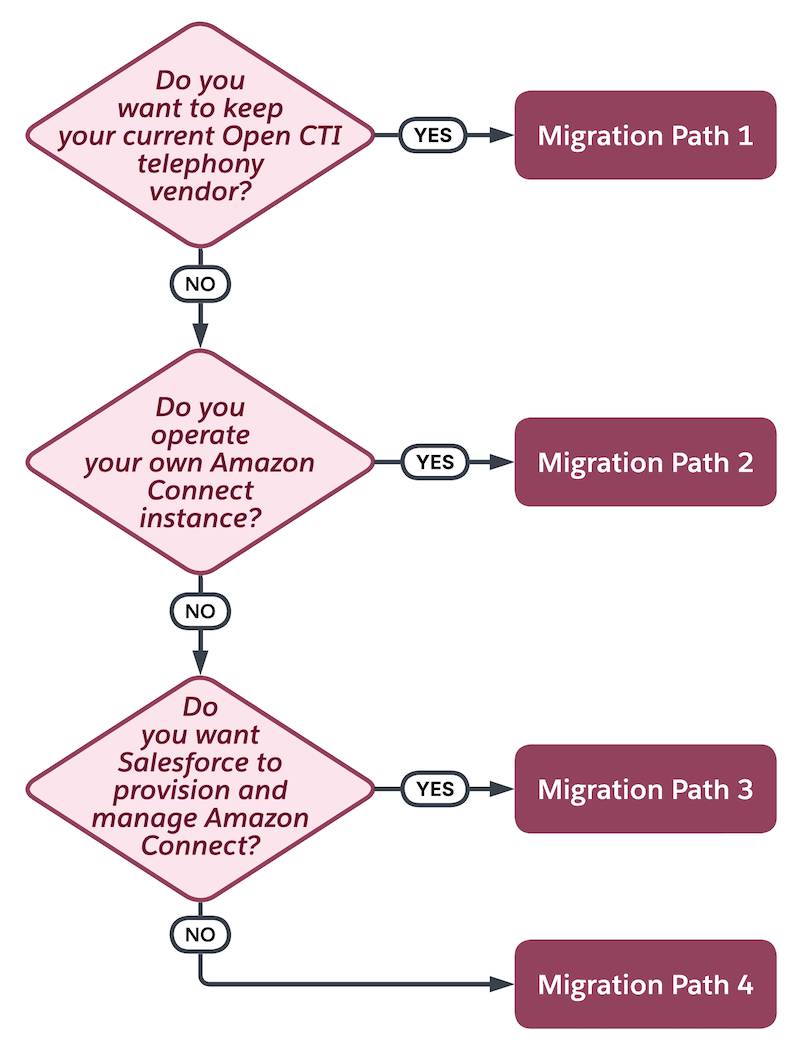
The right path depends on three questions about your current setup and your organization's priorities.
Do You Have an Existing Telephony Vendor?
If your Open CTI adapter is tied to a partner such as Genesys, Cisco, Five9, or Talkdesk, check whether that vendor has published a Partner Contact Center (or Salesforce Voice) package on AgentExchange. If they have, Path 1 is often the lowest-friction option. You keep your existing telephony backend and your existing vendor relationship, and swap only the integration layer.
Do You Already Have an Amazon Connect Instance?
If your organization operates an Amazon Connect instance, Path 2 lets you bring that investment into Voice without reprovisioning. If you don’t have an existing AWS footprint but want Amazon Connect’s telephony capabilities, you might choose Path 3. In Path 3, Salesforce provisions and manages the infrastructure for you.
Do You Want Salesforce to Manage Everything?
Path 4, Agentforce Contact Center, provides the most self-contained option. There's no third-party telephony vendor and no AWS account required. Salesforce provides the telephony service end-to-end. This is the right choice for organizations that want to consolidate vendors and minimize telephony operations overhead.
Here’s a handy diagram to sum it up.
Review the Decision
Now that you’re familiar with the options, review the following migration scenarios. Determine which migration path is the best for each scenario, and then select the scenario card to reveal the answer.