Connect Key Account Strategy to Execution
Learning Objectives
After completing this unit, you’ll be able to:
- Explain why life sciences key account strategy requires connected planning.
- Distinguish account planning from territory business planning in Agentforce Life Sciences.
- Describe how the Key Account Management data model connects strategy to execution.
- Explain how structured Key Account Management data supports visibility, coordination, and Agentforce insights.
Before You Start
Before you start this module, consider completing this recommended content.
Recognize the Need for Connected Planning
Life sciences account strategy has grown too complex to manage in isolation. A large provider organization often brings clinical leaders, pharmacy committees, and access stakeholders, into a single decision. Whether a therapy gets adopted hinges on evidence requirements, formulary timing, contracting priorities, operational readiness, and relationships across the organization.
Key Account Management (KAM) is the discipline of managing high-value relationships through coordinated, long-range planning. It gives teams a way to define the account strategy, weigh stakeholder influence, align internal roles, and track the work that moves shared objectives forward. Without a shared structure, planning fragments. A national strategy lives in a launch deck while account details sit in private notes. One person knows a stakeholder's influence; the rest of the team doesn't. Tactical work gets done, but leadership can't see how it moves the plan.
Key Account Management in Agentforce Life Sciences replaces that fragmentation with a connected model. It links strategic goals, plans, stakeholders, internal teams, and tactical work in one place. Progress tracks against the plan as the work happens, so strategy becomes measurable execution.
In this badge, you learn exactly how KAM makes this integral connection between strategic planning and coordinated execution in Agentforce Life Sciences. You explore the shared model for account and territory planning, build reusable blueprint records, apply them to a live account plan, and scale the same approach across a territory.
Compare Account and Territory Scopes
Key Account Management supports two planning scopes, offering different approaches depending on which one is chosen.
An Account Plan focuses on one customer account, which in life sciences is often an integrated delivery network (IDN), a major hospital, a group practice, or another high-value organization. It helps a team understand a customer's priorities, map the stakeholders who shape decisions, align internal participants, and coordinate account-specific work.
A Territory Business Plan covers a broader scope. It helps regional leaders coordinate strategy across a geography, a specialty, or a portfolio of accounts, applying the same strategic foundation over a wider area.
Each scope answers a different question. An account plan asks what a customer needs, who shapes the decision, and what work advances the relationship. A territory business plan asks how the strategy is progressing across the region and where to direct support next.
By supporting both scopes, Key Account Management gives teams one planning language without forcing every plan into the same purpose. Account teams tailor execution to a single customer; regional leaders watch patterns across many. Both work from consistent goals, tactics, and progress data.
Map the Planning Model
Key Account Management follows one path from strategy to results. Reusable design becomes a live plan, and a live plan becomes tactical work the team can track. The same path runs under both planning scopes.
The diagram shows the account plan; the territory view mirrors it with some small differences
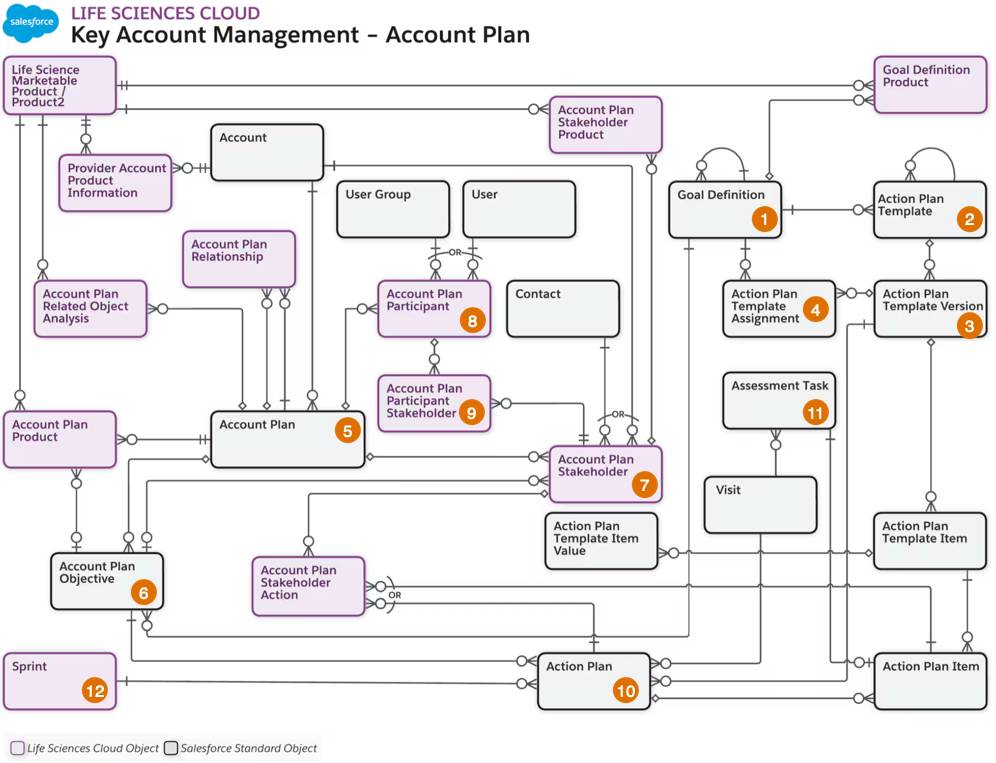
Read the model in three stages.
Stage 1: Reusable Design
Strategy starts as approved, importable building blocks. A Goal Definition (1) is a reusable objective, one that strategy leadership judges meaningful, measurable, and usable across many plans. Goal definitions nest, so a top-level goal carries intermediate goals that support granular workstreams. An Action Plan Template (2) holds the tactical work behind a goal. Publishing a template creates an Action Plan Template Version (3), a governed snapshot teams import, and an Action Plan Template Assignment(4) links a goal definition to the version that deploys with it.
Stage 2: The Live Plan
A team imports that design into a live plan. An Account Plan (5) applies the strategy to one customer; a Territory Business Plan applies it across a region. Importing a goal creates a goal instance inside the plan—an Account Plan Objective (6) in an account plan, or a Goal Assignment in a territory plan.
Stage 3: People, Work, and Progress
A live plan then connects people and tactical execution. On the relationship side, Account Plan Stakeholder(7) records identify the external decision-makers who shape access, while Account Plan Participant(8) records name members of the internal team. An Account Plan Participant Stakeholder(9) record links an internal participant to an external stakeholder, establishing clear ownership of the relationship.
Action Plans (10) organize the tactical work, Assessment Tasks(11) capture the specific actions, and Sprints(12) group that work into dated windows. As tasks close, progress rolls up from the task to the action plan, then to the goal instance, and finally to the plan.
And that’s how a strategy is linked to the people and their work. Design becomes a plan, and a plan becomes tracked execution, all connected in one place.
Put the Plan to Work
A connected model proves its worth when teams run the plan day to day. Two tools turn the structure into live visibility. The Account Plan Hierarchy, and its regional counterpart the Territory Plan Hierarchy, show the whole plan on one screen, from top-level objectives down to individual tasks, with completion percentages that stay current as work closes. And because much of the work happens in the field, the plan travels to mobile, where a rep keeps the stakeholder map current between visits and links their field activity back to the plan.
Because goals, people, tactical work, and progress live as connected data in one plan, Agentforce can draw on it for account summaries and next-best-action recommendations. The richer the structured plan, the sharper the insight it returns.
What’s Next?
You've seen how Key Account Management connects strategy, plans, people, work, and progress into one model. Account plans focus on a single customer, territory business plans span a broader scope, and both draw on reusable goals and templates.
In the next unit, you build the reusable strategy layer. To make the setup concrete, you follow Cumulus Pharma, a fictional life sciences company preparing a planning framework for a new therapy launch. You define approved goals, build tactical templates, publish governed versions, and connect goals to the templates that teams import into live plans.