Experience the Power of Unified Data
Learning Objectives
After completing this unit, you’ll be able to:
- Explain the value of unifying Sales and Service data in Data 360.
- Describe how Data 360 creates a single source of truth.
- Identify the impact of harmonized data on customer experiences.
Before You Start
Before you start this badge, consider completing this recommended content.
The Data Silo Challenge
In an ideal world, your customer’s journey would be a seamless narrative. Every interaction—whether a clicked email, a support chat, or a closed deal—would be a known chapter in that story. However, for most organizations, the reality is fragmented. This is the data silo challenge.
Silos occur when departments operate as islands. Your sales team lives in Agentforce Sales, focused on leads, opportunities, and revenue. Your service team lives in Agentforce Service, focused on cases, response times, and customer satisfaction (CSAT) scores. While both teams use Salesforce, the context often remains locked within specific objects, records, or completely separate external systems.
The Pain of Disconnection
Consider this “before” Data 360 scenario: A high-value customer, Acme Corp, has been facing a critical technical issue for 3 days. Acme Corp is frustrated and has escalated the ticket. Meanwhile, an eager sales rep, unaware of this service turmoil, calls the Acme Corp VP to push for a renewal and upsell.
The result? The VP feels unheard and disrespected. The sales rep looks uninformed. The brand reputation suffers.
- Sales impact: Upsell is lost and renewal is now at risk.
- Service impact: The service rep struggles to calm a customer who is now doubly annoyed by the sales call.
- Operational impact: Hours are wasted reconciling issues caused by critical information living in disconnected silos.
Without a unified data strategy, you force your customers to bridge the gaps in your own internal infrastructure.
The Data 360 Solution
Data 360 solves this by shifting your architecture from point-to-point integrations to a unified data layer. It acts as the high-speed engine that ingests, harmonizes, and unifies data across your ecosystem.
-
Ingestion: Data 360 connects to sales and service (and other internal and external data sources) to pull in raw data.
-
Harmonization: It maps this raw data to the Customer 360 Data Model. Standard CRM objects like Leads and Contacts—whether they come from Agentforce Sales or Agentforce Service—are mapped to standardized data model objects (DMOs) like Account, Contact Point Email, or Contact Point Phone. As a result, your data can be matched and reviewed across features and systems.
-
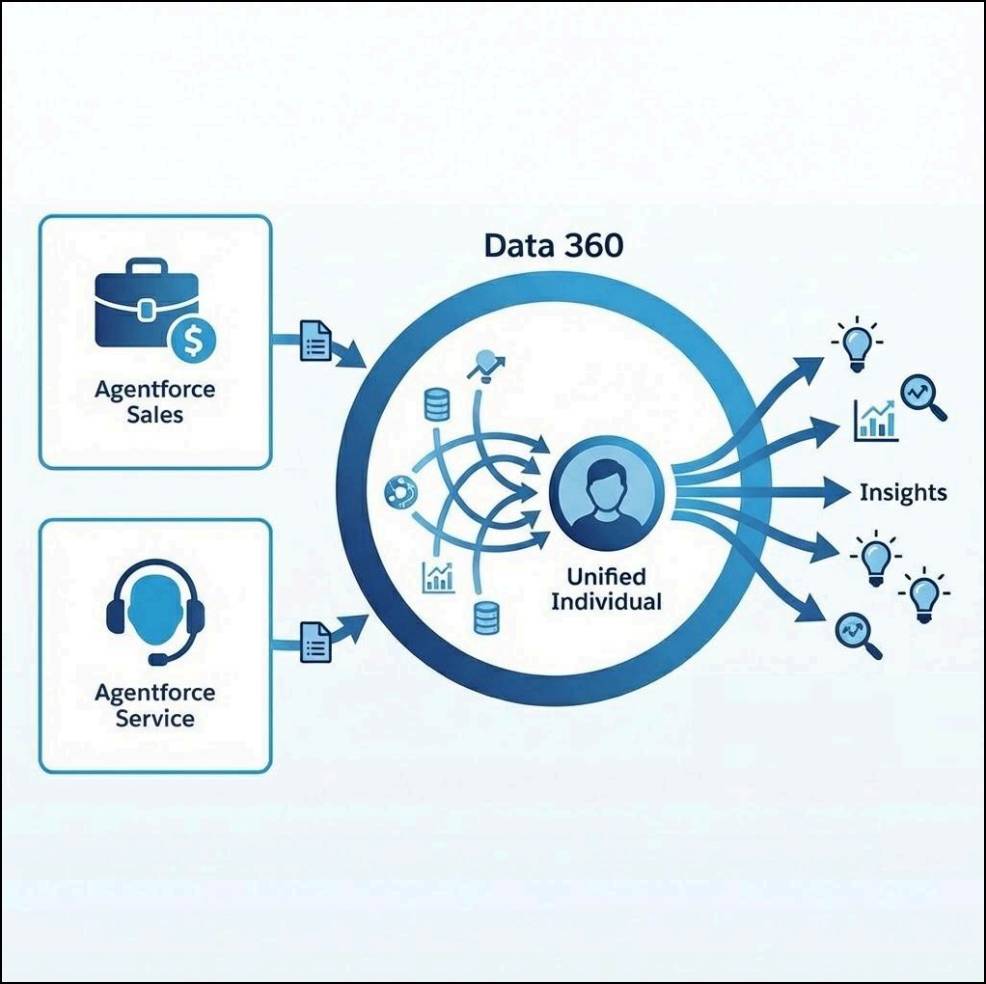
Unification: Using Identity Resolution, Data 360 identifies records about the same individual or account and links them to a single Unified Individual or Account record. Now you can locate all the data about an individual or account and surface important information–like outstanding cases–where you need it.
Real-World Transformation
When you implement Data 360, the Acme Corp scenario changes dramatically. The sales rep checks their account records before the call. They see a high risk alert generated by Data 360 because of the open case. Instead of pitching an upsell, they call to say, “I see you're having trouble with the implementation. I’ve escalated this to the support manager personally.” The crisis becomes a relationship-building moment.
When data flows from Agentforce Sales and Agentforce Service into Data 360, it harmonizes into a Unified Individual to provide new insights.
The One Salesforce Vision
Integrated sales and service data helps you to realize the one Salesforce vision. This is a strategic shift that transforms Salesforce from a system of record to a system of reference.
A single source of truth empowers your sales and service teams to act like a concierge. This is the power of harmonized data: It turns isolated transactions into intelligent relationships.
Feature |
System of Record (Traditional) |
System of Reference (Data 360)
|
|---|---|---|
Data Access |
Siloed in specific clouds |
Unified across the enterprise |
Customer View |
Fragmented (lead versus contact) |
Harmonized (Unified Individual) |
Actionability |
Reactive (look up past data) |
Proactive (real-time insights) |