Model and Rate Products
Learning Objectives
After completing this unit, you’ll be able to:
- Explain the role of product modeling in insurance.
- Identify core components of Digital Insurance product models.
- Describe how rules and pricing logic support compliant, flexible quoting.
Design Products That Drive the Entire Lifecycle
In insurance, the product isn't the policy a customer buys. It's the underlying definition–the coverages, rules, and pricing–that drives how that policy is quoted, issued, and serviced. When that definition is clean and consistent, everything moves faster. But for many insurers, product logic lives in spreadsheets, legacy PDFs, and other brittle tools. Updates take months. The same product behaves differently across regions and channels. When something breaks, say, an invalid quote or a disputed claim, tracing the problem back to its source is slow and cumbersome.
Now multiply that across personal, commercial, and group products, each with its own structure, regulations, and risk appetite. Managing this manually is risky. Scaling this portfolio without governance is nearly impossible.
Digital Insurance brings order to this complexity by helping you define your product portfolio—structure, rules, pricing, and surcharges—in a single declarative model.
In this unit, you learn how to build that blueprint and use it to power quoting, policy servicing, and claims with speed and precision.
Follow the Product Administration Lifecycle
Every insurance product is a layered set of business decisions that are rarely simple or linear. A policy is a collection of people, places, and things, each with its own attributes, rules, and risks. For instance, a single auto policy might cover three cars and four drivers for one family. A business might need to cover dozens of assets across multiple locations.
Digital Insurance provides a declarative toolkit to model this complexity across four connected stages.
Stage |
What Happens |
Digital Insurance Capabilities |
|---|---|---|
Model Products |
Define the structure of what’s being insured–the people, places, and things a policy covers. |
Bundle components such as vehicles, drivers, and coverages into reusable hierarchies. |
Configure Product Rules |
Apply business logic to ensure valid, compliant quotes. |
Set rules for eligibility, configuration, and underwriting at any level of the hierarchy. |
Build Pricing Logic |
Translate risk factors into clear, explainable premiums. |
Use decision matrices and pricing procedures to calculate accurate premiums. |
Apply Surcharges |
Add taxes, fees, and other charges to finalize the price. |
Apply reusable surcharge records based on coverage, jurisdiction, or other logic. |
By modeling products in this layered way, you create a consistent foundation for your entire portfolio, whether it’s a personal auto policy, a commercial package, or a group medical plan. The structure might differ, but the tools and governance stay the same.
Next, explore how each stage of the product lifecycle shapes the way insurers quote, service, and manage risk.
Model the Product
Product modeling is how an insurer defines products and services as a structured blueprint. In Digital Insurance, that blueprint captures the product’s hierarchy, the attributes you need to collect, and the building blocks that quoting, policy servicing, and claims can reuse consistently.
To see this in action, let’s follow Justus Pardo, a product admin at Cumulus Insurance, a large, well-diversified provider of insurance services. Justus has been tasked with launching Auto Gold, a new personal auto product.
Auto Gold needs to support multiple vehicles and drivers on a single policy. Some coverages apply across the policy, while others apply only to a specific vehicle. Justus first defines the core building blocks—drivers, vehicles, and coverages—as classifications, the reusable components that let Cumulus define a structure once and reuse it across products. He also defines the attributes that affect risk and pricing, such as age, driving history, and vehicle value.
Because these definitions are reusable, Cumulus can apply them across other products, so the same information is captured and the same rules apply every time. First, Justus creates the structure that brings those building blocks together. At the top is the root product, which is the overall container for Auto Gold. Beneath it, he organizes the product into two component groups:
- Policy-level coverages that apply across all vehicles
- Vehicles, where each insured auto gets its own entry

Each vehicle then includes its own:
- Driver information, showing who’s covered and how they’re assigned.
- Vehicle-specific coverages, such as Collision, which can differ by car.
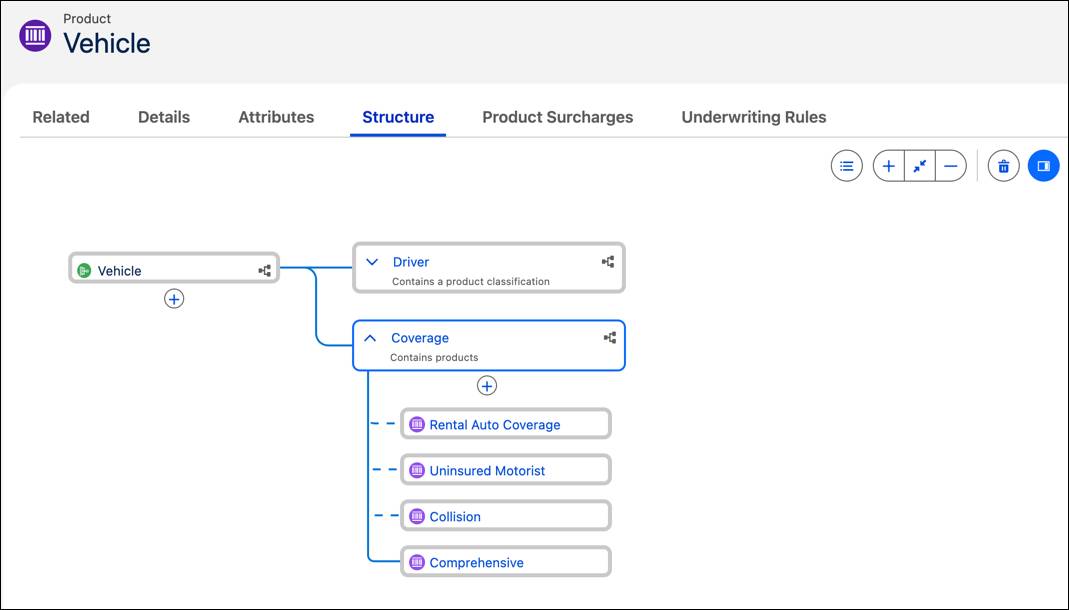
This structure supports real-world policies—multiple cars, multiple drivers, different coverages per vehicle—while keeping everything governed by a single product model.
Configure Product Rules
After the structure is in place, rules govern how an insurance product can be offered and configured. Rules control eligibility, guide valid selections, and route higher-risk cases to the correct level of review.
Justus configures three types of rules for Auto Gold.
-
Qualification rules control basic eligibility. For example, Auto Gold can be limited to drivers over a certain age and offered only in select states. Customers who don’t meet those criteria won’t see the product when quoting begins.
-
Configuration rules guide what can be selected during quoting. If a vehicle is classified as high horsepower, collision coverage can be automatically included and locked in. Other rules allow only the deductible and limit options the product permits together so users can’t build an invalid quote.
-
Underwriting rules determine whether a quote can be approved automatically or requires review. Standard risks can be auto-approved, while quotes involving recent violations or unusually high limits can be flagged for an underwriter.
Together, these rules keep quoting consistent and compliant, speed up routine cases through auto-approval, and still allow flexibility where it’s permitted.
Build Pricing Logic
Pricing translates risk inputs into a premium. Digital Insurance separates pricing data from calculation logic by using Business Rules Engine (BRE), which enables insurers to update rating factors and design pricing procedures without rewriting custom code.
Justus first creates decision matrices, which are structured lookup tables that translate real-world inputs into rating factors. Matrices can support many pricing needs across lines of business. An auto product might map driver age and driving history to risk tiers. A property product might adjust factors based on building characteristics. A territory matrix can apply modifiers based on where the risk is located, such as state, region, or ZIP code.
Here’s an example of a matrix that uses vehicle value to determine factors for collision and comprehensive coverage, which covers non-collision damage, such as theft, fire, or weather.
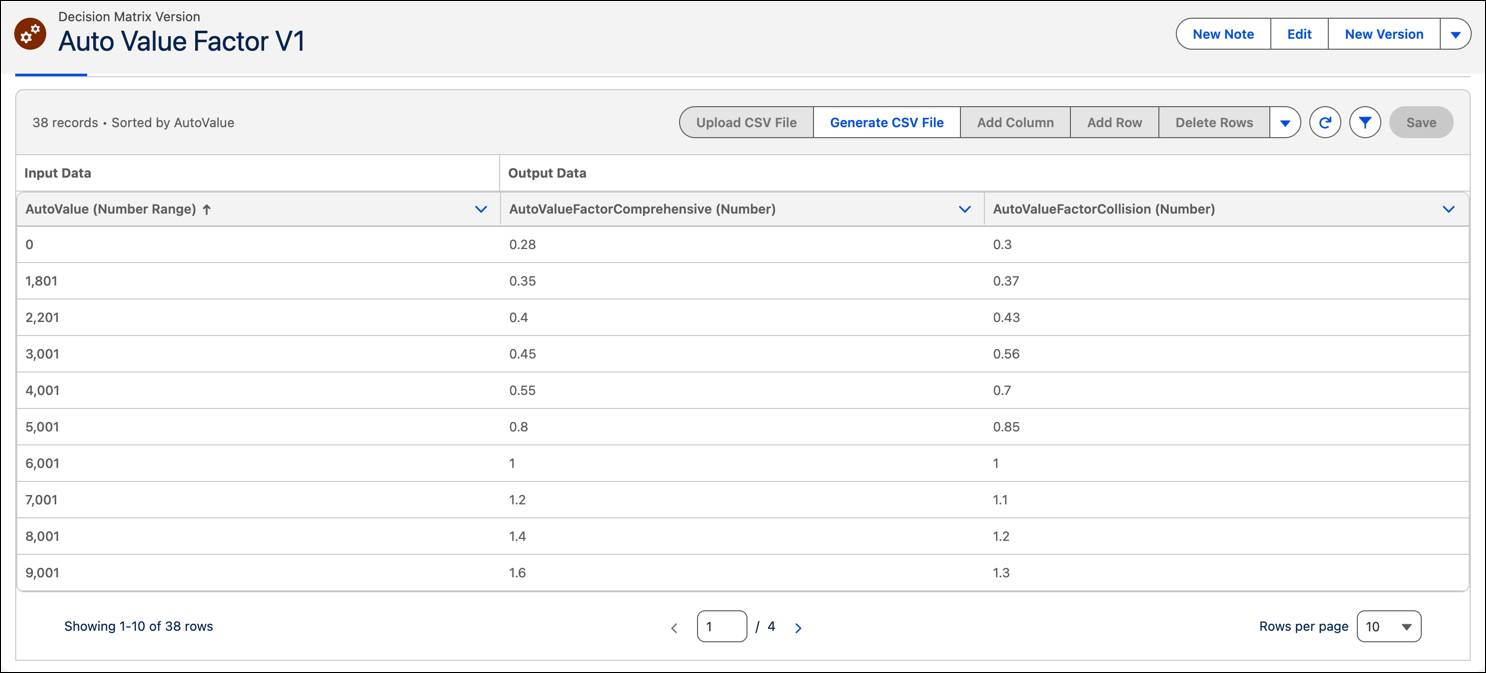
Each row represents a value range, with factors that adjust the premium. As vehicle value increases, the factor increases accordingly. These matrices are versioned and editable, so business teams can update them as pricing strategy changes.
After the matrices are in place, Justus assembles a pricing procedure, which is a structured sequence of steps that uses matrix outputs, formulas, and rollups to compute the premium.
The procedure first retrieves the applicable factors for each vehicle and driver.
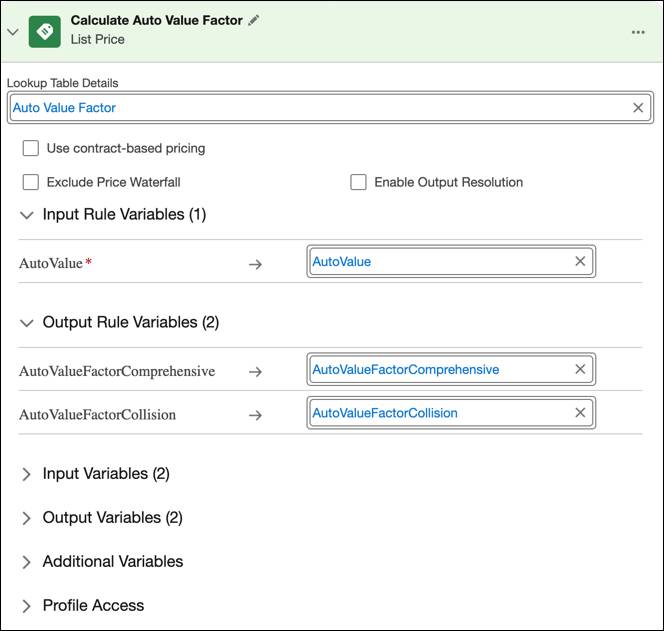
Next, the procedure applies formulas to calculate the premium for each selected coverage.
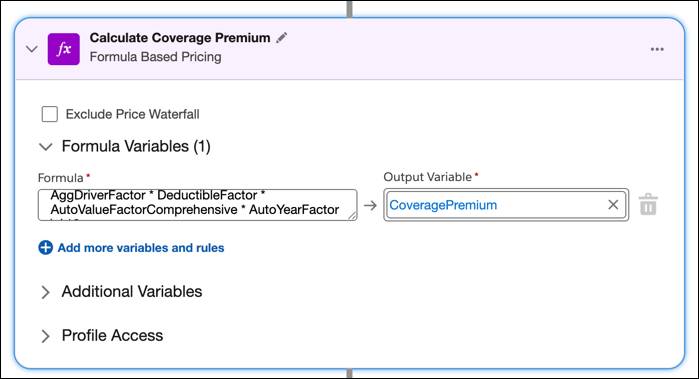
Finally, the procedure aggregates those amounts into a total policy premium for each vehicle.

Because the procedure is declarative and visual, Justus can simulate scenarios, validate the logic, and share the procedure with underwriters or actuaries. After being published, the same procedure powers real-time quoting in the UI and through APIs for other channels.
Apply Surcharges
To finalize the product, Justus adds any applicable taxes and fees.
He first defines surcharge records, which include the type, amount, and jurisdiction for each charge. These records are created once and can be reused across products.
Next, he uses rule logic to attach the appropriate surcharges to the Auto Gold product. For this product, a premium tax applies when the policy territory is California, while a service fee is added when collision coverage is selected with certain deductible options.
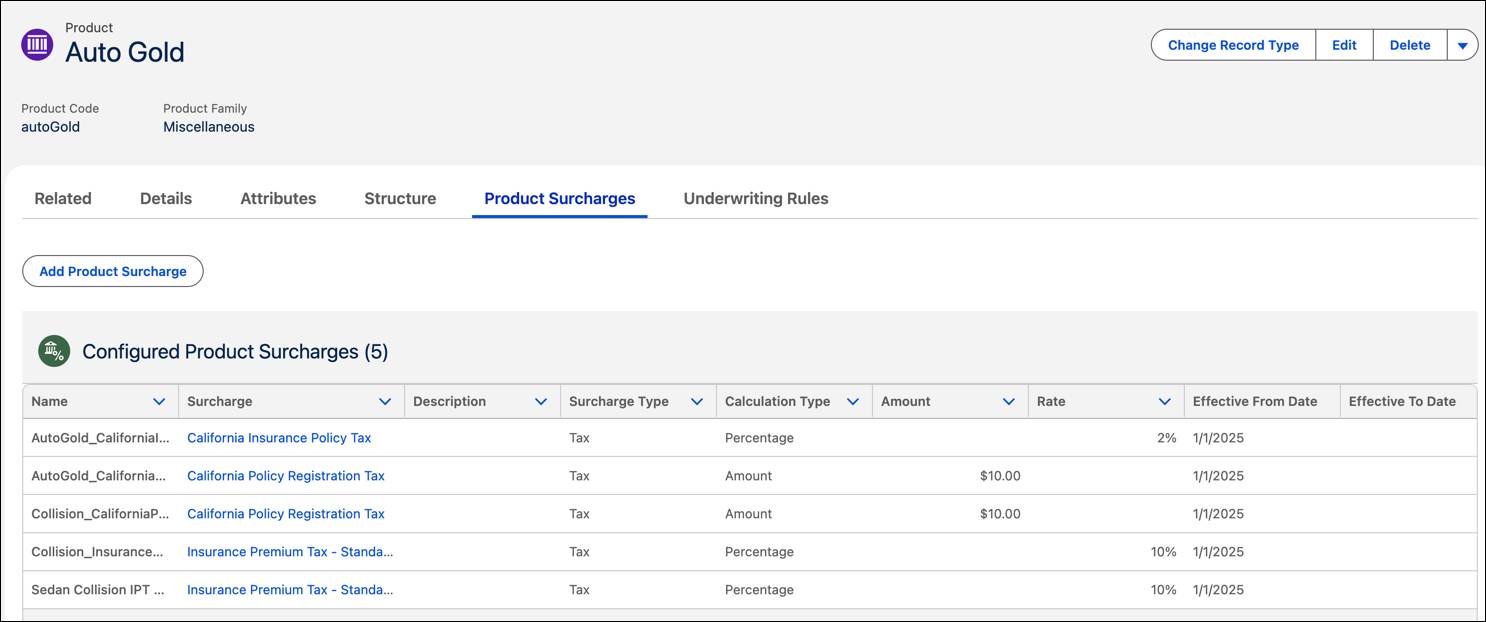
Because these surcharges are defined as reusable components, Justus can apply them to related auto products, or even to entirely different lines of business, with consistent results. During quoting and policy issuance, the correct charges are automatically applied based on the product and coverage selections.
What’s Next
You’ve now seen how to architect an insurance product from the ground up using Salesforce Digital Insurance. By combining a flexible product model with structured rules, pricing logic, and reusable surcharges, you don’t just build one product but define a blueprint.
That blueprint then becomes the foundation of your portfolio. The same components you used to launch one product can support regional variants, commercial policies, and other lines of business. Modeling products this way improves speed, reduces duplicated structure and rules, and ensures consistent product behavior across quoting, servicing, and claims.
In the next unit, explore how this foundation comes to life as producers, brokers, and customers use it to move from the first quote to a fully managed policy.