Define Data Enrichment
Learning Objectives
After completing this unit, you’ll be able to:
- Define data enrichment, and explain where it fits in the data quality lifecycle.
- Differentiate between different data enrichment sources.
- Distinguish enrichment of existing records from prospecting and net-new sourcing.

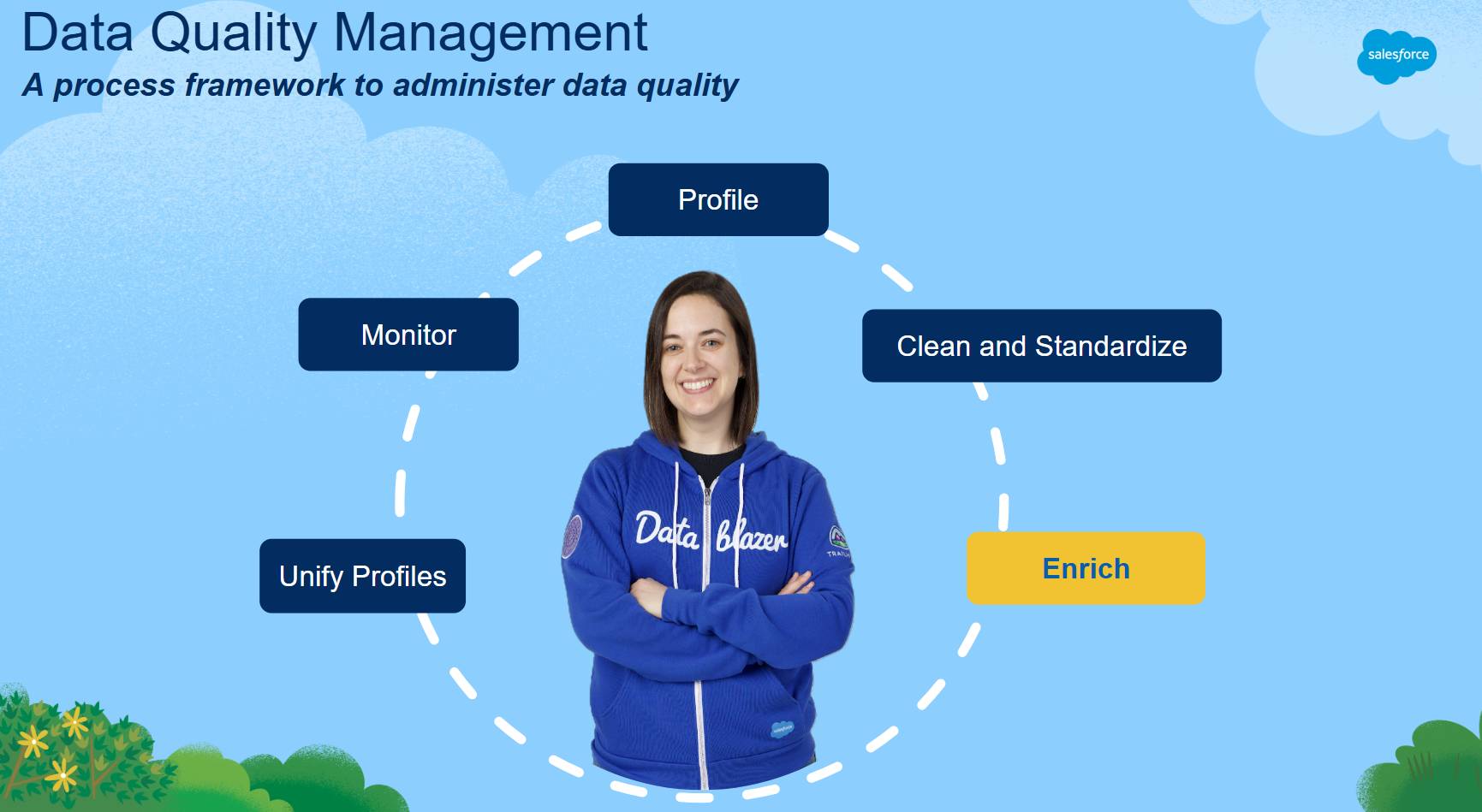
If you have taken Data Management Fundamentals, you learned that data quality management is a multistep process. In the Salesforce Data Quality Management framework, data enrichment is typically the third step.
What Is Data Enrichment?
Data enrichment is the process of improving existing data by adding information from another trusted data source to make it more complete, current, or useful.
Enrichment can be a one-time activity or part of an ongoing data stewardship process. Organizations often use enrichment after profiling and cleanup to identify gaps in customer understanding, but enrichment can also operate continuously to keep data current and reliable.
Common enrichment needs include:
- Missing values in key fields
- Outdated or stale information
- Limited detail that prevents effective decision-making
- Data that exists in other systems but isn’t available where it is needed
In the Data Quality Management framework, enrichment builds on profiling and cleanup activities by helping organizations improve data completeness, recency, context, and usability.
Examples of Data Enrichment
Different business needs require different types of enrichment. The goal is not simply to add more data, but to improve the organization’s ability to make accurate and timely decisions.
Business Need |
Enrichment Approach |
|---|---|
Customer service reps need to understand a customer’s total spend to prioritize support interactions. |
Calculate total lifetime value (LTV) using unified purchase and return history from systems such as CRM, commerce platforms, or a data lake. |
Physical mail must be deliverable to avoid wasted cost and failed outreach. |
Use postal code enrichment and deliverability assessment services to validate and standardize mailing addresses. |
Organizations need to know when customers moved to a new address. |
Use change-of-address reference services to identify newer addresses while preserving historical address information. |
Teams need to determine whether two business records represent the same organization across subsidiaries or locations. |
Use business registry or firmographic reference data to associate records with a common business identifier or parent hierarchy. |
Sales and marketing teams want more personalized engagement with businesses based on what they do and their size. |
Use firmographic enrichment services that provide granular industry classifications such as Standard Industrial Classification (SIC) or North American Industry Classification System (NAICS), along with employee and revenue bands. |
These enrichment activities help organizations improve customer understanding, increase operational efficiency, and support more reliable analytics, automation, and AI experiences.
Sources for Data Enrichment
Data enrichment can come from several types of sources, depending on the business need.
Enrichment Source |
Description |
Example |
|---|---|---|
First-party |
Data from your organization’s other systems. |
You can enrich CRM customer records with recent order history from Commerce Cloud so service reps can better understand customer activity. |
Second-party |
Business partner data shared through agreed collaboration models to improve customer understanding. |
You can enrich customer profiles with audience insights from a trusted business partner to enable more relevant segmentation and engagement. |
Third-party |
Specialized external data providers that maintain and deliver reference datasets as a service to improve validation, recency, business context, or risk understanding. |
You can enrich customer records with address validation and change-of-address data from a third-party provider to validate mailing addresses and identify customers who have moved. |
Calculated Insights as Enrichment
Calculated insights are a form of enrichment that derives new values from existing data, which can come from first-, second-, or third-party sources. They aggregate information across a customer’s unified profile to create reusable metrics, such as customer LTV.
For example, you might calculate LTV by combining purchase and return data.
- The transaction data can come from internal systems (first-party).
- It could be supplemented with partner or external data (second- or third-party).
- The final calculated value is then stored and used across systems.
Once calculated insights are stored in your systems, they become first-party data, even if they were derived from external sources. This distinction is important for governance, retention policies, lineage tracking, and downstream AI or analytics use cases.
Enrichment and Prospecting
Some data providers offer prospecting services alongside enrichment, but these services support different business goals. Understanding the difference helps teams choose the right approach for their business needs.
Prospecting focuses on identifying new people or organizations not already in your systems, so teams can expand outreach and make better business decisions, while data enrichment improves existing records for known customers, partners, or accounts.
Story: Why Northern Trail Outfitters Needs Data Enrichment
After profiling and cleansing your data, you might discover that some challenges still remain. That’s exactly what happens at Northern Trail Outfitters (NTO).
Following the Data Quality Management framework, Luna, a data architect at NTO, profiles the objects in scope for case deflection, prioritizes the highest-impact data quality issues, and cleanses unreliable or no longer relevant data.
Even after cleanup, Luna still identifies important gaps.
- Customer purchase history exists in other systems but is not available to service reps.
- Some customer addresses are no longer current.
- NTO can’t consistently relate business customers across subsidiaries and locations.
- Existing CRM industry classifications are too broad for personalized engagement.
When cleanup alone doesn’t resolve these issues, you can use enrichment to provide additional context and improve customer understanding. To close these gaps, Luna defines a data enrichment strategy that uses different enrichment approaches to support more reliable analytics, automation, and AI experiences.
- Luna recommends implementing Data 360 to provide a more complete understanding of customer cases and orders. This helps unify customer activity across systems through identity resolution.
- Luna recommends implementing a change-of-address enrichment solution to reduce data quality risks before identity resolution processing, so outdated addresses don’t weaken customer matching outcomes.
- Luna recommends implementing a shared LTV KPI, using calculated insights from Data 360 to create a trusted understanding of customer value across the enterprise.
These decisions help NTO better understand customers while supporting more reliable analytics, automation, and AI experiences.
Let’s Recap
Data enrichment improves customer understanding by adding or deriving information that makes data more complete, current, and useful for business outcomes. Organizations can use first-party, second-party, third-party, or calculated enrichment approaches depending on the need.
One of the most important enrichment areas is contact point data, where incomplete or unreliable email addresses, phone numbers, and addresses can lead to missed communications, incorrect identity resolution outcomes, and poor customer experiences.
In the next unit, you explore how contact point enrichment helps organizations improve customer context and reduce these risks.
Resources
- Trailhead: Data Profiling Fundamentals
- Trailhead: Data Cleanup Fundamentals
- Trailhead: Data 360 Insights
- Salesforce Ben Article: Guide to Data Management Tools on the AgentExchange
- AgentExchange: Data Enrichment Solutions
- AgentExchange: Prospecting Solutions
- Salesforce Help: Data 360 Prospecting Center
- IBM: What Is Data Enrichment?
- Informatica Blog: How to Improve Data Quality with Data Enrichment