Understand the Data Quality Management Process
Learning Objectives
After completing this unit, you’ll be able to:
- Outline the four phases in the Data Quality Management Process.
- Explain the six dimensions of data quality.
- Describe the services that support data quality work.
Data Quality Is a Practice, Not a Project
Jamal used to think of data quality as a one-time fix—something you clean up, check off, and move on from. But the more he learns, the more he understands that data quality is a continuous practice, not a destination.
New data arrives every day. Systems change. Records go stale. Without an ongoing approach, even clean data quickly becomes unreliable. That’s why Informatica Cloud Data Quality (CDQ) is built around a cyclical process—a continuous loop that keeps data quality actively managed.
The Data Quality Management Process
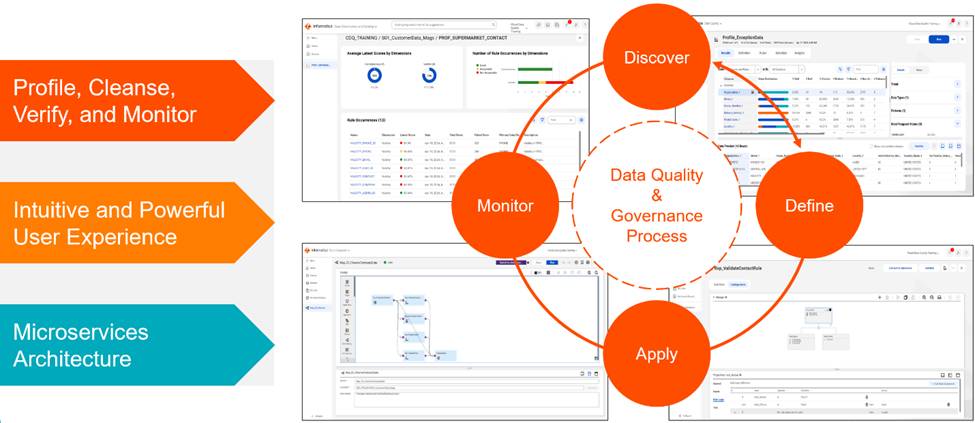
CDQ manages data quality in four repeating phases.
-
Discover: Before you can fix anything, you need to understand what you’re working with. You analyze your data sources to identify quality issues—missing values, format inconsistencies, duplicate records. Data profiling is the primary tool here.
-
Define: Once you understand the issues, you define the rules and standards your data must meet. You specify what valid values look like, what formats are acceptable, and what makes a duplicate record.
-
Apply: With rules defined, you apply them. CDQ’s cleanse, parse, verify, and deduplicate assets transform raw, inconsistent data into trusted, standardized information.
-
Monitor: Data quality doesn’t stay fixed on its own. You use scorecards and ongoing profiling to track quality trends over time, which catches new issues before they cause downstream problems.
This cycle—Discover, Define, Apply, and Monitor—repeats continuously, so your data quality improves and stays strong across the organization.
The Dimensions of Data Quality
How do you measure whether data is truly “good”? Informatica uses six key dimensions of data quality to assess and report on data health.
Dimension |
What It Measures |
|---|---|
Completeness |
Missing or unusable data |
Validity |
Data that conforms to defined business rules |
Consistency |
Data that gives conflicting information |
Accuracy |
Data that’s incorrect or out of date |
Uniqueness |
Repeated data records or attributes |
Timeliness |
Whether the data regularly updates to ensure it remains relevant |
For Jamal, these dimensions are a revelation. His customer count discrepancy? That’s a consistency problem. Undeliverable mail? Those are accuracy and validity issues. The inflated customer list? That’s a uniqueness problem. The dimensions give him a precise framework to diagnose each type of issue.
Data Quality Services
CDQ organizes its capabilities into focused services, each targeting a specific part of the data quality lifecycle.
-
Data Profiling: Analyzes data to assess completeness, validity, and consistency—this is your starting point for any DQ project.
-
Data Quality: The service where you create and manage DQ assets—dictionaries, rule specifications, labeler, cleanse, parse, verifier, and deduplicate.
-
Data Integration: Where you apply DQ assets inside mappings and mapplets to transform source data.
-
Data Governance and Catalog: This service supports scorecarding and organization-wide oversight of data quality trends.
-
Monitor: This service tracks the execution status of data quality profiles and mapping jobs.
Together, these services give Main Stage Analytics control over its data—from first discovery to ongoing monitoring.

It’s time to put the Data Quality Management Process into action. Next, you learn about the Discover phase and data profiles help you uncover hidden data quality issues.