Explore Data with the Discovery Agent
Learning Objectives
After completing this unit, you’ll be able to:
- Explain the three core skills of the Discovery Agent: data discovery, metadata exploration, and data exploration.
- Use natural language prompts to search for data assets across catalogs, databases, and repositories.
- Apply advanced search criteria such as owner, creation date, and data quality scores to target specific assets.
Before You Start
Before you start this badge, consider completing this recommended content.
Meet the Discovery Agent
You already know that the Discovery Agent is one of four specialized agents in CLAIRE GPT—the one that helps you find relevant data assets across your connected sources. In this badge, you explore in-depth how Discovery Agent works and how to get the most out of it.
Ana, the Cloud Kicks data analyst, now uses the Discovery Agent constantly. Follow along as she learns its core skills and starts to use more targeted prompts to narrow her search results.
The Three Core Skills of the Discovery Agent
The Discovery Agent achieves your data goals through three distinct skills, each suited to a different stage of how you find and understand data.
-
Data discovery helps you quickly and easily find assets across connected services like Data Governance and Catalog, Data Integration, Data Marketplace, and MDM SaaS. This is the starting point for almost any question, since you usually need to locate an asset before you can do anything else with it.
-
Metadata exploration helps you search and understand the metadata of an asset once you’ve found it—things like its owner, lineage, data quality score, and relationships to other assets. This skill answers the questions “Can I trust this?” and “Where did it come from?”
-
Data exploration helps you understand the quality and shape of your source data. It lets you explore actual field values and identify anomalies. This skill gets you closest to hands-on analysis since it works with the real data inside an asset rather than just information about the asset.
When Ana wants to segment Cloud Kicks’s customers, she starts with data discovery to find candidate datasets, uses metadata exploration to check their data quality scores and confirm they’re certified, and finally uses data exploration to look at the actual customer records before building her segmentation.

Search with Natural Language
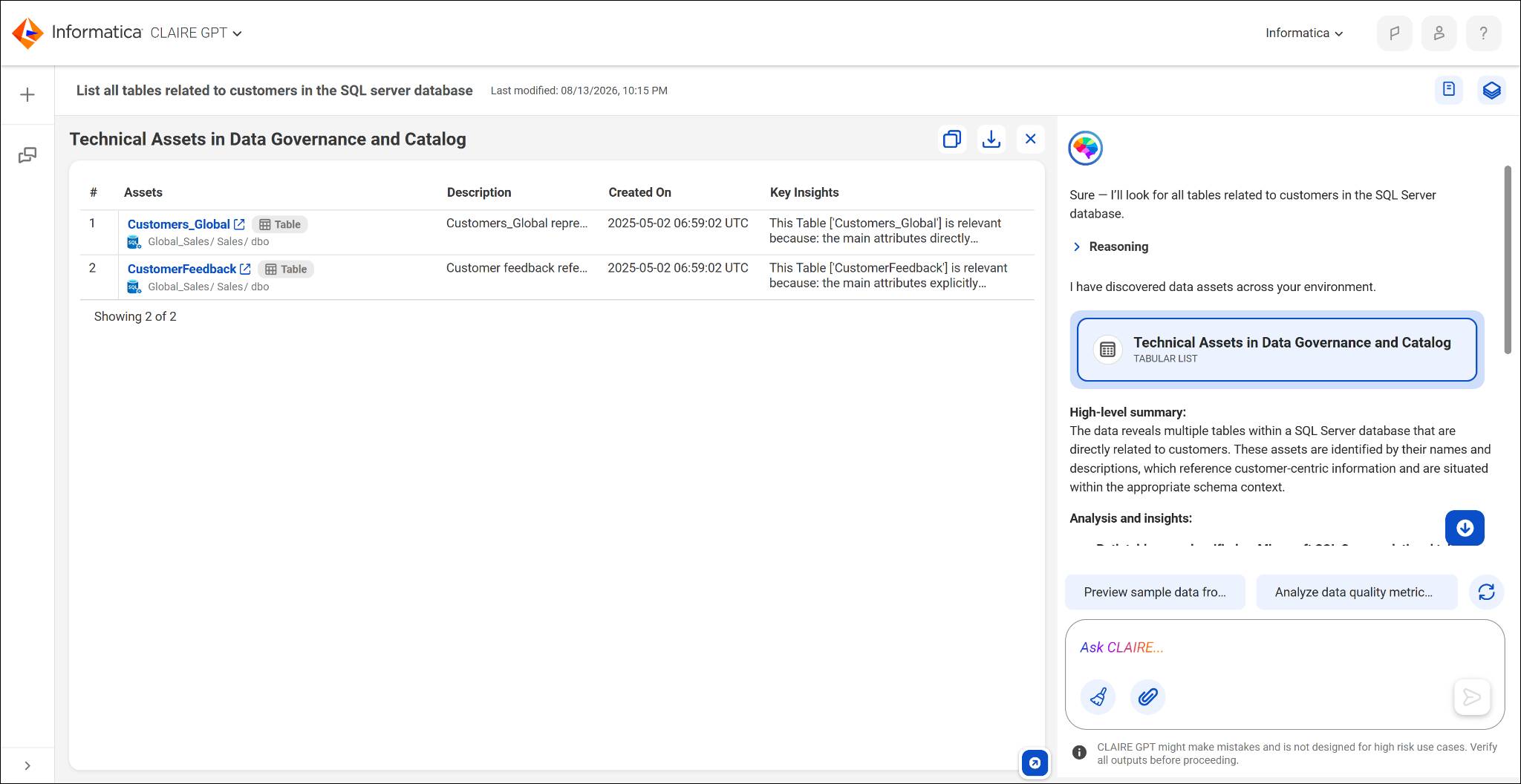
Ana doesn’t need to know exact table names or which system holds her data. She can type a plain-language request, and the Discovery Agent searches across catalogs, databases, and repositories to find what’s relevant.
For example, when Ana wanted to find datasets suitable for customer segmentation, she asked CLAIRE GPT to help her identify them. The Discovery Agent returned two certified customer datasets and a card she could open to see them in a table.
This matters because Ana’s day-to-day questions rarely start with a table name. They start with a business goal, like segmenting customers or reporting on regional sales. The Discovery Agent is built to translate that goal into a search across Intelligent Data Management Cloud (IDMC).
Target Assets with Advanced Search Criteria
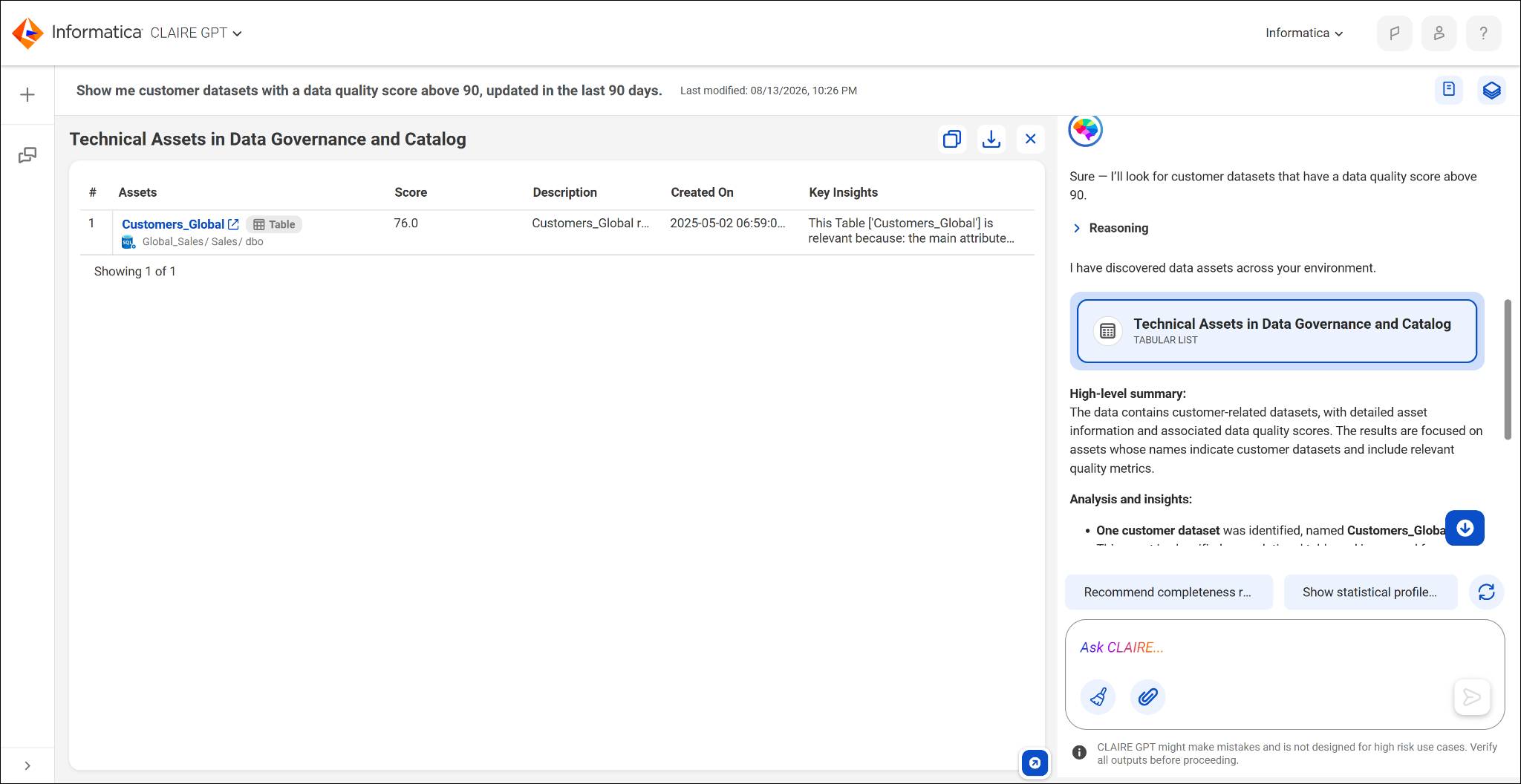
Once Ana is comfortable with basic natural language search, she sharpens her results using more specific criteria. The Discovery Agent understands prompts that reference an asset’s owner, its creation or update date, and its data quality score. This lets Ana narrow a broad set of results down to exactly what she needs.
For example, instead of asking generally for customer datasets, Ana asks for customer datasets owned by a specific team, created within the last quarter, or with a data quality score above a certain threshold. Note that some search behaviors have known limits: Queries based on creation or update dates may return inaccurate results. With this in mind, Ana double-checks date-based results against the metadata view before she relies on them for a report.
Example prompt:Show me customer datasets with a data quality score above 90, updated in the last 90 days.
Wrap-Up
With the help of core skills and search techniques in Discovery Agent, you’re ready to move from a vague question to a specific, trustworthy dataset. In the next unit, you learn how to use that dataset to start the analysis.