Manage Assets, Warranties, and Inventory
Learning Objectives
After completing this unit, you’ll be able to:
- Explain how the Automotive Asset Service Management agent supports asset and vehicle service management.
- Describe how the Automotive Warranty Claims Assistance agent assists with warranty claims processing.
- Identify how the Inventory Management agent keeps service teams equipped with the right parts.
- Explain how the three agents work together across the service lifecycle.
Overcome Asset, Warranty, and Inventory Challenges
Post-sales service is where customer loyalty is won or lost. Service teams often struggle with delays because they have to manually connect real-time telematics alerts to warranty rules, autopart compatibility checklists, and historical customer claims. Requiring service reps to click through dozens of screens across systems leads to longer resolution times and frustrated customers.
In this unit, you explore how three Automotive agents support this work: Automotive Asset Service Management, Automotive Warranty Claims Assistance, and Inventory Management.
Manage Service Estimates with Automotive Asset Service Management Agent
Before a repair begins, a service advisor reviews vehicle history, checks warranty coverage, and prepares a quote. These tasks often span several systems.
The Automotive Asset Service Management agent brings the service information and related tasks into one conversational flow. For example, a service advisor receives a telematics alert about repeated battery charge-cycle anomalies. The advisor asks the agent to retrieve the vehicle’s service history, open recalls, and related maintenance gaps. The agent checks applicable warranty coverage, applies the approved labor rate, and generates a service quote.
This shows the agent generating the quote for the vehicle.
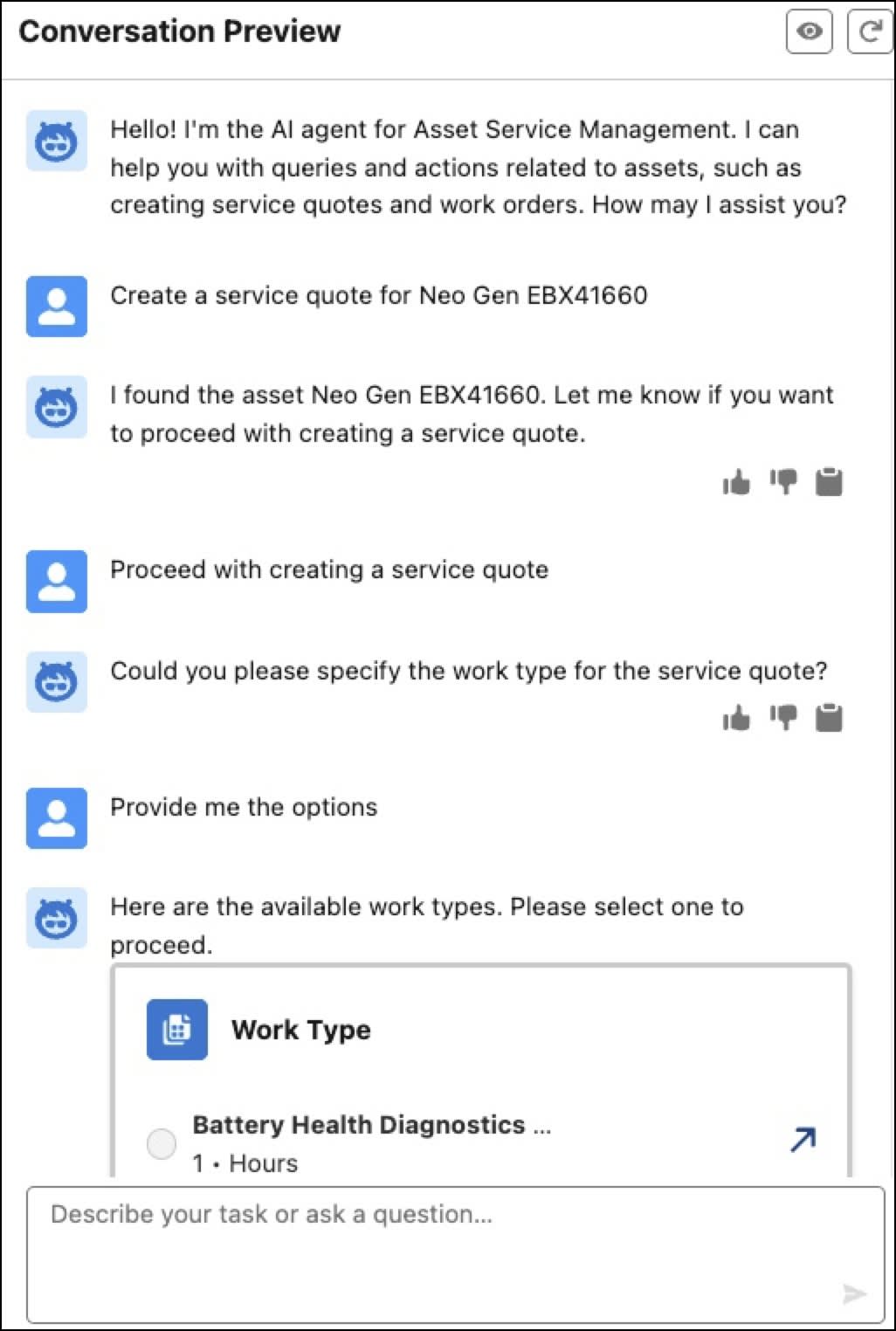
Two specialized subagents manage the process. Vehicle Service Estimation summarizes asset performance and telematics data, generates accurate service quotes, and drafts customer emails to streamline communication. Vehicle Service Work Order Management handles the rest of the end-to-end workflow. It uses the service quotes to autonomously create the necessary work orders and draft follow-up communications for the customer.
Handle Claims with Automotive Warranty Claims Assistance Agent
Warranty claims slow down when analysts manually verify coverage rules, look up part eligibility, and track claim status across systems. The Automotive Warranty Claims Assistance agent brings the full claims workflow into a single conversational flow.
For example, a dealer submits a warranty claim for a customer whose steering column failed while still under standard coverage. The warranty analyst asks the agent to summarize the claim and check coverage. The agent provides the claim details and validates coverage in one view. The analyst then asks it to verify part eligibility for the replacement column and update the claim status based on the coverage outcome.
Behind the scenes, the Automotive Warranty Claims Assistance subagent manages the full claims process such as warranty claim summaries, coverage validation across vehicles, assets, and dealer networks.
Automotive Warranty Claims Assistance for Partners extends these same capabilities to partner dealerships through Experience Cloud. Dealers can validate warranty coverage and manage claims directly, without routing every query through the OEM service team.
Track Stock with Inventory Management Agent
You can’t repair a vehicle without the right parts. The Inventory Management agent helps service and inventory managers track product availability and coordinate part transfers. Instead of manually searching through warehouses and dealer lots across different systems, service teams always have what they need to fulfill a work order.

Consider this example. A service manager notices a brake job scheduled for later in the week but isn’t sure if the right parts are in stock. The manager asks the agent to check availability for the brake caliper assembly across nearby locations and flag any shortfalls. The agent surfaces the stock summary, identifies a gap at the Chicago service center, and initiates a transfer request.
A Connected Service Experience
One service case shows how the three agents support different stages of the work.
It’s Tuesday morning at a dealership service center, and the team is working through a full schedule of repairs and inspections. A service advisor spots a telematics alert on a customer’s commercial van flagging a coolant anomaly. The advisor asks the Automotive Asset Service Management agent to pull the vehicle’s service history, identify any related maintenance gaps, and generate a quote for a coolant system inspection.
Before the repair begins, the inventory manager uses the Inventory Management agent to check stock across nearby locations. The agent identifies a shortfall at the service center and initiates a transfer request in time for the scheduled repair.
After the repair, the customer raises a question about warranty coverage on a related component. The warranty analyst uses the Automotive Warranty Claims Assistance agent to summarize the claim, validate coverage, and update the claim status.
Together, these agents keep a service case moving from first alert to final resolution. And that’s where customer loyalty is won.
Next Up
In this unit, you explored how service focused agents work together to reduce manual effort and keep the service lifecycle moving from first alert to final resolution. In the next unit, you explore how agents optimize automotive finance and channel revenue.