Create Your Learning Data
Learning Objectives
After completing this unit, you’ll be able to:
- Describe how the Learning Wizard helps you to build learning programs and courses.
- Explain how to create program plans with Program Plan Builder.
- Review examples of data model configurations.
Planning Your Learning Data Model
You now know that the Learning Data Model includes many objects that strengthen and simplify academic operations at your institution. But how do you go about building out your own institutional data? Because institutions offer different types of curriculum, Agentforce Education is purposefully designed to be flexible, meaning that you can configure your own data structure in a way that best fits the needs of your staff, faculty, and students.
Flexibility is always great, but it can also be a little intimidating. How can you create a model that best supports your academic operations? How do you make it scalable and future-proof? In this unit, we go over a few examples of curriculum configurations to give you some inspiration.
First, take a moment to explore the different tools for building out learning courses, programs, and program plans. The Academic Operations app includes two helpful tools for constructing your curriculum: the Learning Wizard and Learning Program Plan Builder.
The Learning Wizard
With the Learning Wizard, you can create and modify your learning programs and learning courses. The tool also makes it easy to structure the order of learning by configuring prerequisites, corequisites, and recommended courses.
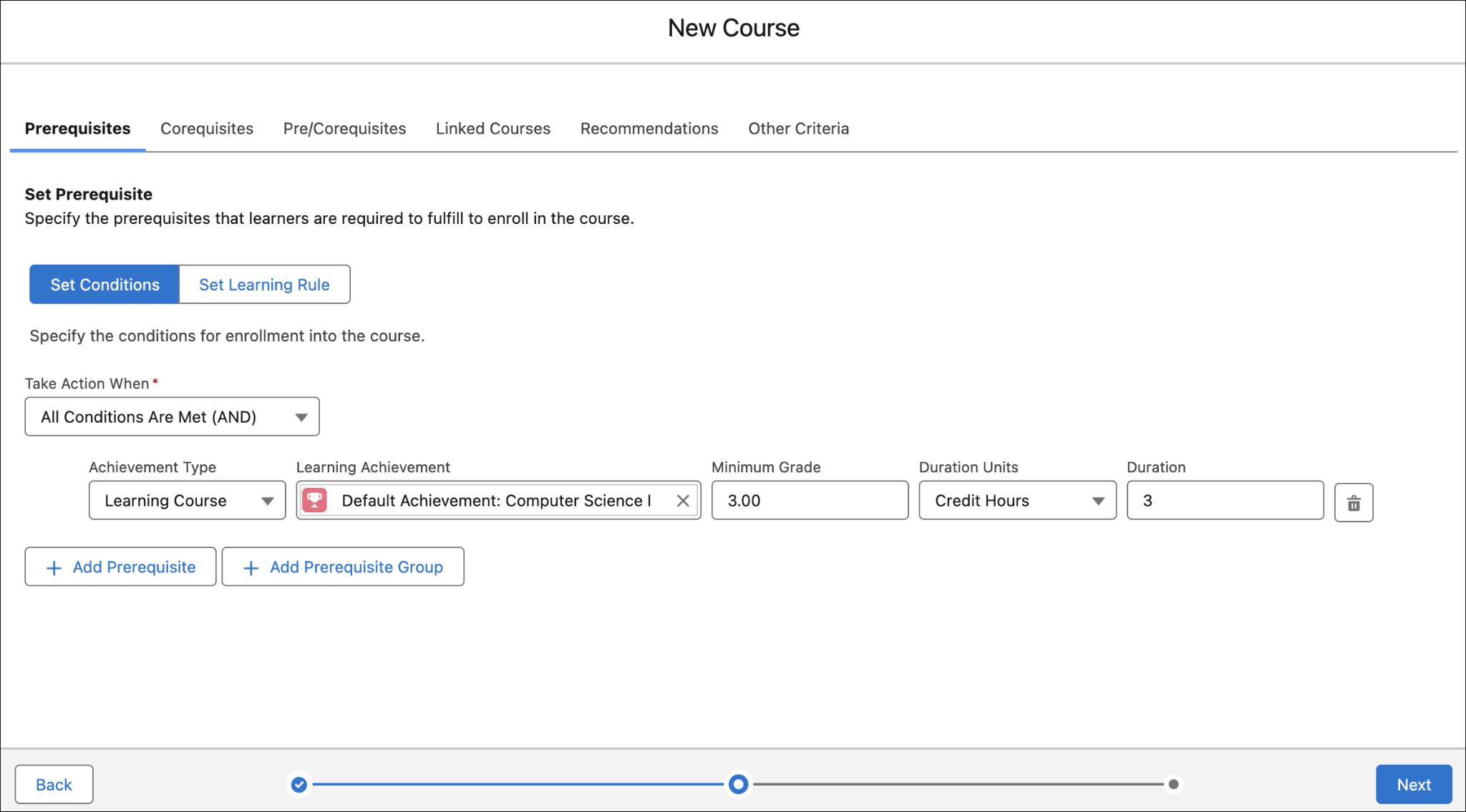
For each prerequisite, corequisite, or recommendation, you can add conditions to specify required minimum grades and durations. You can also map a set of outcomes to each program or course, and use Einstein Skills Generator to surface relevant skills for each offering.
Program Plan Builder
After using the Learning Wizard to shape your learning programs, use the Program Plan Builder to create, manage, and visualize your learning program plans.
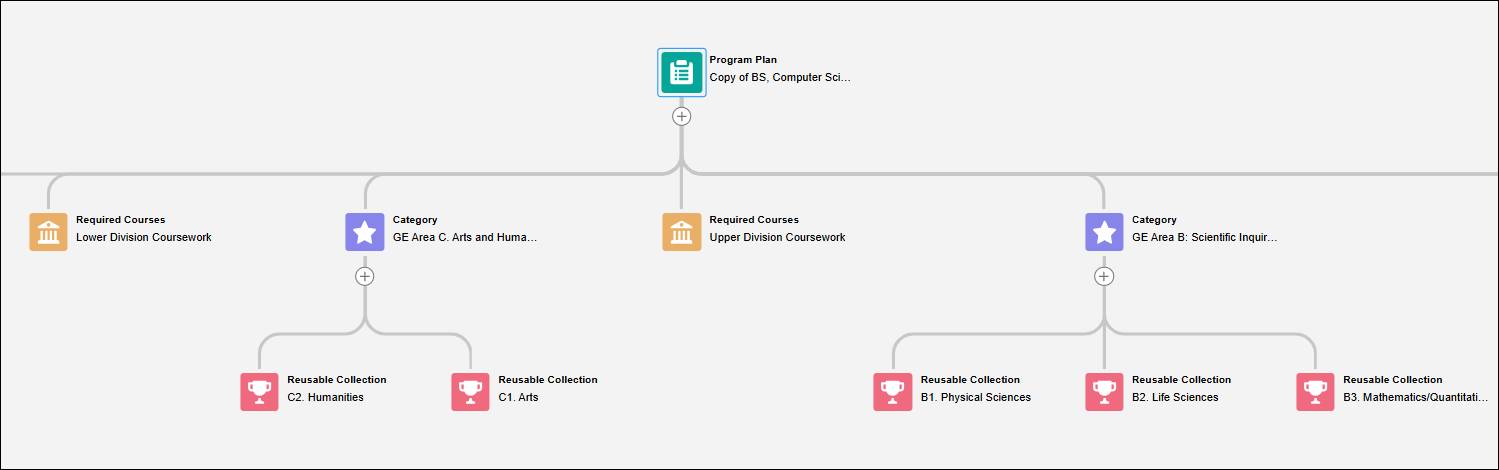
With the builder, you can organize the specific requirements of your program plans and configure variations of each plan to account for different tracks or versions across academic years or accreditation cycles. If a series of courses is required for multiple program plans, such as core curriculum, you can build a reusable collection of the courses and then quickly apply the collection to each plan.
To learn more about the Learning Wizard and Program Plan Builder, visit the Academic Operations App article in Salesforce Help.
With these tools, you can quickly build out your curriculum structure, but what does that structure look like? Well, it depends on your institution.
Implementation Inspiration
These days, academic institutions differ significantly, and the subject, scope, and format of their educational offerings are tailored to best fit the needs of their students. While some institutions offer traditional on-campus graduate and undergraduate programs, others enable busy adults to build their skills through professional workshops or microcredentialed online programs. The good news is that the Learning Data Model is built to enhance your academic operations, no matter what types of programs or accreditations you offer.
Let’s explore a few examples of how different types of institutions model their offerings using the Learning Data Model objects. As you look through these examples, consider which approach might make the most sense for your institution.
Example A: Traditional Undergraduate Degree
Astro University is a traditional college that offers both graduate and undergraduate degrees in a wide array of disciplines. Here’s how they model a Computer Science undergraduate degree program.
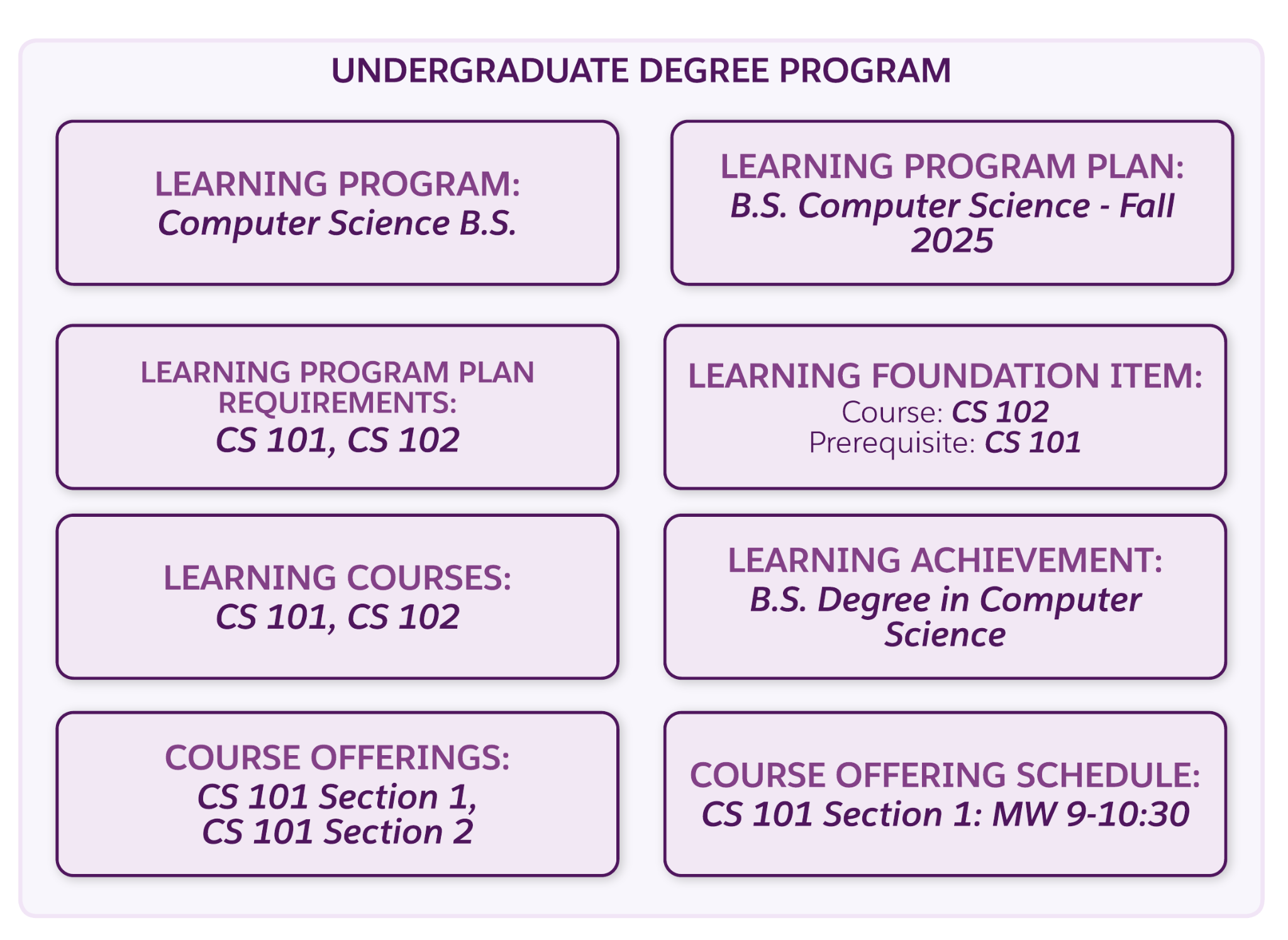
Object |
Details |
|---|---|
Learning, Learning Program |
Computer Science BS |
Learning Program Plan |
BS Computer Science–Fall 2025 |
Learning, Learning Courses |
CS 101, CS 102 |
Course Offering |
CS 101 Section 1, CS 101 Section 2 |
Course Offering Schedule |
CS 101 Section 1: Mondays and Wednesdays, 9–10:30 |
Learning Program Plan Requirements |
CS 101, CS 102, other required and elective courses |
Learning Foundation Items |
CS 101 is a prerequisite to CS 102. |
Learning, Learning Achievement |
Bachelors of Science in Computer Science |
Example B: Certificate or Microcredential
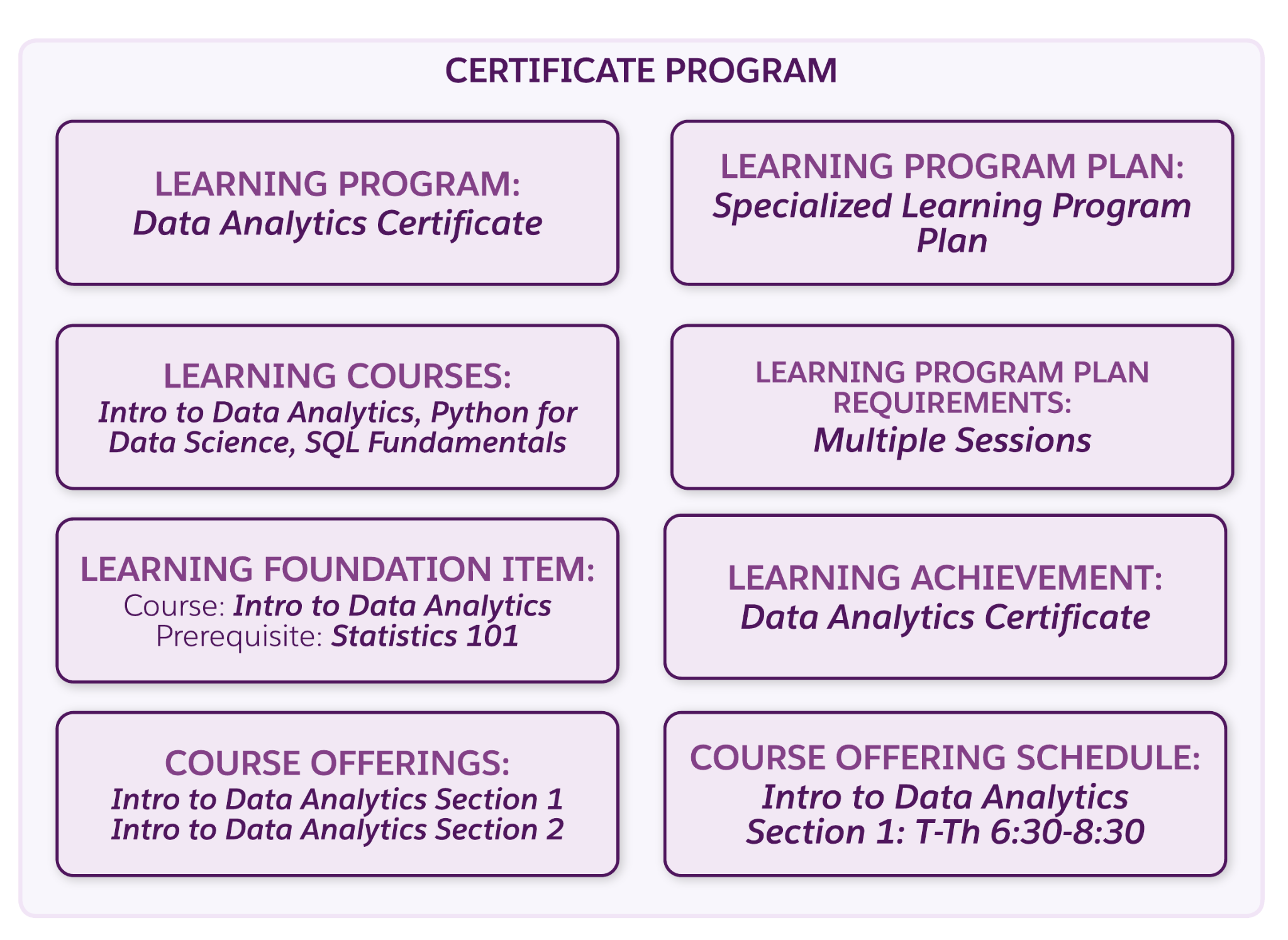
A technical college specializes in self-paced online certification courses, through which continuing education students can earn certificates or microcredentials in various subjects. Check out how they structure one program in particular: a Data Analytics certificate program.
Object |
Details |
|---|---|
Learning, Learning Program |
Data Analytics Certificate |
Learning Program Plan |
Specialized Learning Program Plan |
Learning, Learning Courses |
Intro to Data Analytics, Python for Data Science, SQL Fundamentals |
Course Offering |
Intro to Data Analytics Section 1, Intro to Data Analytics Section 2 |
Course Offering Schedule |
Intro to Data Analytics Section 1: Tuesdays and Thursdays, 6:30–8:30 |
Learning Program Plan Requirements |
Learners must complete multiple sessions to earn the certificate. |
Learning Foundation Items |
Prerequisites for the program include a basic statistics course. |
Learning Achievement |
Data Analytics Certificate |
Example C: Professional Workshop
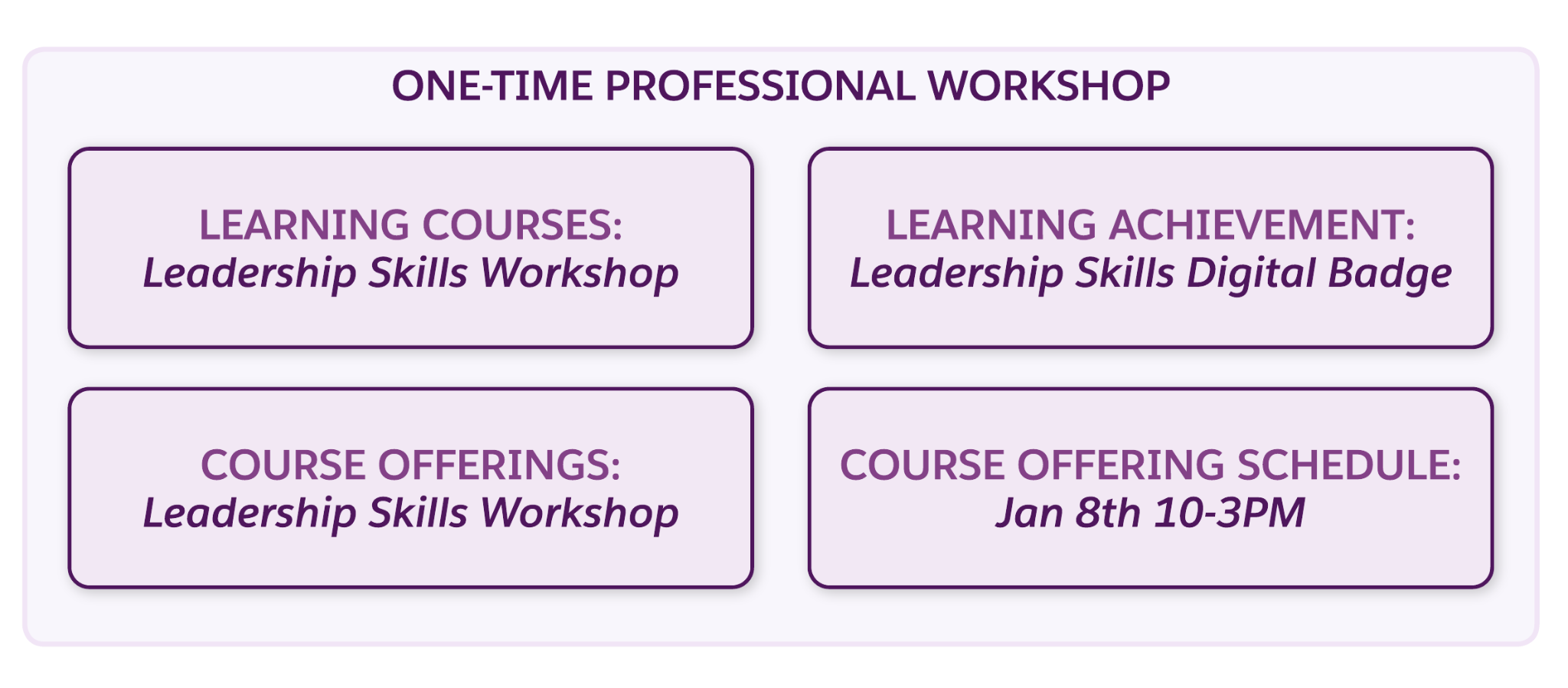
As a final example, consider how a corporate training center models a one-time professional development workshop that provides leadership training for adult learners.
Object |
Details |
|---|---|
Learning, Learning Courses |
Leadership Skills Workshop |
Course Offering |
Leadership Skills Workshop (one section) |
Course Offering Schedule |
Leadership Skills Workshop: January 8, 10–3 PM |
Learning, Learning Achievement |
Leadership Skills digital badge |
Notice that, unlike the previous examples, this simple structure includes only a Learning Course and a Learning Achievement record. If the training center decides to add more sessions to its curriculum later, they can create a learning program, include additional learning courses, and map the program plan requirements. If needed, they can also define prerequisites by using learning foundation items.

In this unit, you explored examples of how to configure a curriculum using the Learning Data Model. The main takeaway is that the model is flexible and supports all kinds of structures to align with the various types of learning experiences that institutions provide.
Next, you learn the best practices for configuring your data and the reporting and analytics capabilities included with Agentforce Education.