Build an Evidence-Based Enrichment Strategy
Learning Objectives
After completing this unit, you’ll be able to:
- Use stakeholder input and data profiling to determine whether enrichment is needed.
- Evaluate and select enrichment solutions using an evidence-based methodology.
- Distinguish between one-time and ongoing enrichment strategies.
Detect and Decide: Identify When Enrichment Is Needed
Enrichment can improve data reliability, but it also introduces cost, governance requirements, and operational decisions. In this unit, you learn how to recognize when enrichment is needed and how to choose an enrichment approach with evidence rather than assumptions.
At Northern Trail Outfitters (NTO), Luna previously helped the B2B sales and partner management teams evaluate and implement a firmographic enrichment strategy.
Sales leaders wanted better segmentation and more personalized engagement for retailers, distributors, and franchise partners. However, NTO’s existing CRM data lacked sufficient reliable industry and company information to consistently support these goals.
Rather than immediately purchasing enrichment data, Luna followed an evidence-based process.
- Confirm the problem using stakeholder feedback and data profiling.
- Evaluate enrichment providers based on business and technical requirements.
- Compare profiling results from before and after enrichment to determine the enrichment solution’s value.
- Determine how often data enrichment should occur.
- Make enriched data accessible across systems and processes.
Luna now shares this same process with other teams at NTO so they can evaluate enrichment opportunities more consistently across customer service, analytics, operations, and AI initiatives.
Step 1: Confirm the Problem
Data quality issues are typically identified in two ways.
- Stakeholders report operational problems or missing context that impact business processes or decision-making.
- Data stewardship and monitoring activities reveal gaps in completeness, inconsistent values, or other reliability concerns.
Data profiling is then used to validate whether the issue exists and measure its impact. Potential issues include:
- Low fill rates in important fields.
- Shared or unreliable contact points.
- Overly broad classifications.
- Missing organizational relationships.
- Inconsistent or conflicting values across systems.
If the issue can’t be confirmed or doesn’t show a meaningful impact, document the findings, defer enrichment, and continue monitoring.
NTO Investigates the Problem
At NTO, sales and partner teams report that account segmentation is inconsistent, and personalization of outreach is limited because many account records contain incomplete or overly broad industry information.
Luna analyzes the data profiling results to validate the issue. She notices that the Industry field has a low fill rate and limited distinct values, making it difficult to support more granular segmentation and engagement strategies.

For example, the Industry field on the Account object is not only sparsely populated (14%), but it has few distinct values (7). This indicates it’s not sufficiently granular to differentiate retail stores from clothing stores.
By combining stakeholder feedback with profiling evidence, Luna confirms that this is a high-impact problem worth addressing through enrichment.
Step 2: Evaluate Enrichment Providers
Once the problem is understood, enrichment solutions are assessed based on key criteria.
-
Security and compliance: Does the solution align with the required security controls, data-handling expectations, and regional compliance requirements?
-
Granularity of data: Does the solution provide the level of detail needed to improve decisions (for example, more specific classifications or stronger validation signals)?
-
Breadth and coverage: Does the solution cover the relevant geographies, industries, and record types in scope?
The goal is not simply to add more data, but to add trusted and actionable context that improves business outcomes.
NTO Evaluates Firmographic Enrichment Providers
Luna evaluates several firmographic enrichment providers that offer:
- Detailed industry classifications, such as the Standard Industrial Classification (SIC) or the North American Industry Classification System (NAICS).
- Company size and revenue information.
- Parent and subsidiary relationships.
- Geographic and organizational hierarchy data.
She prioritizes providers that maintain authoritative reference datasets and support the industries and regions most important to NTO’s business.
Step 3: Compare Profiling Results to Measure Value
Before selecting a solution, it should be tested on a sample that reflects the data issues validated in the first step. A strong sample includes active, operationally important records, focuses on known data gaps, and is large enough to be meaningful but small enough to evaluate efficiently.
A strong sample set is:
-
Relevant: Includes active customers and operationally important records.
-
Targeted: Includes records with the specific gaps you’re trying to fix.
-
Right-sized: Large enough to be meaningful, but small enough to evaluate efficiently.
Data profiling before and after enrichment helps teams measure whether enrichment improves completeness, usability, segmentation, matching, and business outcomes.
NTO Tests Their Enrichment Solution with a Sample
Luna selects a representative sample of account records with incomplete information on industry and company.
After applying the enrichment solution, she reprofiles the same records and compares the results.
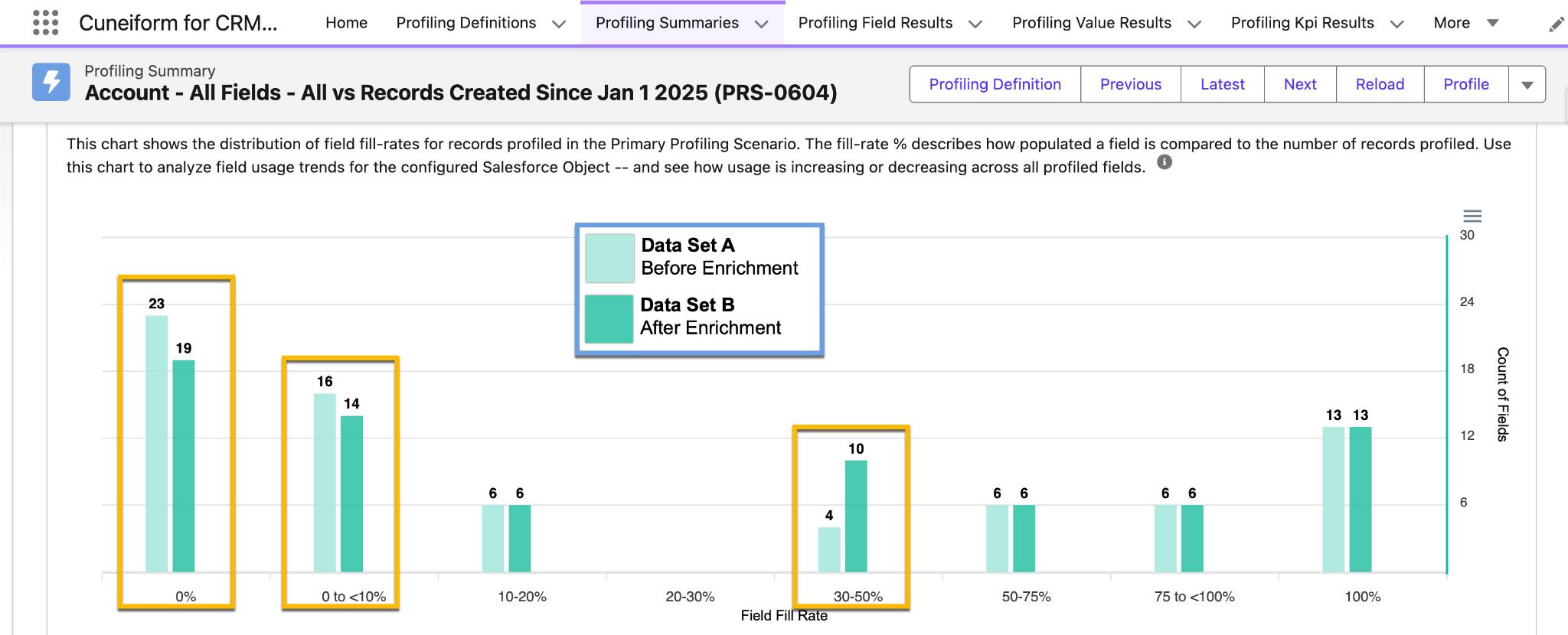
The comparison shows measurable improvements in the six key fields that were never or rarely populated in the past: Standard Industrial Classification (SIC) and North American Industry Classification System (NAICS) industry codes and descriptions, revenue, employees, and company identifiers. Luna configures the enrichment solution to update these fields on the Account object. After the enrichment, Luna confirms that six fields went from less than 10% to almost 50% populated—a meaningful improvement.

This step provides clear evidence to Luna that the solution improves outcomes and justifies the investment.
Step 4: Determine How Often Data Enrichment Should Occur
After selecting a solution, teams must determine whether enrichment should be applied once or maintained continuously.
One-time enrichment is useful when:
- Historical records need a baseline improvement.
- The data changes infrequently.
- Another system will become the ongoing source of truth.
Ongoing enrichment is more appropriate when:
- Data changes frequently over time.
- External providers continuously maintain the reference data.
- Business processes depend on current information.
For example, company hierarchies, industry classifications, business ownership, and risk indicators can change over time and require periodic refresh.
NTO Operationalizes Ongoing Enrichment
Because firmographic and organizational data changes over time, Luna recommends that this data be periodically refreshed with enrichment to keep account segmentation and relationship data current.
This ensures that the enriched business context remains reliable for sales planning, analytics, automation, and AI experiences.
Step 5: Make Enriched Data Accessible Across Systems
After enrichment is applied, it must be operationalized across the systems and workflows that depend on it. This can include:
- CRM interfaces
- Automation workflows
- Analytics and reporting
- Customer segmentation
- AI and recommendation systems
Teams should also track:
- The enrichment source
- When enrichment was last refreshed
- Which records were enriched
- How enrichment impacts downstream processes and decisions
This supports governance, troubleshooting, lineage tracking, and ongoing stewardship.
NTO Ensures Data Enrichment is Accessible
At NTO, enriched firmographic data is made available across CRM, reporting, segmentation, and planning workflows.
Sales and partner teams can now:
- Segment accounts more effectively.
- Coordinate engagement across related organizations.
- Improve territory planning.
- Support more relevant analytics and AI-driven experiences.
Luna combined profiling, enrichment, measurement, and operationalization, which helps NTO build a more trusted, actionable understanding of its business relationships.
Sum It Up
As Luna has shown at NTO, data enrichment helps turn incomplete and inconsistent data into a trusted foundation for decision-making. By combining internal and external data, validating it with evidence, and making it usable across systems, NTO can better understand and engage with its customers.
Ready to learn more? Dive deeper with Customer Context and Profile Unification Fundamentals in the Explore Data Quality Fundamentals trail.