Identify Why Customer Profiles Become Fragmented
Learning Objectives
After completing this unit, you’ll be able to:
- Identify common causes of fragmented customer understanding.
- Distinguish between intentional duplicates, unintentional duplicates, disconnected records, and invisible duplicates.
- Explain why customer profiles must be complete, contextual, and compliant.

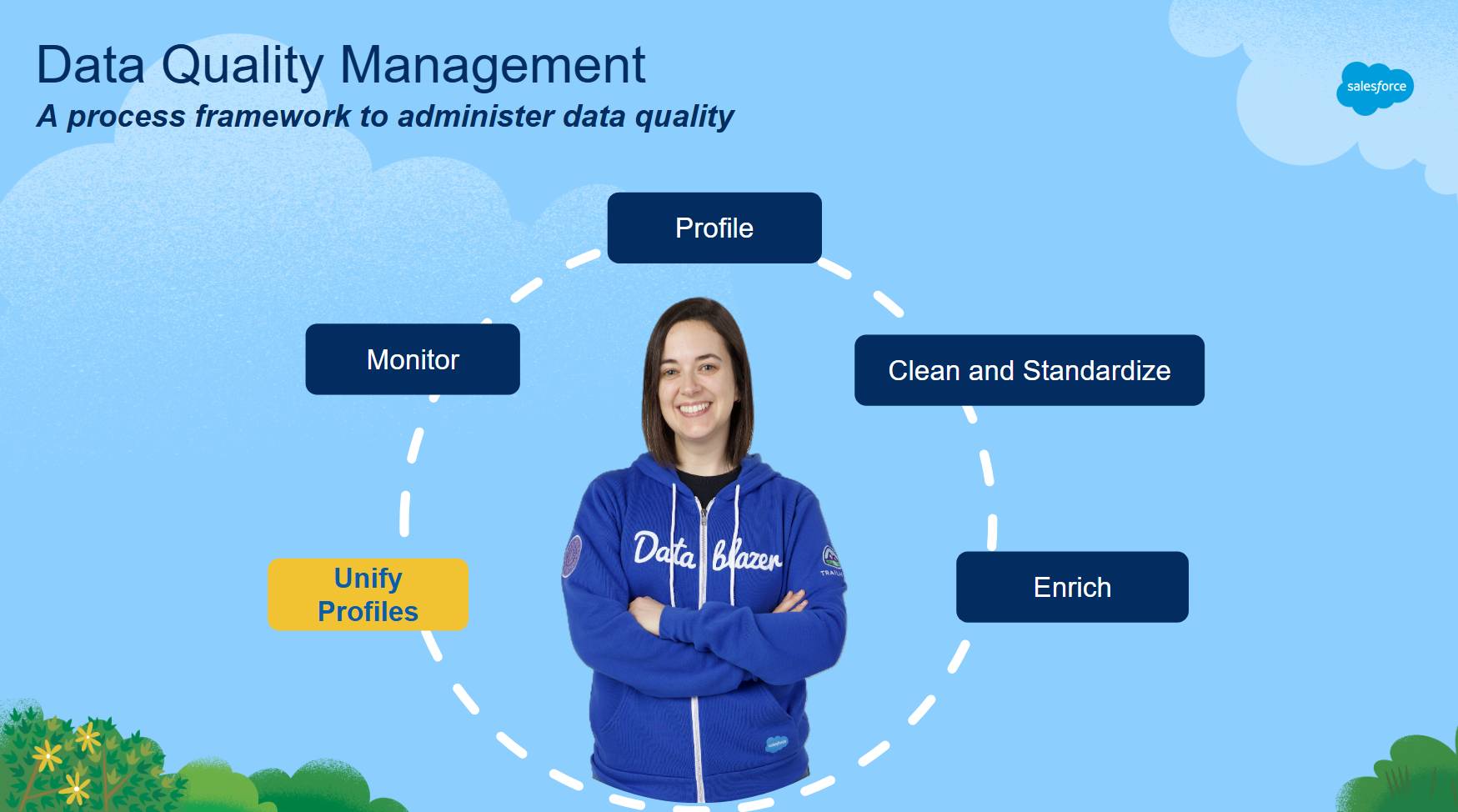
If you have taken Data Management Fundamentals, you learned that data quality management is a multistep process. In the Salesforce Data Quality Management framework, unify profiles is the fourth step, which occurs after enrich data.
What Is a Customer Profile?
A customer profile is the collection of information an organization uses to recognize, understand, and engage with a person or organization. In Salesforce environments, this information often spans multiple objects, channels, and systems, including CRM records, service interactions, orders, and digital experiences.
This information rarely resides in a single place or follows a single lifecycle. Even well-managed orgs can struggle to maintain a reliable understanding of who a customer is and how to engage them, which leads to a fragmented view of the customer caused by context gaps.
Complete Customer Information Serves Business Needs
Different types of completeness matter for different business needs.
-
Field completeness: Important values are populated in the record, such as phone number, address, or loyalty ID.
-
Customer profile completeness: Related records, transactions, and interactions can be connected to provide a more complete understanding of the customer.
-
Contextual completeness: Users and systems can access the right information needed for a specific business process or interaction.
Northern Trail Outfitters Customer Context Gap
Luna, a data architect at Northern Trail Outfitters (NTO), used data profiling to uncover completeness gaps, inconsistencies, and risk signals in NTO’s data. Then, she explored multiple approaches to correct errors, standardize inconsistent values, and remove irrelevant data.
Next, Luna followed data enrichment best practices to build a more complete picture of the customer. She brought in missing information and connected internal data sources. Even with richer data, Luna continued to notice customer context gaps from data being stored across multiple systems.
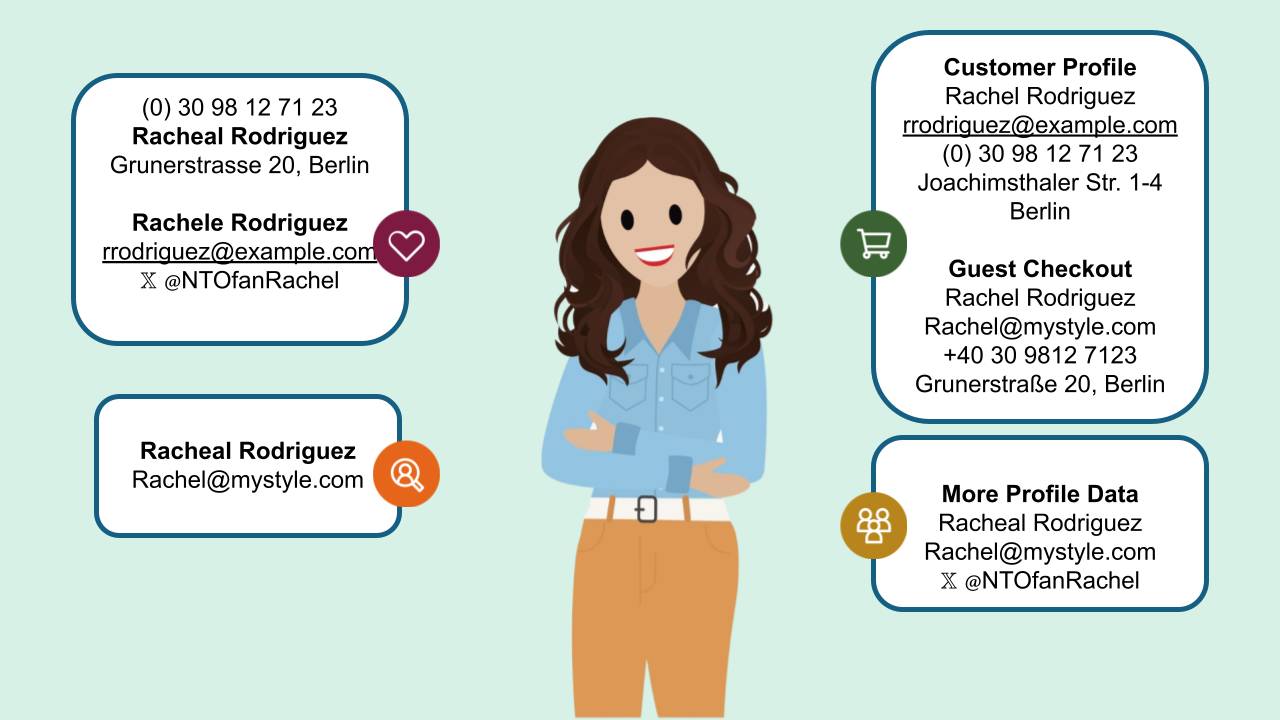
Rachel is an NTO customer. NTO stores information about Rachel in several systems. Each holds different contact points, such as email address, mailing address, and phone number. Not only is Rachel’s information stored in different systems, but each system also has different information about her, which makes it difficult to know if the records are for the same Rachel. So, how does NTO get a complete understanding of Rachel? This is where unified profiles come in!
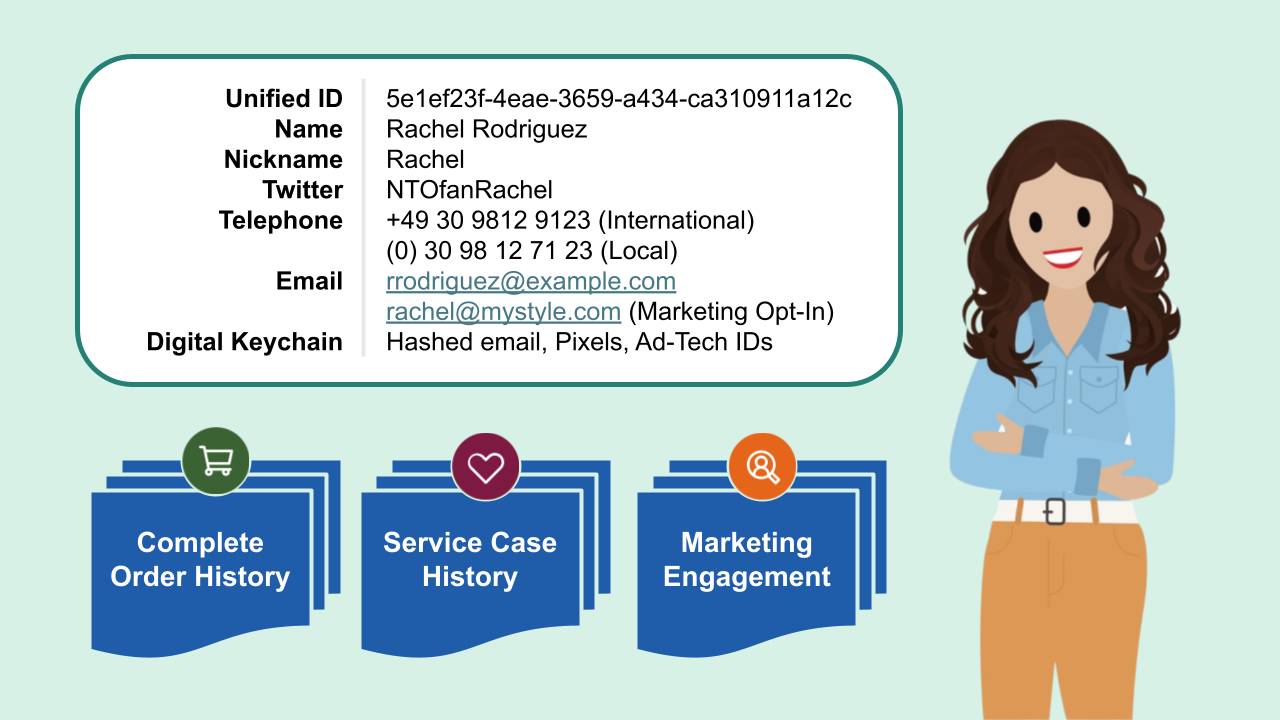
The ideal unified profile provides a clear, accurate view of the customer by connecting data across systems without merging duplicate records or losing important context.
Common Causes of Customer Context Gaps
Customer context gaps arise when customer information is scattered across different systems and not fully connected. As data accumulates across CRM records, service cases, orders, and digital interactions, it can become inconsistent or fragmented. As a result, it can be harder to identify an individual customer or organization. When you understand what causes these gaps, you can build a more complete and reliable customer profile.
What Causes the Customer Context Gap? |
Description |
NTO Example |
|---|---|---|
Unintentional duplicates |
Two or more records represent the same entity (for example, real-world person, account, and case) and context due to data entry, integrations, or process gaps. |
Rachel signs up for NTO’s hiking newsletter using rrodriguez@example.com and later makes a purchase using rachel@mystyle.com. NTO now has two contact records for Rachel, splitting her engagement and purchase history. |
Intentional duplicates |
Separate records are intentionally distinct for governance or operational reasons and therefore not considered true duplicates that cause customer context gaps. |
Rachel shops for personal gear but also places bulk orders for her outdoor tour business. NTO maintains one record for Rachel as an individual customer and another tied to her business account to track separate purchases and pricing agreements. |
Disconnected transactions |
Transactions relate to a customer but are not connected to a single customer record. For example, support activities can be tracked in one system, while billing and sales activities happen in another. This creates a fragmented view of the same customer, making it harder to see their full history and interactions in one place. |
Rachel places a guest checkout order for a tent using one email address and later contacts support about a defect using a different email. Her order exists in the commerce system, and her case exists in the support system, but they aren’t linked, so NTO can’t see her full history in one place. |
Invisible duplicates |
Two records can’t match within a single object because each is sparsely populated (for example, one has only phone, another only email). They become detectable only when combined with other sources. |
Rachel calls support and is logged with only her phone number. Later, she signs up for loyalty rewards using only her email address. Because the records don’t share a common identifier, NTO doesn’t recognize them as the same person until more data is collected or enriched. |
Completeness Is Not Enough: Context and Compliance Matter
A complete customer profile isn’t always appropriate to show in full. More data doesn’t automatically mean better outcomes, especially when access to that data must be controlled.
Different users need different views based on their roles and responsibilities. For example:
- Service agents need context relevant to support interactions.
- Sales teams need relationship and opportunity context.
- Customers accessing Experience Cloud should only see what they are permitted to view.
At the same time, compliance requirements define what data can be accessed, shared, or combined. Regulations, internal policies, and governance standards all place limits on how customer data is used and exposed.
This means unified profiles must do more than bring data together. They must ensure that:
- Only the right data is visible to the right users.
- Sensitive information is protected.
- Access aligns with both business needs and regulatory requirements.
Without this balance, a complete profile can introduce risk instead of clarity. Later, you see how NTO approaches unified profile design to meet both context and compliance requirements.
Let’s Recap
Now that you’ve learned about the common causes of a fragmented customer view and the importance of context and compliance, continue to the next unit to explore how Luna’s team at NTO assesses the need for profile unification.