Explore Sustainability at Salesforce and Get Involved
Learning Objectives
After completing this unit, you'll be able to:
- Summarize Salesforce’s efforts to incorporate sustainable business practices.
- Outline key areas of Salesforce’s sustainability work.
Explore Sustainability at Salesforce
Salesforce embeds sustainability directly into our operations, technology, partnerships, and investments. This intentional, target-driven strategy allows us to mitigate systemic risk while simultaneously unlocking new business opportunities that help build a more regenerative global economy.
You can check out our Stakeholder Impact Report for our latest sustainability achievements and areas of continued focus. Let’s review a few key areas of this work.
Advancing the Energy Transition
We believe a more sustainable future hinges on a rapid and successful energy transition.
- We procure 100% renewable energy for our global operations, a goal we have achieved annually since FY22. This means we utilize renewable energy or renewable energy certificates that are equivalent to the electricity used globally on an annual basis.
- We use a mix of virtual power purchase agreements, green tariffs, and direct supplier contracts to incentivize the development of new clean energy resources.
- We advocate for public policies that align with our core values to support long-term business success and to create shared value for our key stakeholders.
Accelerating AI Sustainability
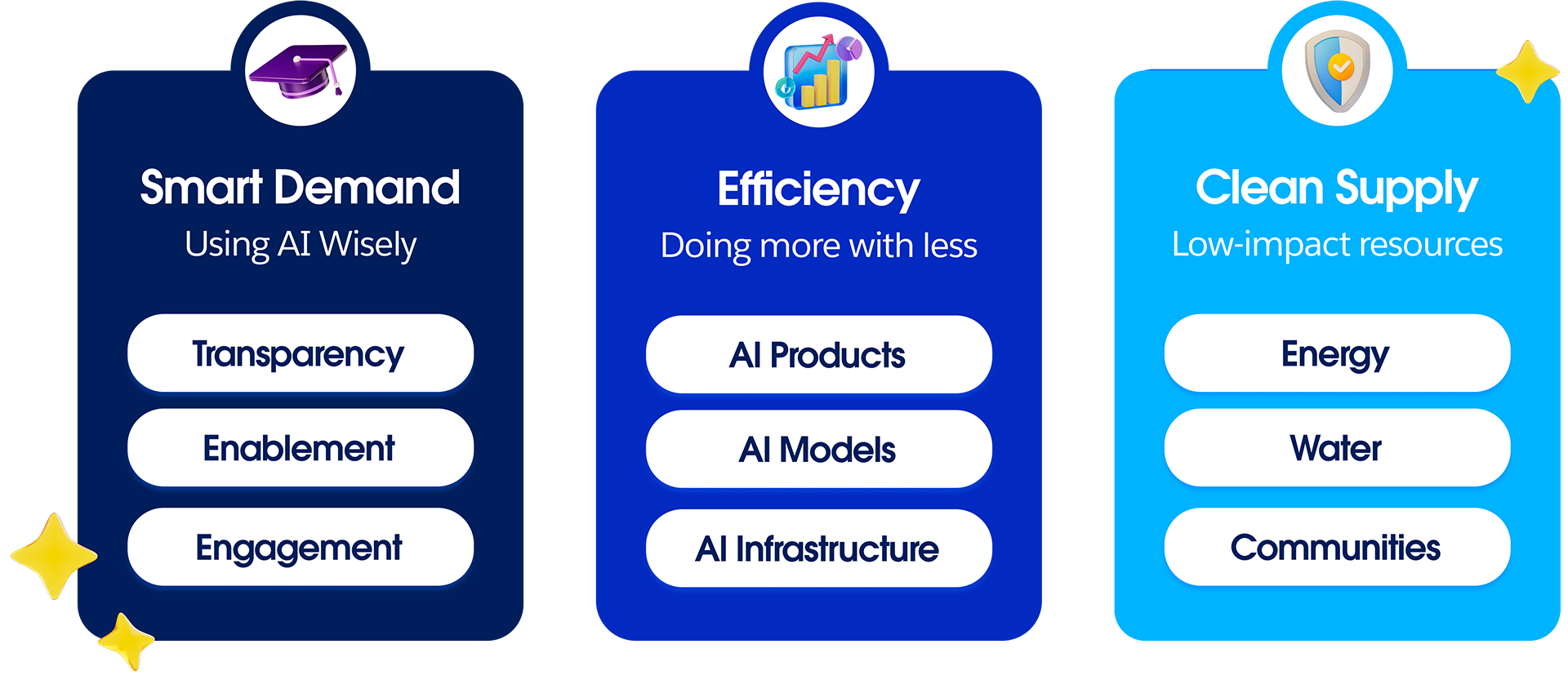
We address the energy demands and environmental risks associated with scaling AI infrastructure. Developed through a cross-functional partnership across AI Research, Sustainability, and the Office of Ethical and Humane Use, our preliminary approach to AI sustainability focuses on three core operational areas:
-
Smart Demand: Using AI wisely by calibrating model size to the specific task and avoiding unnecessary compute waste. For example, we expanded our AI model cards with standardized environmental impact metrics.
-
Efficiency: Building compact, task-specific models that lower energy requirements and applying architectural innovations like Zero Copy to eliminate redundant data movement.
-
Clean Supply: Partnering across our cloud ecosystem and provider networks to advance shared commitments around grid decarbonization, hardware efficiency, and clean power procurement.
Decarbonizing Our Business
For more than a decade, we've been embedding sustainability into everything we do—cutting emissions and driving impact across our value chain. Our vision is to operate as the world's most sustainable agentic enterprise.
- We work toward science-based targets to reduce our absolute scope 1 and 2 emissions alongside reductions in our scope 3 emissions intensity.
- We take responsibility for the emissions we can’t yet reduce by investing in high-impact climate solutions beyond our value chain.
- We ask all of our suppliers to set science-based targets, increase sustainability disclosures, and deliver carbon-neutral products and services—all as part of their contractual obligations to Salesforce.
Champion a Nature-Positive Future
Guided by our Nature Positive Strategy, we work to reduce our nature impacts, scale global restoration, and accelerate the nature-positive movement. For example:
- We operate a dedicated water program focused on resilient data centers, power supply, and watersheds. For example, Salesforce is prioritizing watershed resilience investments in 13 priority basins, contributing to the water supply and quality in basins that provide millions of people with water.
- We are a founding partner of the Forest Future Alliance to conserve and steward forest landscapes worldwide, and are helping to fund the conservation, restoration, or growth of 100 million trees by the end of the decade.
- Our climate funding includes a strong focus on nature-based solutions. The lack of alternative funding sources for nature, and the rigor of carbon finance, makes nature-based solutions both well suited for and in need of carbon markets. To that end, we're working to accelerate the next generation of nature-based carbon projects with key partners including the Symbiosis Coalition, Mangrove Breakthrough, and Lowering Emissions by Accelerating Forest Finance Coalition.
Leveraging Our Own Technology
As Customer Zero, we put our technology to work on our own toughest challenges—and that includes scaling Salesforce’s sustainability programs. For example:
- In 2019, Salesforce’s sustainability team built an app using the Salesforce Platform to manage emissions data. The following year, we offered customers the same complete sustainability management solution that we developed and improved internally.
- In 2022, that custom app became Net Zero Cloud, allowing us to conduct scope 1, 2, and 3 carbon accounting, assurance, and reporting all within one sustainability management platform.
- As agentic AI has become more mature, we’re exploring how to use Agentforce to accelerate our sustainability efforts and programs.
Energizing the Ecopreneur Revolution
Ecopreneurs are innovators focused on solving sustainability challenges. We continue to invest in bold, innovative sustainability solutions that scale climate and nature benefits. For example:
- Salesforce provides philanthropic grants to sustainability-focused nonprofits.
- The Salesforce Accelerator—Agents for Impact initiative provides technology, funding, and pro bono expertise to help nonprofits build and customize AI agents, including a cohort focused exclusively on nature.
- The Salesforce Ventures Impact Fund invests in enterprise software companies creating better access to clean energy, improving resource efficiency, and increasing supply chain performance.
- We also co-founded UpLink, the innovation platform at the World Economic Forum that supports the growth and scales the impact of best-in-class startups working on innovative climate solutions.
Join the Movement
Salesforce doesn’t have all the answers, and no single organization can solve environmental challenges alone. While enterprise-level strategies drive systemic progress, global transformation relies on collective action. You don't need a sustainability title to make a tangible difference. Here are a few practical ways you can bring sustainability into your everyday work and routine:
Practice More Sustainable AI Usage
As AI becomes a daily partner for productivity, adopting intentional digital habits ensures we leverage AI effectively while keeping environmental impact top of mind:
-
Choose the Right Model for the Task: Match model capability to your specific workload. Default to smaller, specialized, or task-specific models for routine requests (like simple summaries or text reformatting) as they require significantly less computational energy than large frontier models.
-
Write Efficient Prompts: Craft clear, detailed, and structured prompts on your first attempt. Clear asks and context reduce the need for multiple follow-up queries, cutting down on repeated requests and compute cycles.
-
Build Productivity Habits That Work for the Planet: Use AI with intention by applying it where it adds the most value. Stay mindful of when and how you use it to keep your energy footprint in check.
Drive Grassroots Advocacy & Engagement
As individuals, we have opportunities to advocate for sustainability—whether it be through civic engagement, workplace policies, or transparency from the platforms, products, and services you use.
-
Engage in Community Efforts: Discuss environmentalism with colleagues, friends, and neighbors. Participate in public council meetings and voice your perspectives on environmental health to local representatives.
-
Advocate for Values-Driven Practices: Share sustainability tips with your teammates, ask suppliers about their environmental commitments, and support workplace policies that align business operations with planetary health.
-
Ask Questions & Champion Transparency: For example, what is powering this technology? How efficiently? And are they transparent about it? These questions—from employees, customers, and citizens—are what nudge companies toward renewable energy commitments, efficient AI design, and transparent emissions reporting.
Reduce Your Digital & Workplace Footprint
We can also take action for sustainability via lifestyle changes, both at home and in the workplace.
-
Take Action With a Green Team: Tap into workplace networks like Earthforce—Salesforce’s sustainability-focused employee group—or launch a green team at your company to lead local recycling and community service initiatives.
-
Conserve Operational Energy: Power down workstations, secondary displays, and office equipment at the end of the day. Transition home and office lighting to energy-efficient LEDs.
-
Dispose of E-Waste Responsibly: Extend the lifespan of electronics through proper maintenance, and ensure retired devices are recycled through verified e-waste programs rather than sent to landfills.
-
Commute Sustainably: Participate in and encourage carpooling, biking, and public transport to reduce vehicle emissions.
Sustainability is an ongoing journey of innovation, accountability, and collective action. By embedding environmental responsibility into our daily work, from how we design and engage with AI to how we manage our operational footprints and supply chains, we build a more resilient and sustainable future, together.
Resources
- Salesforce Website: Salesforce Ventures Impact Fund
- External Site: Future Forest Alliance
- External Site: Uplink
- External Site: Science Based Targets