Make Sample Management Compliant and Measurable
Learning Objectives
After completing this unit, you’ll be able to:
- Explain how Sample Management reduces regulatory and financial risks during distribution.
- Distinguish Sample Management from the broader Product Management foundation.
- Describe the sample management lifecycle from setup to field execution and reconciliation.
- Identify how admins and field representatives share responsibility across the lifecycle.
Before You Start
Before you start this badge, consider completing this recommended content.
- Product Management for Agentforce Life Sciences
Understand Why Sample Distribution Needs Controls
For a life sciences company, a physical sample is one of the most direct ways to put a new therapy in a provider's hands. A sample gives a healthcare professional (HCP) a way to start a patient on treatment right away, test tolerance, and build familiarity with a product. That makes sampling central to how field teams engage HCPs during a launch.
A sample is also a controlled physical asset, not a catalog entry. Regulations hold manufacturers accountable for every sample a representative carries. Companies track each unit by product, quantity, batch, and expiration; record who received it and when; reconcile physical stock against the system on a regular cycle; and account for anything lost or returned. Records like these are kept for years and made available to regulators on request.
Meeting that bar in the field is the hard part. A field representative carries trunk stock that moves constantly. Stock ships in, transfers between colleagues, expires, and goes out as samples during visits. When one of those movements goes unrecorded, the physical count and the system drift apart, and a gap no one can explain is exactly what an audit looks for.
Sample Management in Agentforce Life Sciences governs all of this in one connected system. It links sample products, inventory locations, production batches, quantity balances, distribution limits, visit disbursements, count assessments, and adjustments in Salesforce. This constellation of data helps the organization control how samples move and account for every unit, from manufacturing source to provider hand-off.
In this badge, you learn how Sample Management supports compliant sample distribution. You build the inventory hierarchy that tracks field stock and configure the guardrails that limit how much providers can receive and territories can distribute. Then, you validate sample drops during provider visits, and reconcile inventory through dashboard operations and count assessments.
Connect Sampling to the Product Foundation
Commercial operations in Agentforce Life Sciences connect core configuration to field execution.
The architecture map shows how foundational features connect to field engagement capabilities.
The Foundation layer establishes the shared commercial model across accounts, territories, and products. Product Management lives here. It defines product identity, hierarchy, specifications, and account restrictions. The result is a curated catalog of which products exist, how they relate, and which teams are cleared to promote or sample them.
Engagement Planning and Execution builds directly on that foundation. This is where Sample Management operates alongside capabilities like Visit Management. Sample Management extends a catalog product into physical field stock. It adds inventory locations, production batches, distribution limits, and reconciliation workflows.
A sample product still relies on its catalog setup. Its specification, sampling availability, order quantity rules, distribution method, territory alignments, and account restrictions all carry over. Sample Management builds the operational layer on top, turning a configured product into inventory a representative can carry, distribute, and fully account for.
Follow the Sample Management Lifecycle
Governing a sample includes three stages. An admin configures inventory and rules before anything moves, representatives distribute samples under live checks during provider visits, and the team does routine counts to keep the physical and digital records aligned long after the launch. Each stage depends on the one before it. Let’s find out more about the lifecycle.
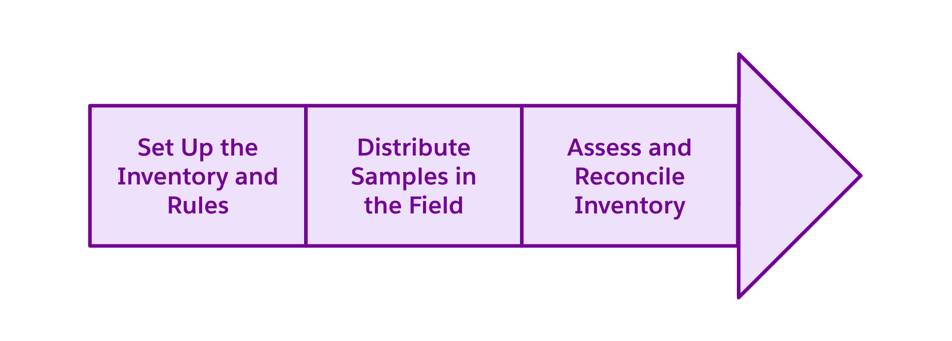
Set Up the Inventory and Rules
Before a representative hands out a single sample, the system needs to know where stock lives, where it came from, and how much anyone can distribute. An admin answers those questions first, building the inventory hierarchy that makes each unit traceable, from a storage location to the production batch that supplied it and the records that track quantity by product and source. The same preparation defines the limits on distribution. Provider Sample Limits cap how much an HCP or healthcare organization (HCO) can receive in a visit and over a period, and Territory Product Quantity Allocations cap how much a region can distribute in a set timeframe.
This work comes first because everything downstream relies on it. Once it's in place, every unit traces back to its source and location, and every provider and territory carries a limit the system can enforce.
Distribute Samples in the Field
With that structure in place, the field rep goes to work. They acknowledge inbound shipments and transfers, move stock between locations, and record sample drops during provider visits. The drop is the decisive moment. When a representative submits one, Sample Management checks it against the structure already configured. The system confirms that there's enough stock on hand, the product is active for sampling, the provider is under their limit, and the territory still has budget for the period. A drop that clears every check updates the connected records. A drop that breaks an enforced rule stops before any balance changes.
Here, the configured rules stop being settings and start making decisions in real time, so only compliant distribution reaches the record.
Assess and Reconcile Inventory
Validation keeps each transaction honest, but physical stock still drifts from the record over time. Units get damaged, a transfer arrives late, an earlier entry goes off by a few units. Counting is how a representative proves the two still agree. An initial count sets the baseline, and later counts repeat on a schedule, on demand, or under audit, each comparing the physical total against the system total. A match stands as evidence. A mismatch moves into reconciliation, where Sample Management records the reason, creates the adjustment, and connects the original count, corrected balance, and the reason for the change.
Counting and reconciliation turn a one-time configuration into a record that stays current, one that explains how every number was reached when a regulator asks.
Explore Sampling in the Flow of a Visit
For a field representative, sampling isn't a separate task to manage. It happens as part of the visit. A rep spends the day on a tablet in the Agentforce Life Sciences mobile app, working through the visit workflow that Visit Management provides. They prepare for the call, present approved content, and capture what happened. Handing a provider a sample is one moment in that flow, and it's where the inventory and rules an admin configured take effect.
When a rep records a disbursement on the visit screen, the Samples section draws straight from the records built during setup. It shows the stock on hand and the batch it came from, validates the quantity against the limits and any allocations that apply, and captures the provider's signature on the device.
A compliant drop records against the visit. A drop that breaks an enforced rule surfaces a warning or a block right there, before the rep hands anything over.
For the representative, all of this happens without leaving the conversation. There's no separate inventory system to reconcile by hand, and no compliance checklist to run from memory. The guardrails an admin built do the work quietly, in the background of a normal visit, so the rep stays focused on the provider while the system keeps the drop compliant and the record complete.
The configuration and the visit are two sides of one system. An admin defines the inventory, limits, and validation ahead of time, and a representative meets those rules as a few fields on a visit screen. Every compliant drop flows back into the connected record the organization counts on at audit time.
What’s Next?
Sample Management gives life sciences organizations a governed model for physical sample distribution.
You learned why samples require chain of custody, receipt limits, inventory tracking, and reconciliation. You also explored how Sample Management extends the product foundation with the records and workflows needed when selected products move through the field as physical inventory.
In the next unit, you begin the setup stage. To make the process concrete, you follow Cumulus Pharma, a fictional life sciences company preparing sample operations for the launch of a fictional product named Immunexis. You create the inventory hierarchy that identifies where a field representative’s stock lives, how much is available, and which production batch supplied it.