Explore the Ship and Debit Lifecycle
Learning Objectives
After completing this unit, you’ll be able to:
- Identify the key personas and objects involved in the ship and debit journey.
- List the lifecycle stages of the ship and debit incentive process.
- Explain how automated validation improves claim accuracy.
Review Key Personas
In the previous unit, you learned how ship and debit incentives act as a safety net for distributors. But how does a manufacturer go from a manual, spreadsheet-driven process to a streamlined, automated system?
Every ship and debit program follows a structured lifecycle from setup and configuration to claim validation and payout. Behind the scenes, multiple roles collaborate to make sure incentives are accurate, compliant, and paid on time.
Before you walk through the lifecycle, let’s understand the key personas who drive each stage of it.
Persona |
What They Do |
|---|---|
Admins |
Set up and configure ship and debit. They automate claim validation for quick and accurate verification and payout calculation. |
Program managers (channel managers) |
Design the programs based on requirements provided by sales and finance teams. These include special prices and discounts for partners. |
Claims analysts |
Focus on the operational validation of claims, audit claims, and adjust payouts as needed. |
Partner users |
Maintain and submit ship and debit claims and invoices using the Experience Cloud sites. |
Claim clerks at partner companies |
Submit detailed claims and track their payouts. |
Finance team |
Maintain the book of business and ensure fiscal accuracy. |
Now that you're familiar with the key players, let’s explore the essential objects that power these programs before we walk through the ship and debit lifecycle.
Key Objects in Ship and Debit
To manage these incentives effectively, let’s explore the essential Salesforce objects that power ship and debit programs.
-
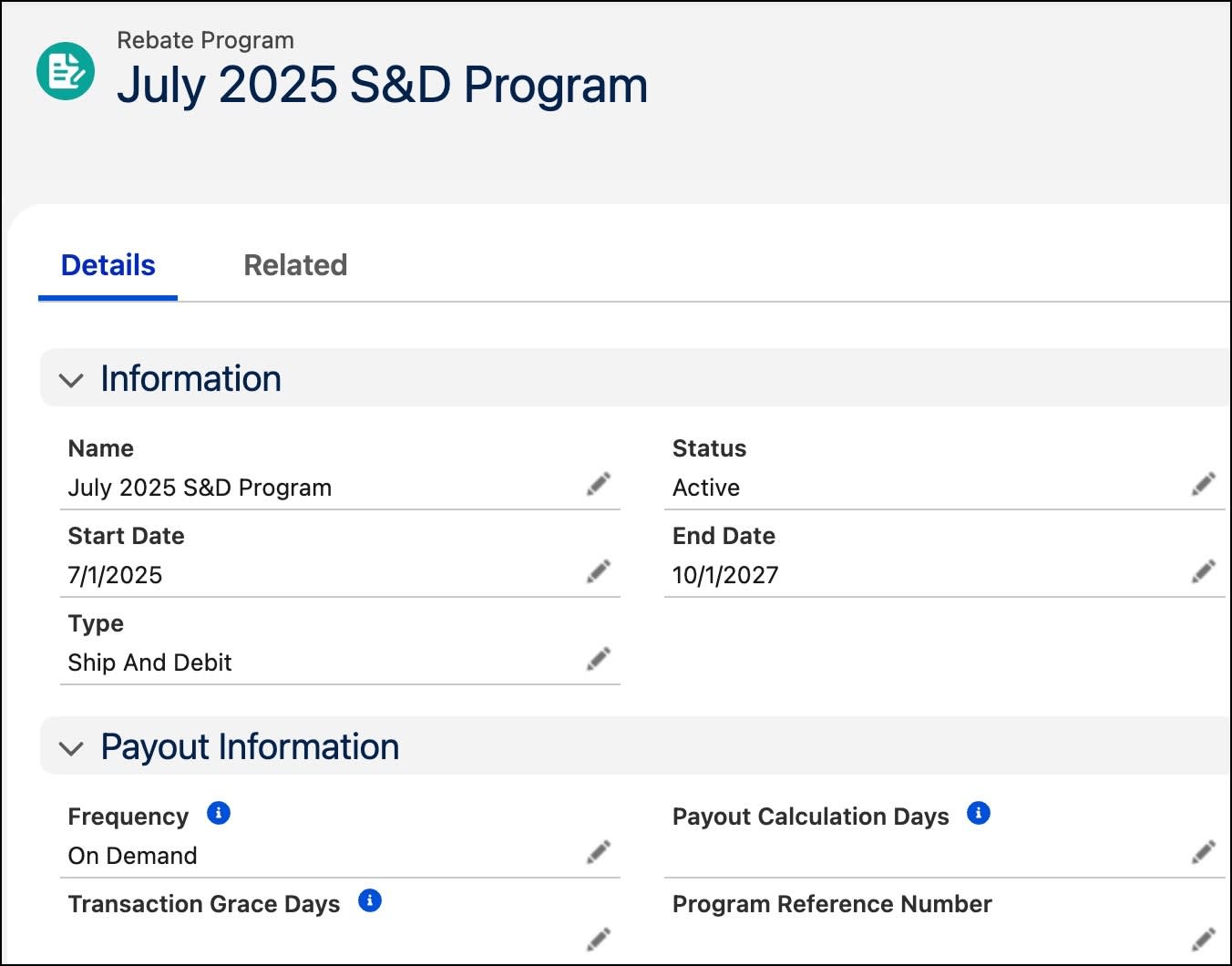
Rebate program: The master program definition that establishes the ship and debit agreement between the manufacturer and partners. This is where you set program dates, status, and overall terms.
-
Rebate partner special pricing term: The heart of ship and debit. This object defines the special price a distributor can offer to specific customers, the standard reference price, the price difference the manufacturer will reimburse, and any quantity thresholds or eligibility criteria. Each pricing term connects to a rebate program and specifies the products included.
-
Rebate program member: Represents the enrolled partner or distributor who participates in the program. This links the partner account to the rebate program.
-
Rebate claim: The distributor's formal request for reimbursement, submitted after selling products at the special price. Claims reference the special pricing term and include transaction details.
-
Received documents: Proof of sale documents such as invoices and purchase orders that distributors attach to claims to substantiate their reimbursement requests.
-
Transaction journal: Financial records that track approved payouts and maintain an audit trail of reimbursements.
With these objects working together, Ship and Debit Process Management automates the flow from program setup to partner payout.
First Ship, Then Debit: The Incentive Lifecycle
Here are the stages of the ship and debit lifecycle in Ship and Debit Process Management.
-
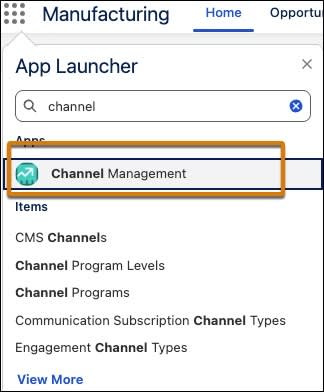
Prepare the org: The lifecycle begins with system readiness. The admin enables ship and debit features, assigns permissions, and configures partner collaboration using Experience Cloud. Once the setup is complete, open App Launcher and search for Channel Management to create and manage rebate programs and claims. This technical foundation makes sure programs and claims are managed securely and efficiently by both internal teams and external partners.
-
Design the program: Once the system is ready, the channel manager creates the ship and debit program. They define special pricing terms, eligibility criteria, and claim requirements. They also enroll partners and eligible customers and establish the necessary partner relationships.
-
Execute transaction: With the groundwork done, the partner sells products at the special price to eligible customers.
-
Submit claims: After the sale, the claim clerk submits and manages the claims with proof of sale through the partner portal. The system stores these proofs of sale as Received Documents, which are linked to the claim for validation and audit purposes.
-
Validate claims: After the documents are uploaded to the partner portal, the claim analyst runs automated checks and calculates payouts.
-
Settle payouts: Finally, after the claims are verified, finance team members review the payouts, apply adjustments, and process reimbursements.
Let’s consider an example to better understand the lifecycle.
How Ship and Debit Works
When distributors sell to eligible customers at a special price, the distributors submit their claims and proof of sales information. The system compares this data with the rebate partner special pricing term, to automate the creation and validation of debit claims. The debit claim is the request a distributor sends to the manufacturer to get reimbursed for the price difference.
Here's a simple example to illustrate the concept. A distributor purchases industrial sensor modules from a manufacturer at US$100 per unit. To win a competitive deal, the distributor needs to sell to an end customer at $90 per unit for orders over 1,000 units. The manufacturer agrees to this special pricing and will reimburse the distributor $10 per unit through a ship and debit claim. Here is how the process unfolds.
- The distributor sells the modules to a customer at the special $90 price.
- The distributor submits a rebate claim of $10 per unit to the manufacturer.
- The distributor provides point of sales data to substantiate the rebate claim.
- The manufacturer reviews, approves, and reimburses the distributor.
While this simplified example shows the core logic, ship and debit programs handle diverse pricing scenarios based on market conditions, competitive pressures, and strategic partnerships.
Let's look at a real-world example. There's a rebate partner special pricing term for Chipset 300 with a minimum quantity of 100 units. The standard list price is $100, and the special pricing term sets a discount of $61 per unit. This is the amount the manufacturer reimburses to the distributor. This pricing term makes sure that when the distributor sells Chipset 300 at the discounted price to eligible customers and meets the minimum quantity, they can submit a claim for the discount amount, protecting their margins while staying competitive.
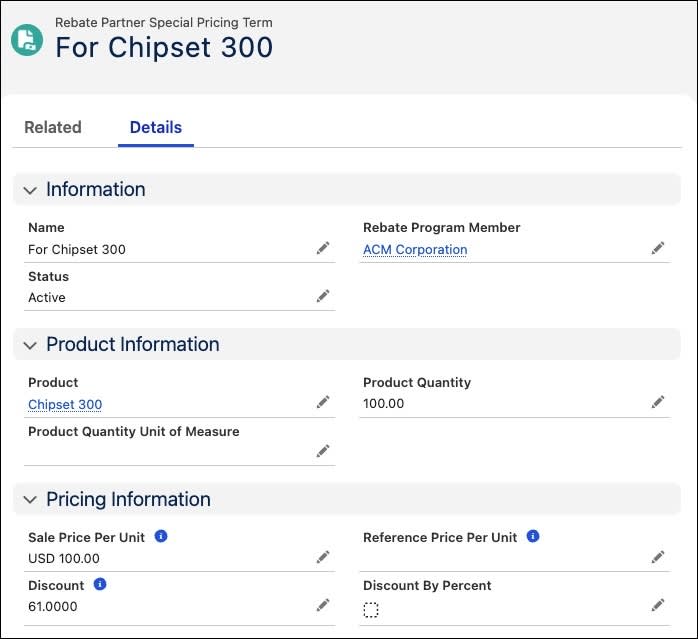
Ship and debit pricing scenarios vary widely. In some cases, manufacturers help distributors maintain competitive pricing by covering discounts. In others, special pricing terms account for volume commitments, market-specific conditions, or strategic customer relationships. The flexibility of the rebate partner special pricing term object lets manufacturers design programs that fit their specific business needs.
Manually processing hundreds or thousands of claims like this would be time-consuming and error-prone. That’s where automation becomes essential.
Automate Validation and Payouts at Scale
In ship and debit, flows automate business processes such as claim submission, approvals, and integrations, while data processing engines (DPEs) handle large-scale validation and payout calculations. Together, they ensure claims are processed efficiently, accurately, and at scale.
Automated validation improves claim accuracy by checking claims against program rules, rebate program member special pricing terms, and transaction data before they’re approved. So the system flags duplicates, incorrect quantities, and ineligible transactions automatically. This reduces errors, speeds up processing, and ensures distributors are paid the correct amount every time.
For example, a ship and debit rebate claim for Chipset 300 has been automatically validated. The Processing Status is System Processed, indicating the claim passed all automated checks.
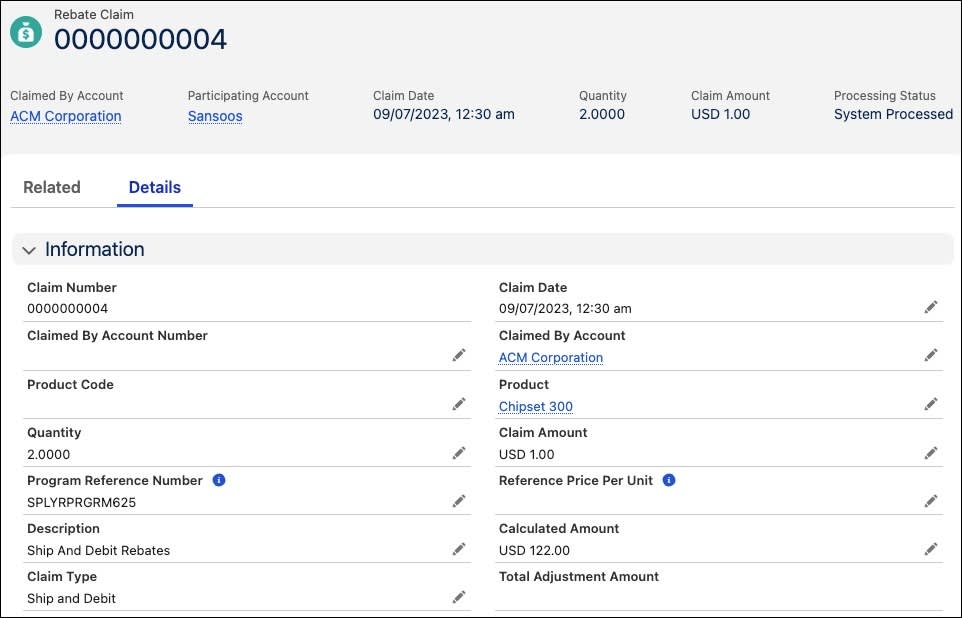
The system calculated the payout amount by comparing the claim data against the rebate partner special pricing term for Chipset 300. This automated validation eliminates manual review for eligible claims, processes hundreds of claims simultaneously, and ensures distributors receive accurate reimbursements within hours instead of weeks.
Wrap Up
With Channel Revenue Management, manufacturers move away from messy spreadsheets toward a streamlined, automated system. You’ve learned the fundamentals of ship and debit, the key personas, and the end-to-end lifecycle in Salesforce. You’re now ready to explore how you can use it for your business to streamline claims and payouts.