Deflect Cases
Learning Objectives
After completing this unit, you’ll be able to:
- Explain how to deflect customer cases with Agentforce Financial Services.
- Describe how to provide proactive service with record alerts.
- Explain how the Financial Services Client Portal enables customer self-service.
- Describe how Agentforce agents deflect cases and provide customer service.
Case Deflection with Proactive Alerts and Customer Self-Service
It’s almost always better to prevent inbound cases than to resolve them quickly.
Sometimes, your customer service reps notice a problem before a customer does and fix it quickly. This move proves to your customer that you’re looking out for their best interest. Other times, a customer solves their own simple issues so your reps can instead focus on challenging customer problems.
Agentforce Financial Services can deflect cases and shift routine inquiries away from your reps using automations and self-service features. These features help customers find answers at any time through intelligent banking portals and AI agents that can deflect routine calls.
In this unit, you explore some of the proactive service and self-service features in Agentforce Financial Services.
Proactive Service
Agentforce Financial Services helps your reps spot problems as they occur and then proactively work with customers to prevent inbound calls.
Integrated record alerts surface potential issues from data in third-party systems, such as possible fraudulent transactions and overdraft warnings. For example, imagine that your team receives an alert about a possibly fraudulent transaction on a customer’s credit card.

Your team contacts the customer and quickly cancels the transaction to prevent fraud. That’s how your institution builds lifelong customer relationships.
Customer-Facing Processes
Not every situation can be addressed proactively. In many cases, customers prefer to resolve simple requests on their own.
Agentforce Financial Services supports this by extending the same service processes used by service teams to customer-facing digital and automated channels. These foundational, multichannel processes automate common tasks such as address updates, fee reversal requests, and transaction disputes.
These processes move common requests out of your contact center to enable customers to solve their own issues. For example, Transaction Dispute Management uses partner integrations to add details to transaction data, helping customers easily identify fraudulent charges and avoid unnecessary dispute calls.
Most self-service begins through a branded portal experience. The portal can include embedded AI-powered agents that guide customers through more complex tasks, or complete the tasks for the customer, using real-time data and business logic.
Explore how the portal and autonomous agents help deliver consistent, scalable service.
Self-Service Portal
Use Experience Cloud to set up a self-service portal so that your customers can complete their own address changes, file disputes, and so on. Experience Cloud helps your team create branded digital experiences and set up a site quickly with specialized templates, such as the included Financial Services Client Portal template.
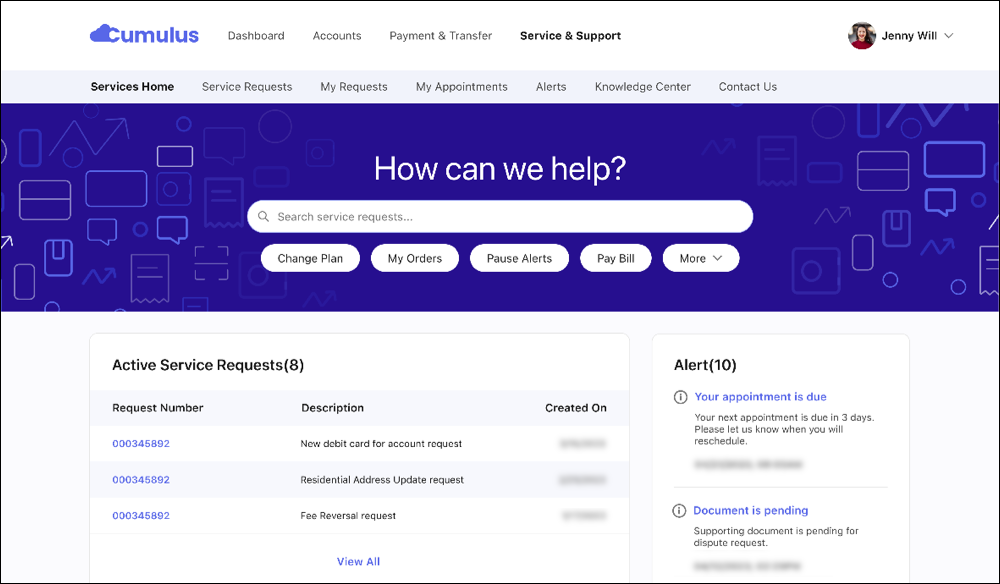
These customer-facing service processes are built using the same features that drive your employee processes, such as Unified Catalog Management, Omnistudio, and Flows.
Self-Service Agents
Deploy autonomous AI agents on your self-service portal and other channels to support dynamic, conversational, and guided service.
Starting with prebuilt Agentforce templates for financial services, quickly set up agents to handle high-volume requests, such as balance inquiries, stop payments, and card replacements. Plus, these agents can integrate with your core banking systems and unified Salesforce data to complete entire workflows without human intervention for vastly increased service scale.
For example, if a bank customer’s credit card is lost or stolen, that customer can work with an autonomous customer assistance agent in the bank’s self-service portal to lock the credit card and prevent fraudulent transactions.
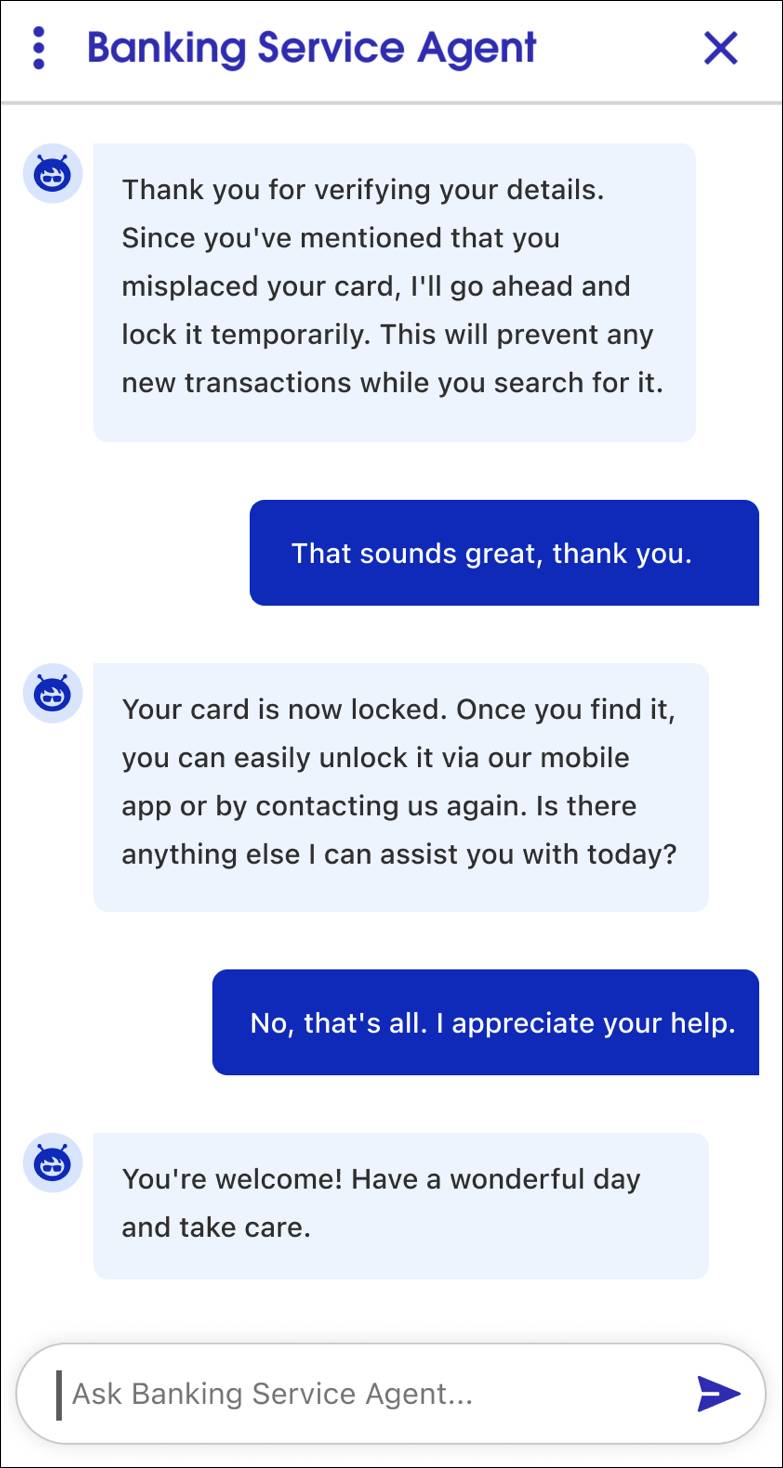
If you’re concerned about security—and who isn’t?—know that Agentforce agents operate within your compliance framework and the Agentforce Trust Layer. These tools make sure that an agent’s actions adhere to required approvals, disclosures, and audit trails. Your customers get consistent answers, and your team gets the required transparency and control.
What’s Next
In this unit, you learned how Agentforce Financial Services deflects customer cases. You explored how to provide proactive service by using integrated record alerts to resolve issues before a call. You also learned how to provide customer self-service through an Experience Cloud portal and AI-powered agents to automate common inquiries securely within the Agentforce Trust Layer.
But not every case can be prevented. When a customer reaches out for help, your team needs to respond quickly, securely, and accurately. In the next unit, learn how Agentforce Financial Services accelerates case intake and gives service reps the tools to manage service interactions from start to resolution.