Get to Know AI Models
Learning Objectives
After completing this unit, you’ll be able to:
- Explain what AI Models is.
- Describe the types of models available in AI Models.
Before You Start
Before you start this module, consider completing the following recommended content.
What Are AI Models?
With AI everywhere these days, you’ve likely seen headlines about its capabilities. But have you ever wondered how it actually works? The secret lies in AI models. Think of an AI model as the engine driving the impressive tasks computers can now handle—things that once required a human touch.
OK, “the brain behind the cool stuff” is an oversimplification, but it’s difficult to explain how AI models work without going deep into data science, statistics, and computer science.
Think of it like this: You feed the model a bunch of examples to learn from. It chews on them, figures out patterns, and improves at its job over time. Then, when you give it new data, it uses what it’s learned to make predictions or decisions. These AI models are the backbone of all sorts of cool tech, from recognizing faces in photos to driving cars autonomously. They’re the differentiator that powers the AI revolution, making computers smarter and more capable than ever before.
Ready to harness the power of predictive AI? Meet AI Models (formerly Einstein Studio) in Data 360!
AI Models
The AI tab in Data 360 is a centralized base that serves as your command center for both predictive and generative capabilities integrated into Data 360.
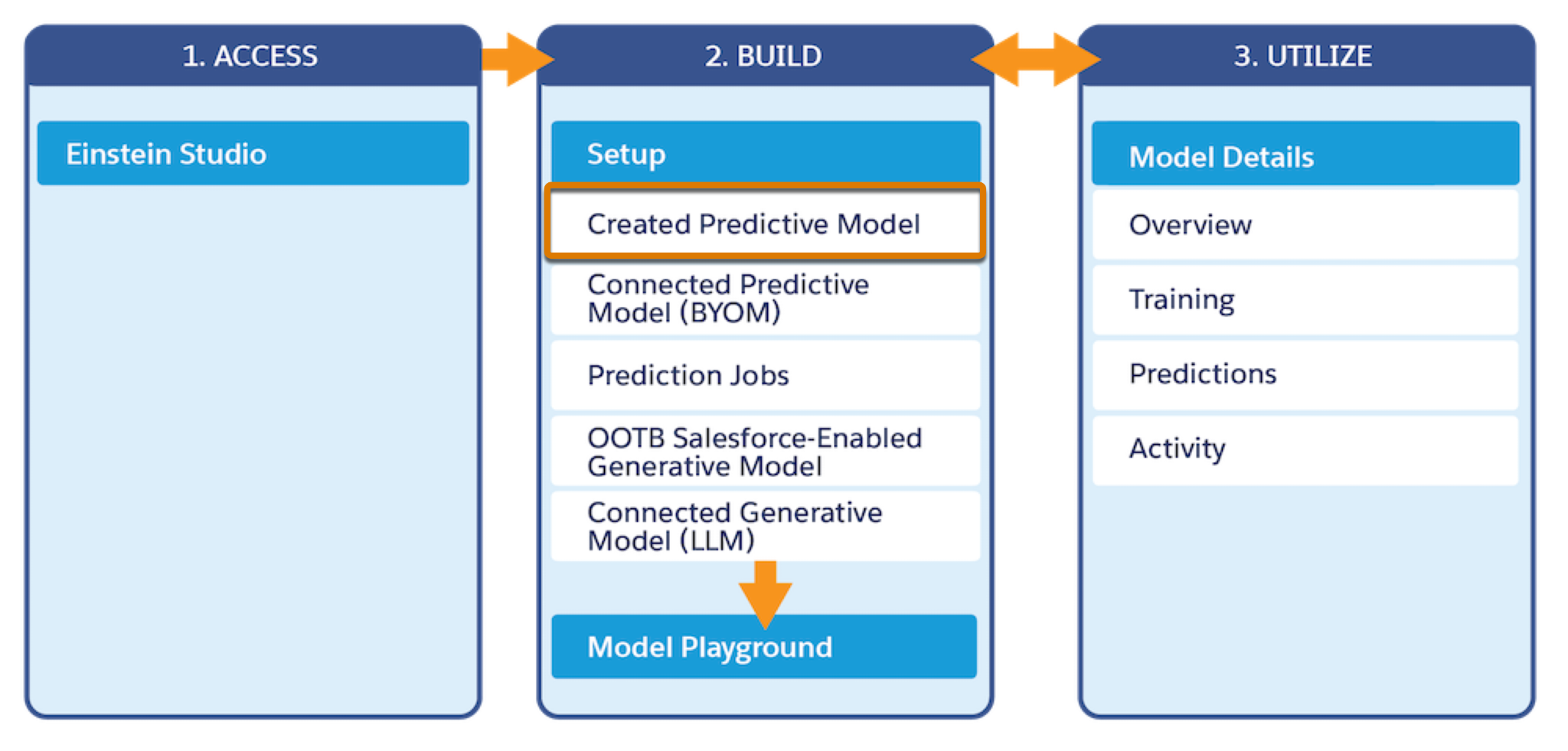
Best of all, you don’t need to know code, data science, statistics, or computer science to use the models. In AI Models, you can:
- Use the model builder to create a new AI model with clicks, not code.
- Connect to an existing AI model in an external platform such as AWS SageMaker, Google Vertex AI, or Databricks. Note that these models are not uploaded and hosted in Salesforce. Salesforce accesses them via an API.
- Connect to an existing LLM (Large Language Model) from third parties like OpenAI, Azure OpenAI, Anthropic and Vertex AI (Google Gemini).
- Manage all these models in one place.
How to Access Models in AI Models
AI Models is a tab within Data 360 is where you access and manage your organization’s predictive and generative models. You can sort and search the models, or open them to see more details, modify settings, or view metrics.
Different kinds of models support various use cases. These models include:
- Predictive Models, which use machine learning to predict future outcomes for use cases such as estimating the likelihood of attrition or conversion.
- Generative AI, which uses LLMs for use cases like chat completion
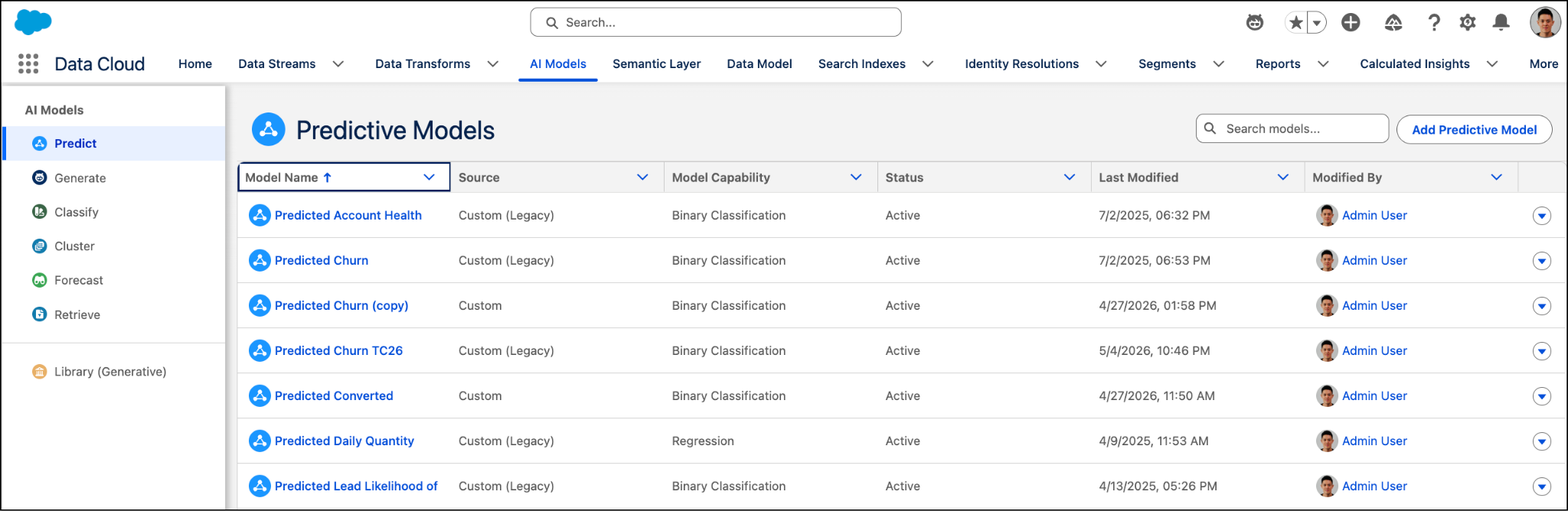
[Alt Text: AI Models page]
The models are shown with key characteristics so you can easily find and manage them.
Model Type
Models in AI Models can be created from scratch, connected to externally built models, created from an out-of-the box template, or global models provided for you.
-
Custom models are built from scratch.
-
Connected models bring in outputs from a model hosted somewhere else such as AWS SageMaker, Vertex AI, or Databricks.
-
Salesforce-Enabled models have been set up for you.
Model Capability
The different model capabilities support these common use cases for business outcomes.
-
Regression models predict a number such as currency amount, count, or likelihood percentage. Example use cases for predicted numbers include:
- Amount of an opportunity
- Time-to-close of an opportunity
- Customer lifetime value of an account
- Customer satisfaction of a case
- Amount of an opportunity
-
Binary Classification models predict an outcome group with two options such as true/false, yes/no, or won/lost. Example use cases for binary classification outcomes include:
- Account churned or not churned
- Opportunity won or lost
- Case escalated or not
- Account churned or not churned
Model Status
The model status can be inactive or active.
-
Active models can be used in flows or batch transforms.
-
Inactive models haven’t been activated.
In this unit, you’ve learned that AI Models is where to access your models built on Data 360. In the next unit you explore creating a new AI predictive model.