Discover the Agentforce Buyer Engagement Agent
Learning Objectives
After completing this unit, you’ll be able to:
- Define Agentforce Buyer Engagement Agent and its core purpose.
- Explain the three layers of intelligence these agents use to personalize interactions.
- Describe the primary functions of these agents in marketing and sales workflows.
- Identify key use cases and best practices for performance.
- Explain the basics of monitoring agent performance and conversation quality.
What’s a Buyer Engagement Agent
In today’s fast-paced digital landscape, you might struggle to maintain personalized outreach across high volumes of campaign leads. The Agentforce Buyer Engagement Agent is an autonomous, AI-driven solution designed to scale personalized buyer outreach and qualify leads 24/7. Its primary strength lies in bridging the gap between sales and marketing by acting as a digital employee that handles outbound lead nurturing and inbound lead generation. Its outbound function focuses on high-scale campaign integration and lead nurturing. For inbound functions, the agent manages web chat interactions and incoming inquiries, identifying prospect intent and providing instant, accurate answers through its access to internal knowledge bases. More on this later in the unit.
Agentforce Buyer Engagement agent consists of two specialized agent templates.
-
Buyer Engagement: A new template that spans both marketing and sales use cases which specializes in high-scale campaign outreach.
-
Lead Nurturing: An existing template that focuses specifically on sales-driven use cases.

Unlike traditional automation that follows rigid, linear scripts, the Buyer Engagement Agent uses generative AI to conduct fluid, two-way, personalized conversations across both email and web chat. Its primary goal is to offload the repetitive, upfront work of qualifying leads and scheduling meetings. By handling the initial handshake and early-stage discovery, the agent helps sellers focus their time on high-value strategic work and closing deals.
Bridge the Gap Between Sales and Marketing
The agent serves as a unified solution that coordinates outreach and intelligence across marketing and sales teams. Its primary functions include:
-
Acts on intent: It identifies prospect intent from incoming replies and web interactions to determine the best next step.
-
Qualifies at scale: The agent asks specific discovery questions such as budget, timeline, or use case, and automatically populates qualification summaries directly on Salesforce records.
-
Handles product Q&A: By accessing your company’s internal knowledge base, it provides instant, accurate answers to technical queries, reducing deal-ending wait times.
-
Orchestrates transitions: After a lead is qualified, the agent can book a meeting on a seller’s calendar and provide a summarized transcript of the interaction so the rep is fully prepared.
How It Works—Three Layers of Intelligence
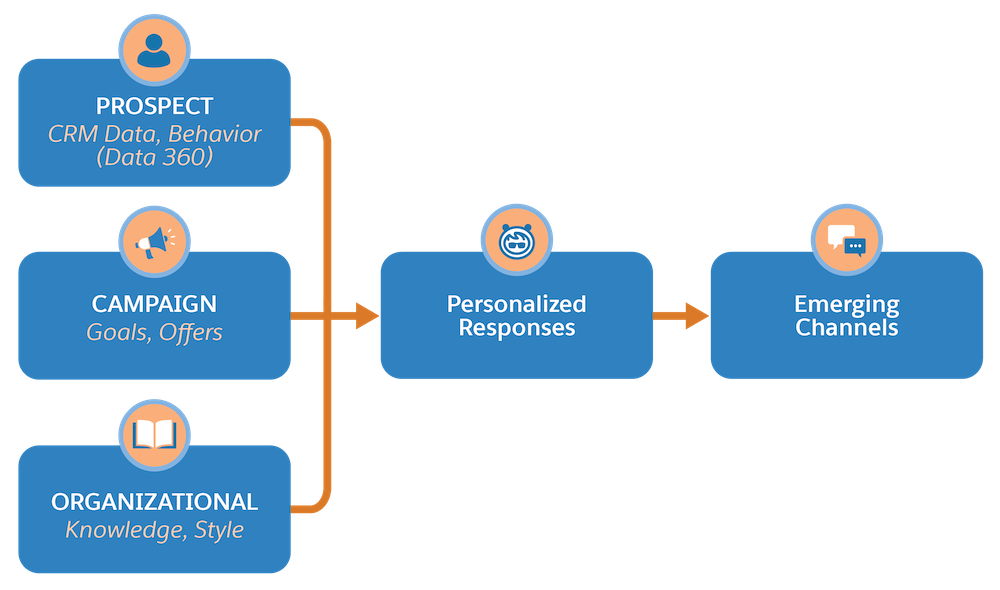
The Buyer Engagement Agent personalizes every interaction by grounding its generative capabilities in three distinct layers of data.
-
Organizational intelligence: It’s grounded in your company’s unique value propositions, proof points, and specific brand tone. It accesses your proprietary knowledge base to answer technical or product-specific questions accurately.
-
Campaign context: It uses campaign briefs and Brand Kits so that the agent’s outreach reflects current marketing goals and specific promotional offers.
-
Prospect intelligence: It pulls real-time data from Data 360 and CRM fields—such as web behavior and historical interactions—to ensure the initial greeting is personalized and relevant to the individual buyer.
Key Use Cases
You can configure Buyer Engagement Agents to support a variety of use cases including outbound marketing efforts and direct sales cadences to ensure no lead is left behind. You can deploy the agents in several high-impact ways.
-
Automated campaign integration: Marketers can add a “Forward to Agent” step directly into a campaign flow. Instead of just sending a static email, the agent takes over to handle personalized follow-ups for all leads in that segment. The agent prevents early-stage leads from falling into the void due to lack of immediate human bandwidth.
-
Real-time lead generation on web chat: The agent lives on your website, initiating conversations with visitors based on their browsing behavior. It answers questions in real time and captures contact information to automatically create new Lead or Contact records in Salesforce, and even book meetings.
-
Seller-led outreach: Sellers can trigger the agent from within a Sales Engagement cadence to work leads on their behalf. Additionally, sellers can manually assign prospect records—including leads, contacts, and person accounts—directly to the agent outside of a cadence context. The agent handles the initial outreach emails and persistent follow-ups. It then hands the lead back to the seller after a meeting is booked or the lead is fully qualified.
-
Meeting booking and qualification: The agent asks direct qualifying questions based on your criteria such as budget, timeline, and authority. It then populates a qualification summary directly on the Salesforce record, giving the seller a cheat sheet before they ever jump on a call.
Best Practices for Success
To ensure the agent enhances your brand experience and maintains trust with your prospects, refer to these strategic guidelines:
-
Ground the agent in knowledge: Populate your data libraries with clean, up-to-date files and company positioning. The agent’s output is only as effective as the data it has access to.
-
Maintain reasonable email intervals: The agent can nudge the prospects who haven't replied yet by sending automated follow-up emails to them. While the agent is persistent, over-nudging can damage your email deliverability and reputation. The agent is intelligently designed to stop all nudge activities the moment a prospect replies.
-
Use Brand Kits: Create Brand Kits from Brand Center to define specific tone and voice guardrails. Brand Kits ensure the agent's generated content consistently reflects your company's unique identity, whether it's professional or casual.
Report and Monitor
To ensure your agent is successful and maintaining a high quality of service, Salesforce provides specific tools to monitor its activity, effectiveness, and health.
-
Activity timeline and messaging sessions: All agent-led conversations are stored as Messaging Session records. These are visible in the Activity Timeline of the target record, where you can review full transcripts and agent emails.
-
Control Center analytics: You can view agent effectiveness in a centralized dashboard. Key metrics include the number of targets assigned, outreaches sent, replies received, and meetings successfully booked.
-
Engagement summaries: On individual Lead or Contact records, the agent provides a summary of qualification outcomes, key insights from the conversation, and suggested next actions for the seller.
Licensing Requirements
To access Buyer Engagement Agent capabilities, your organization must have Salesforce Enterprise or Unlimited Edition and a Marketing Cloud Next Advanced Edition license. Agentforce must also be enabled in the org, and using agents consumes Agentforce Flex Credits, Data 360 Credits, and Salesforce Message Credits.