Personalize Engagement with Insights and Financial Goals
Learning Objectives
After completing this unit, you’ll be able to:
- Explain the benefits of real-time financial wellness assessments.
- Track client goals and plans.
- Target engagement based on client data by using intelligent segmenting and AI-driven features.
Understand and Segment Clients
In the previous unit, you learned how Agentforce Financial Services helps unify client data.
Unified data becomes more valuable when teams use it to understand a client’s financial position, track progress toward meaningful goals, and focus engagement where it matters most. In Agentforce Financial Services, these capabilities work together to help teams move from client context to more informed planning and outreach.
In this unit, you learn about some of the tools to monitor client’s financial wellbeing and goals, and segment clients for targeted outreach.
Explore Real-Time Financial Wellness Metrics
In financial services, the place to start understanding a client is often by reviewing their financial wellness. After all, to best serve a client, you need an accurate view of their financial situation to decide which products and services they need the most.
Agentforce Financial Services and Data 360 work together to generate calculated insights to understand and improve client financial wellness. These metrics provide insights into a client's financial health, income, and aspirations, which help your team understand a client’s situation.
Key calculated metrics include:
- Income and expenditures, such as total monthly expenses, inflow and outflow transactions, and average expense periods such as 90 or 180 days.
- Net worth, including a client’s percentage of assets to liabilities and their managed financial account balance.
- Financial health, such as average monthly expenditure coverage and credit card use ratio.
After you turn on these metrics, use Flexcards to show them on client account page layouts.
Also, the Financial Summary Rollup feature stores aggregated financial information to the Account Financial Summary object. Predefined Data Processing Engine definitions included with Agentforce Financial Services provide the data for these aggregations. These definitions, by default, calculate metrics including:
- Total assets under management (AUM)
- Total bank deposits
- Liabilities
- Last transaction date
These rollups are highly configurable by modifying the provided data processing engine definitions. Plus, they can generate insights at both the client and household level.
If you want even more client financial health insights, add Tableau Next to get comprehensive client dashboards that show client goals, satisfaction, leads, referrals, and managing regional performance.
With these tools working together, your team better understands clients and provides them with clarity on their cash flow and financial standing.
Track Client Goals and Plans
When your team understands a client’s financial situation, financial advisors and others better help those clients craft realistic goals—and suggest the best products and services to help meet those goals.
Use the Financial Goal and Financial Plan objects to store and track your clients’ ambitions and aspirations.
Each financial plan is a collection of financial goals, each with its own progress measure and feasibility of success. For example, imagine one of your financial advisors is working with a client on a retirement plan.
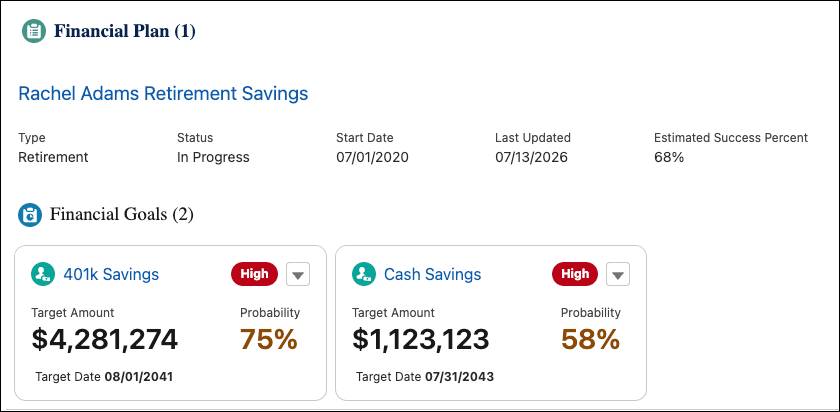
The plan includes two goals. The advisor links the goal to a financial account and specifies contributions that help them to reach their goal. As time passes and the client saves, it’s easy for advisors to track their progress and the probability of success.
Financial goals and plans also integrate with other financial planning systems via open APIs so that data flows between Salesforce and other planning tools.
Clients get relevant, proactive action steps to achieve milestones, such as receiving a congratulatory message upon reaching a down payment goal. Your team has a simple way to advise clients proactively, increase engagement, and deepen client relationships by addressing specific financial outcomes.
If you work with B2B clients, the Business Relationship Plan feature works in a similar way. It extends the Account Plan feature to give relationship teams a more efficient, strategic, and collaborative approach to client planning. See Agentforce Financial Services B2B Foundations for details about this and other B2B-focused features.
Target Engagement Based on Client Data
As you collect more data about a client through automated assessments and plans and goals, you also have more information to apply intelligent segments and AI-driven features to prioritize impactful outreach and identify cross-sell opportunities.
There are a few ways to intelligently target clients in Financial Services.
Use Actionable Segmentation to create targeted client lists based on a certain outcome, such as converting clients to a particular product or feature, or retaining the clients most likely to close their accounts. For example, you can surface the top leads for a quarter, with details about their contact status.
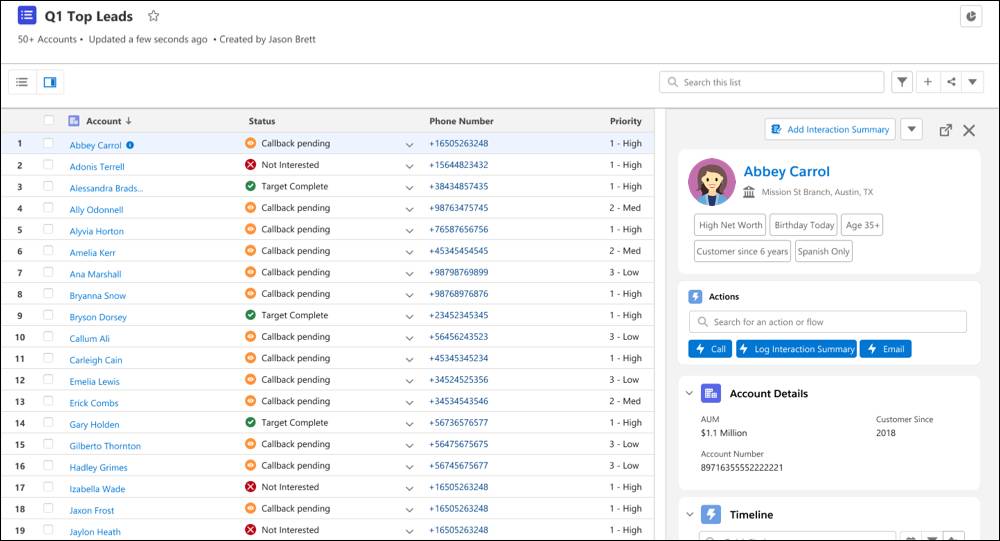
By using data to prioritize your efforts, Actionable Segmentation helps boost productivity by focusing on the clients most likely to convert.
For personalized client-by-client outreach, use predictive analytics and Next Best Action to guide advisors and other team members to convert clients.
First, predictive analytics analyzes client data, predicts future behaviors, and prescribes actionable next steps. Then Next Best Action guides bankers, advisors, and other team members on recommendations and cross-sell opportunities.
Here’s an example of how this process works with the other tools covered in this unit: Predictive analytics find that clients with a high-yield savings account who reach their savings goal are likely to add another investment product. One of your financial advisors gets a Next Best Action alert to check in with a client when they are at 95% to their savings goal and recommend an investment account. The conversation goes great and the client converts.
That example is of only one conversation, though. What about at scale? You can use targeted lists with Marketing Cloud Account Engagement to send clients personalized and timely communication relevant to their life stages and financial needs.
What’s Next?
In this unit, you learned how to put unified client data to work to personalize engagement through automated financial wellness metrics, objects to track client goals, and tools to target your engagement.
Next, you learn about other tools to help your team work with clients, such as purpose-built workspaces, automated workflows, and interaction summaries.