Get to Know the Account Management Data Model
Learning Objectives
After completing this unit, you’ll be able to:
- Explain the purpose of the Account Management data model in Agentforce Life Sciences.
- Describe how the model supports compliant engagement across account, product, territory, and user dimensions.
- Identify the foundational structures that power visit planning, sampling, and strategic coordination.
Before You Start
This unit assumes you’re familiar with the basic structure and capabilities of Agentforce Life Sciences for Customer Engagement. We recommend completing the Agentforce Life Sciences for Customer Engagement badge first.
And check out Data Modeling so you’re comfortable with Salesforce core data model concepts, like standard and custom objects, relationships, and record types.
You explore object structures and entity relationships in this badge.
Why Engagement Requires a Strong Foundation
Life sciences engagement is personal. It is also large in scale.
Teams plan visits, send messages, distribute samples, and follow up across many providers at once. They do this across products, territories, roles, and channels. Each interaction is expected to be appropriate, timely, and permitted.
That expectation rests on data.
Before an interaction can occur, the system must know who the provider is. It must know where the provider practices, which licenses apply, which products are relevant, and which users are allowed to engage. If those details are unclear or disconnected, the system cannot make reliable decisions.
This is the role of the Account Management data model in Agentforce Life Sciences.
The model defines healthcare professionals and organizations as structured records. It connects them to products, territories, and users. Those connections determine what can be seen, planned, and executed at the moment work happens. Decisions are resolved from the data itself rather than inferred later.
This foundation is used everywhere. Planning relies on it. Visits rely on it. Sampling relies on it. Coordination across teams relies on it.
In this badge, you examine how the model is built. You start with provider identity and account structure. You then see how products, territories, and users extend that structure. You finish with the layers that help organizations manage and prioritize engagement at scale.
From Vision to Structure
Consider a field rep preparing to visit a pulmonologist to discuss a new respiratory therapy.
Before that visit appears on a route or calendar, the platform must determine whether the interaction is allowed. It must account for where the provider practices, which licenses apply in that jurisdiction, how the rep is aligned to the account and territory, whether the product can be discussed at that site, and which communication channels the provider has approved. Strategic context, such as affiliations or account importance, may also shape how the interaction is approached.
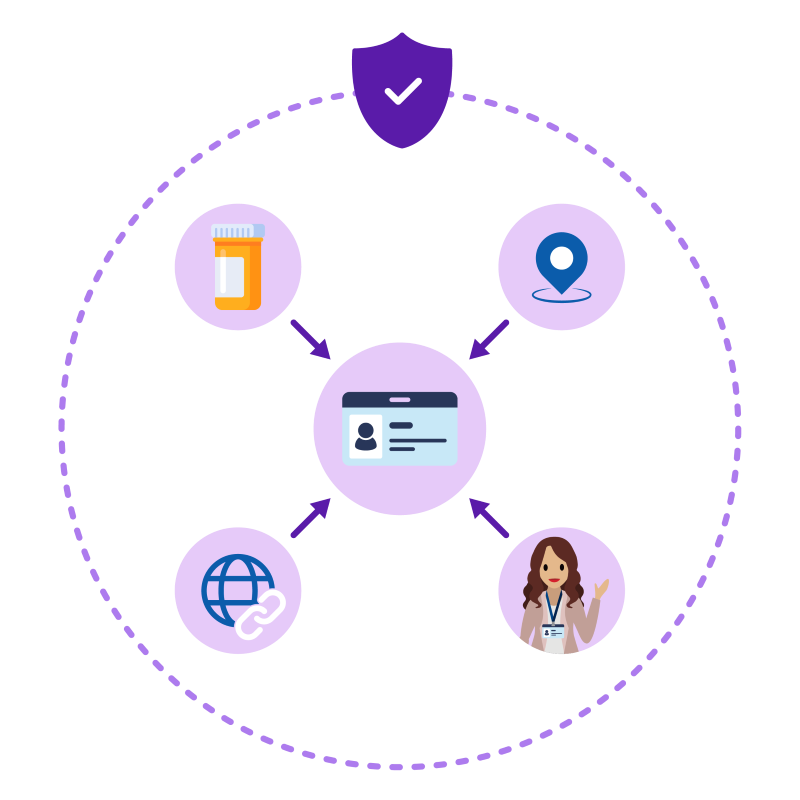
These checks are routine. They happen constantly. They need to be resolved early.
When the underlying data is incomplete or loosely structured, these checks become manual or inconsistent. They happen late, or they are skipped entirely. Teams compensate with judgment calls, and outcomes drift over time.
The Account Management data model is designed to prevent that drift. It makes relationships between accounts, products, territories, and users explicit and enforceable. Eligibility and permissions are built into the process, instead of an afterthought.
View the Whole Model
The Account Management data model consists of many different objects.
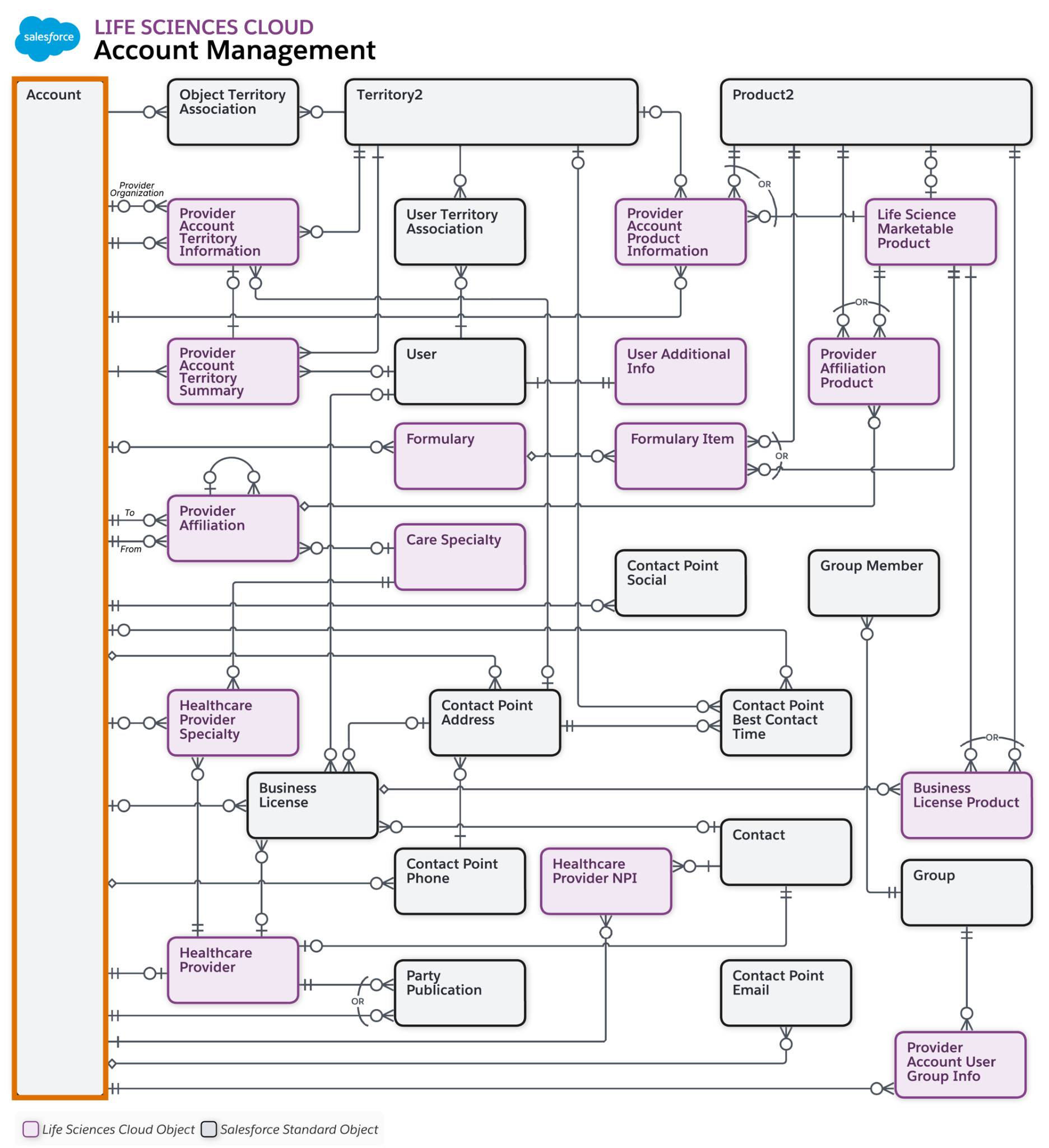
Here, the data model is broken down into smaller chunks. You learn how all of these pieces work together to capture your account management information and processes.
At the center is the Account layer, which represents healthcare professionals and healthcare organizations. This layer includes the information needed to understand how providers operate and how they can be engaged, such as specialties, licenses, identifiers, affiliations, and preferences.
Surrounding the account layer are three additional dimensions that define engagement context.
- Products define what can be promoted, discussed, or sampled.
- Territories define where engagement occurs and which teams are responsible.
- Users define who is authorized to act in each context.
Each layer is built on standard Salesforce architecture and extended with life sciences–specific objects and relationships. The value of the model comes from how these layers intersect.
A product is not simply made available or not available. It is available to a specific provider, at a specific location, in a specific territory, for a specific user, when defined conditions are met.
From Setup to Execution
This model shapes day-to-day work. Here’s how the data model supports your common workflows.
-
Visit planning uses account, product, territory, and user alignment to determine which providers a rep can schedule and what can be discussed in that visit.
-
Sampling workflows rely on licenses, product availability, and account-level restrictions to decide whether a drop is allowed at a particular time and place.
-
Communication and consent management use structured contact points and preferences instead of a single phone or email field, which supports channel-specific compliance.
-
Planning processes, including territory planning and key account management, draw on affiliations, specialties, and product relationships to understand where effort should be concentrated.
Capabilities, such as visit management, key account management, and orchestration all build on this same foundation. Their effectiveness depends on the quality and coherence of the model.
Meet Cumulus Pharma
To make these concepts concrete, you follow Cumulus Pharma, a fictional biotech company preparing to launch a new respiratory therapy.
Cumulus uses Agentforce Life Sciences to build a unified account model that defines healthcare professionals and organizations with structured credentials and affiliations, connects product availability and restrictions to real-world markets, and aligns users and teams to territory-specific responsibilities.
Throughout this badge, you see how these elements are configured and connected, and how they support consistent, data-driven engagement in the field.
In the next unit, you dive into the core Account layer and explore how Agentforce Life Sciences models accounts as regulated, multi-dimensional providers operating within a complex healthcare system.