Learn About Headless Marketing
Learning Objectives
After completing this unit, you’ll be able to:
- Explain what Headless Marketing is and how it differs from traditional, UI-dependent marketing approaches.
- Identify examples of Headless Marketing in action across common marketing use cases.
Think of Marketing Without the Interface
As a marketer, you’re probably used to logging in to a platform, clicking through menus, and building a journey in a visual canvas before activating campaigns. That’s the traditional approach where the UI is the way in, reaching your marketing logic by clicking through screens. Headless Marketing changes that entry point. The traditional Salesforce UI you’ve always used is no longer the only way in. With Headless, that interface can be whatever you want—Slack, a conversational AI client, or even a new custom app. You still drive the work, you just do it from whatever surface you’re already in, with agents assisting alongside you.
With a headless approach, the shift is in how you interact with your marketing logic. The logic, including campaigns, segments, and flows, stay in the Salesforce platform. It’s the same product and the same records you’ve always created. In fact, an action you trigger headlessly, like activating a segment, shows up in the UI exactly as if you’d clicked the button yourself. What changes is what performs the action. It shifts from you clicking in the UI to now an agent taking action directly on your behalf in the platform.
Think of it like a restaurant kitchen. Guests never step into the kitchen, and the cooks don’t care how the dining room is configured. The food is prepared the same way whether the restaurant redesigns its interior or adds outdoor seating. The frontend, or the dining room, is free to change while the backend, or the kitchen, keeps cooking.
Headless Marketing works the same way. The surface your team uses, such as an app, a Slack integration, or a voice assistant, can change anytime, while the underlying campaign logic stays the same. This is what’s known as a decoupled architecture, where the frontend and backend operate independently.
By now you have a feel for the frontend and backend. A few more terms, like API and Model Context Protocol (MCP), are about to come up a lot. Here’s what you need to know before moving on.
Key Terms
-
Backend: This is where the marketing logic lives (the Salesforce Platform).
-
Frontend: This is the surface your team interacts with (Slack, app, custom UI).
-
API: This is the connection that lets your systems talk to the Salesforce platform without a UI.
-
MCP: This is a standard that lets external agents trigger actions in a platform, similar to how an API works. You reach the headless backend through an MCP server from a chat service such as Slack, an AI tool such as Claude or ChatGPT, or a custom integration your IT team builds.
Now that you understand these terms, you’re ready to explore how Headless Marketing works in practice.
Understand How the Layers Connect
A headless setup is built from several connected layers, from the customer data at the foundation up to the surface you use. Each layer has a distinct job.
Layer |
What It Does |
Powered By |
|---|---|---|
Interface |
Lets users and apps run actions and view results |
Slack and custom apps (system of engagement) |
Agents |
Analyze data and trigger the right actions |
Agentforce with third-party models such as ChatGPT, Claude, and Gemini (system of agency) |
Marketing Logic |
Holds records and runs segments, flows, and campaigns |
Customer 360 and Agentforce Marketing (system of record) |
Data |
Unifies customer data in real time |
Data 360 (system of context) |
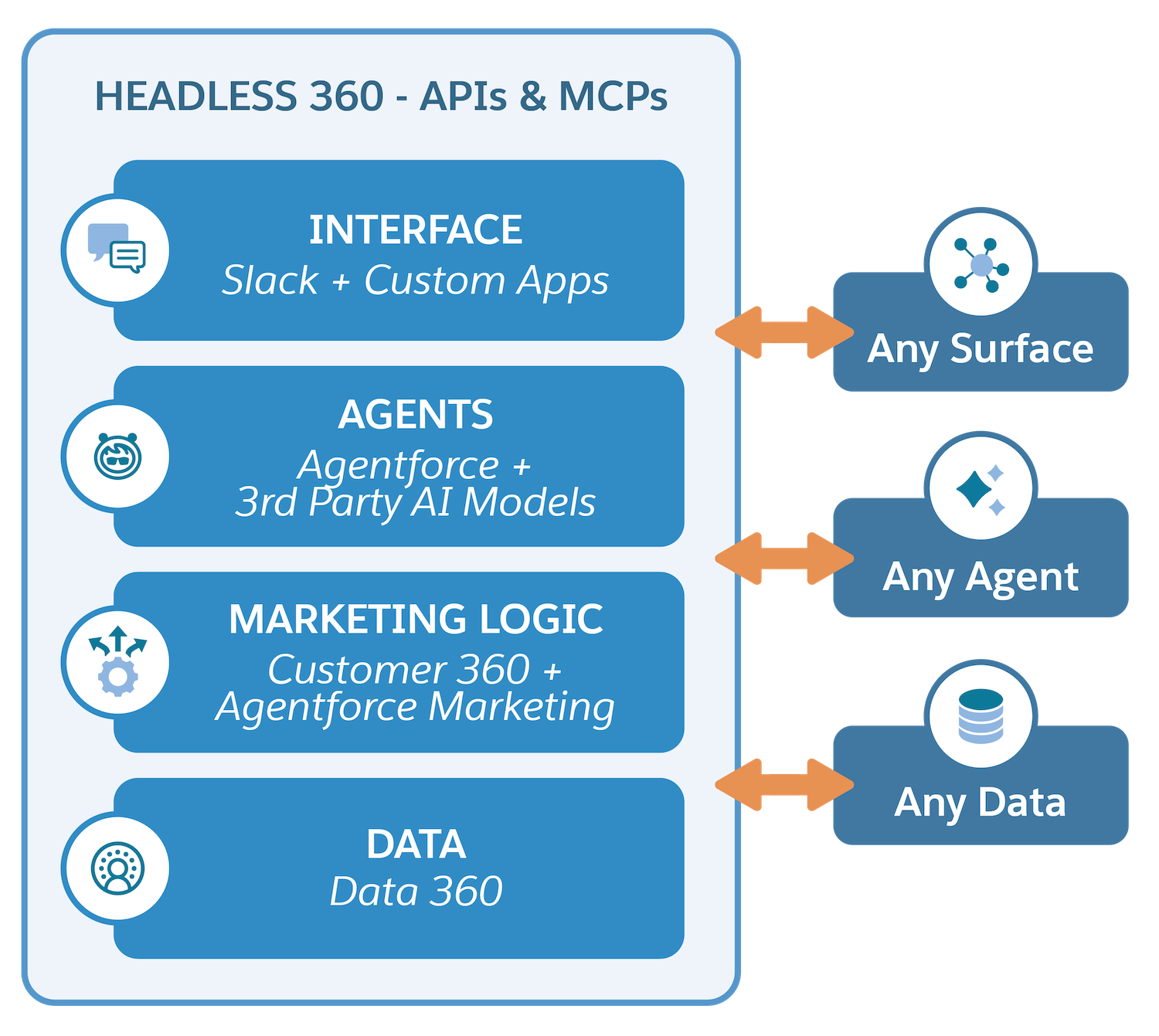
Each layer represents one of the core Salesforce systems.
-
Data 360 provides the system of context.
-
Customer 360 serves as the system of record.
-
Agentforce acts as the system of agency, and your interfaces make up the system of engagement.
Headless integrations connect directly to these layers.
On the delivery side, the platform can push output to any connected surface through APIs and MCP. You define your marketing intent once, and it’s delivered to whatever surface is connected, without rebuilding the logic for each one.
On the request side, MCP offers a standard way to discover and call the right platform actions. Build the request once using MCP and embed it in your integration, so a repeatable task runs the same way every time. MCP is a standard that exposes those actions. It doesn’t manage your entire integration or choose the action for you.
Think of MCP as the standard way to trigger platform actions, and APIs and connected surfaces as the way those results reach your customers and teams.

Spot Where Headless Creates Value
So where does this actually matter for a marketing team? Here are three use cases that show the approach in action.
Use Case |
What It Looks Like |
Why It Matters |
|---|---|---|
Loyalty Campaign Automation |
A loyalty app triggers a personalized reward offer via API the moment a customer hits a milestone. No clicks required from the marketer. |
Campaigns fire in real-time, at the moment of relevance. |
Cross-Channel Delivery |
An external system, such as a custom app, calls Marketing Cloud through the API or MCP to launch a single journey that reaches customers by email, push, and a custom app. |
One source of truth reached every channel, triggered programmatically at the right moment. |
Campaign Management |
From a Slack conversation, a marketer asks for segment data and it’s returned right there. This can be a simple integration that queries and returns data, or, if preferred, an AI assistant layered on top. |
Marketing actions happen inside the tools you already use. |
Headless Marketing works best when Data 360 powers the segment logic. Real-time data is what makes automation meaningful. Without it, you’re delivering campaigns based on stale information.
Wrap Up
Headless Marketing lets your marketing logic work independently of any one frontend. It’s the same platform with the same records. That means your teams can deliver campaigns across any surface through APIs and MCP, instead of relying on a single UI. The platform does its job in the background, invoked by whatever surface fits the moment.
Real-time data is what ties it all together. When Data 360 powers your segment logic, every campaign stays grounded in what’s actually happening in the moment.
You now have a clear picture of what Headless Marketing is and where it delivers value. Take a moment to think about where it could fit into your own organization’s strategy.