Dive into Industries Order Management Decomposition
Learning Objectives
After completing this unit, you’ll be able to:
- Define decomposition relationships in Industries Order Management (OM).
- Discuss the three ways that Industries OM maps the data for downstream fulfillment systems.
- Describe key Industries OM terms.
Decomposition Relationships
Industries Order Management (OM) decomposition maps commercial order information to technical information that downstream fulfillment systems need. Downstream fulfillment systems refer to systems such as shipping, billing, or inventory. Decomposition relationships contain the details of what order information to map and how to map the information.
Decomposition relationships are configured at design time and executed at run time to dynamically produce input data for orchestration. The Infiwave team knows that the Industries Shared Catalog contains commercial products and is shared by Industries OM and Industries Configure, Price, Quote (CPQ). However, Industries Shared Catalog stores the technical products too.
As a fulfillment designer at Infiwave, Greg is responsible for configuring the decomposition relationships. The Infiwave team is all about collaboration, and Greg is confident that they’ll work with him on their areas of expertise.
Data Mapping for Downstream Fulfillment Systems
Decomposition provides a commercial order with the technical information required to fulfill the order during orchestration. Here’s where, when, and how decomposition relationships play a key role in the overall order fulfillment process.
Industries Shared Catalog
Industries Shared Catalog stores commercial and technical order information for products and services. Decomposition takes commercial order information—what the customer sees, such as a smartphone model—and turns that into technical order information. Downstream fulfillment systems use the technical order information for further order processing.
A customer orders a streaming TV service on the Infiwave website. Based on their broadband download speed and high-definition TV, the customer selects the Gold TV package. To fulfill this order, several processes occur, all triggered by this single order.
-
Provisioning: Create the customer account or update an existing account with the new service.
-
Shipping: Ship the high-end set-top box (STB) to the customer site.
-
Scheduling Installation: Schedule a technician to install and test the STB on-site.
-
Billing: Bill the customer after testing.
Information for Downstream Fulfillment Systems
The information that downstream fulfillment systems use to process orders varies based on the system such as shipping, billing, or inventory. After that’s determined, it’s the job of decomposition to map the commercial product information to technical product information that downstream fulfillment systems can consume.
Data Mapping in Industries OM
Using decomposition, you map either standard Salesforce fields to attributes, or attributes to attributes. Attributes are stored as JavaScript Object Notation (JSON) data, a very common data format.
There are three ways to map data: Ad-verbatim, Static, and List. Further, you can control these mappings by setting up one or more conditions. You learn more about them later.
The output of decomposition is used as input for orchestration. Decomposition and orchestration are interdependent and integral for successful order fulfillment.
Notice that the streaming TV service example only hints at the type of technical information hidden from the customer and CSR during their call. Sometimes, even more technically complex information, such as port reservation and activation, is required.
Thanks to decomposition relationships, CSRs at Infiwave don’t bother potential customers with complex, technical information about their orders. This simplifies the ordering process for both CSRs and customers, minimizes loss of sales, and lessens the churn of trained CSRs.
Key Terms in Industries OM
It’s time to explore decomposition further by learning about the key terms in Industries OM. First, study this high-level data flow diagram to understand how orders from the Industries CPQ Cart are decomposed into fulfillment requests.
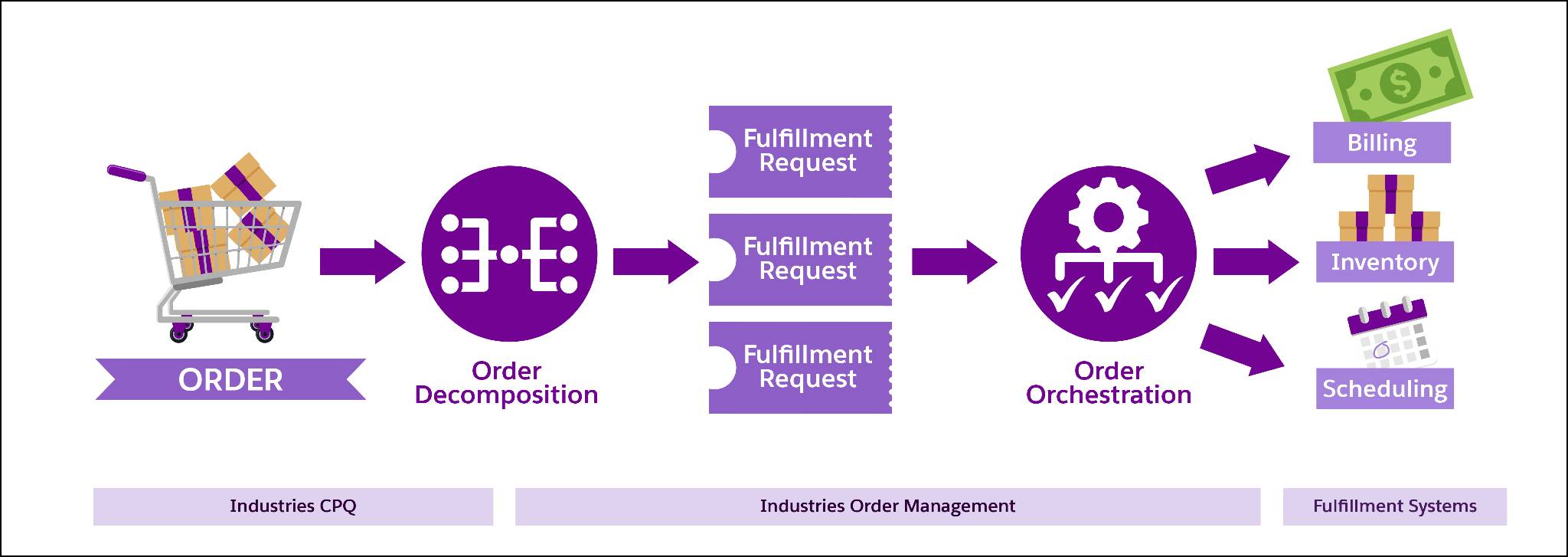
[alt text: Cart orders decomposed into fulfillment requests that orchestration communicates to downstream fulfillment systems.]
Next, learn about decomposition’s role in the overall order fulfillment process.