Learn About Agentforce Commerce for B2C
Learning Objectives
After completing this unit, you’ll be able to:
- Identify how AI-powered features drive higher conversion rates and average order value.
- List the key features and tools available with Agentforce Commerce for B2C.
- Contrast the development approaches used in Storefront Reference Architecture’s server-side framework against the API-first, headless architecture of the Composable Storefront and Progressive Web App Kit.

Experience a Personalized Shopping Journey
Meet Jaimini (he/him), a digital-first shopper. Jaimini is online searching for a new pair of ski goggles. He navigates a storefront, where layouts show recreational skiing images. As he types “goggles” in the search field, the site’s search feature completes the term and prioritizes relevant styles. He selects a pair, and gets a recommendation for matching gloves too. Unsure about fit, he queries a guided shopping assistant, which confirms compatibility. The site shows him that both items are available at a local store. Jaimini orders both, and arranges to pick up the goggles and gloves at the local store on his way out of town for a ski holiday.
While shredding the slopes, Jaimini realizes he needs optional goggle lenses for different light conditions. With Agentforce Commerce for B2C and Salesforce Customer 360 working behind the scenes, an email offer anticipates Jaimini’s need for optional lenses.
During the next gondola ride up the mountain, Jaimini checks his email and finds an offer for goggle accessories and a link to a guided shopping agent ready to help select replacement lenses. Jamini uses the guided shopping experience to help him order optional lenses, and expedite shipping to his condo so he can use the lenses during his ski holiday.
Learn About Agentforce Commerce for B2C
A team of skilled Salesforce admins, merchandisers, and developers use Agentforce Commerce for B2C to bring Jaimini this digital-shopping experience. Agentforce Commerce for B2C is the Agentforce Commerce ecommerce solution that helps your ecommerce business deliver scalable, feature-rich, fully localized storefronts.
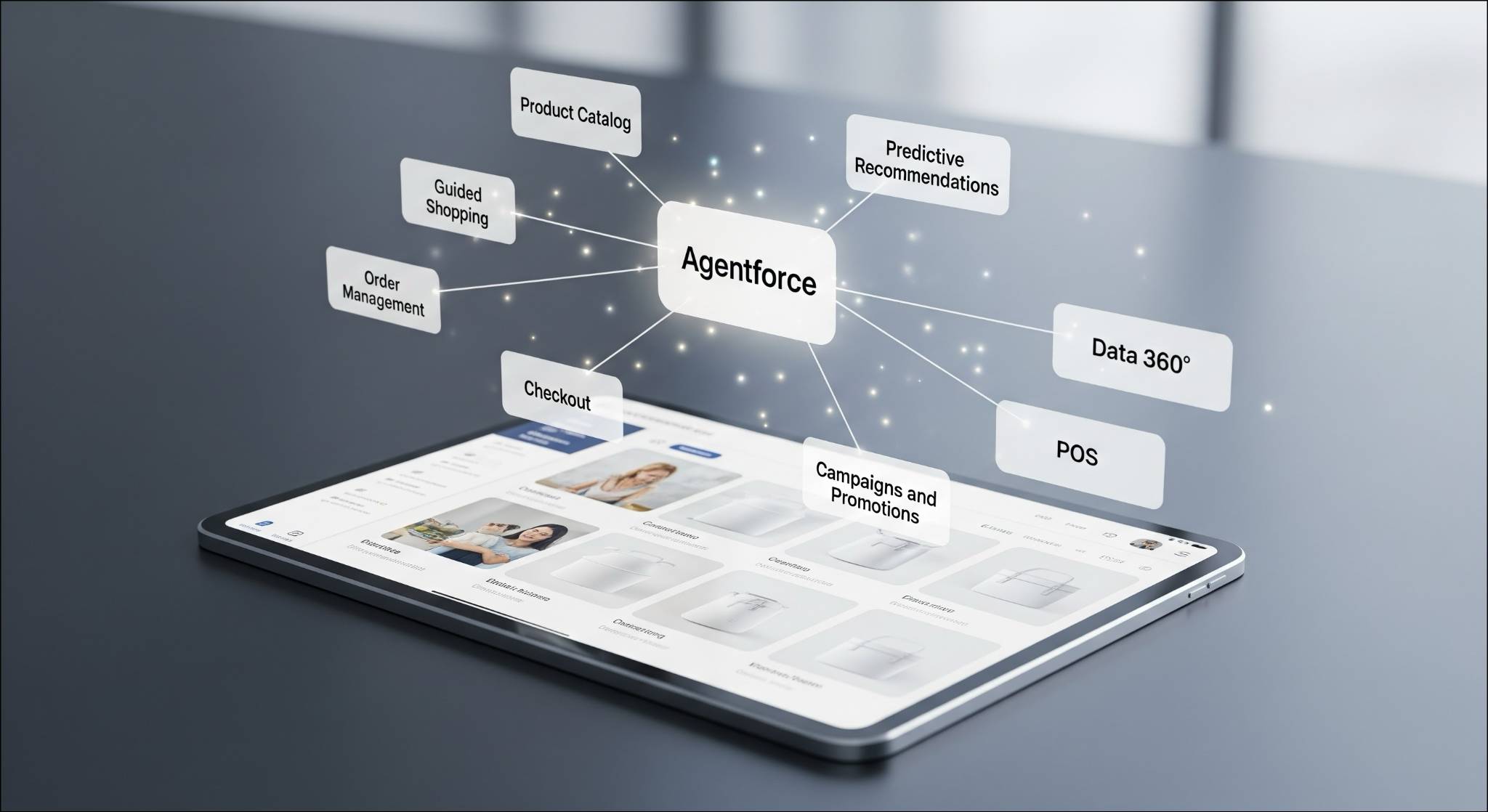
Agentforce Commerce for B2C integrates with other Agentforce Commerce Products, such as Order Management (OM), Salesforce Payments, and Retail Cloud POS (POS). This unified integration helps you personalize the online and in-store shopping experience so you can increase customer loyalty, grow revenue, and lower the cost of ownership.
Agentforce Commerce for B2C Highlights
The easy-to-use Agentforce Commerce for B2C tools and features integrate with data-driven insights to help you optimize your ecommerce strategies effectively.
Agentforce Commerce for B2C offers various features.
-
Personalization across the customer lifecycle: The platform enables retailers to personalize interactions at every stage of the customer journey, from onboarding to retention. Features such as Einstein recommendations provide tailored product suggestions, cross-sell opportunities, and upsell strategies to increase AOV.
-
AI capabilities: Tools like add to cart recommendations and post-purchase product suggestions use AI to predict customer preferences and encourage more orders. These features reduce friction and abandonment while promoting higher-value transactions.
-
Targeted promotions and offers: Retailers can create dynamic, segment-specific promotions that use the industry-leading promotion engine and Data 360. This makes sure that customers receive relevant offers, which can lead to higher conversion rates.
-
Optimized search and navigation: With features like Einstein search, customers can find products more efficiently, reducing bounce rates and improving the likelihood of conversion.
-
Data-driven insights to increase revenue: Agentforce Commerce for B2C provides actionable insights through its analytics and reporting tools.
-
Commerce insights: Retailers can analyze customer behavior, sales trends, and product performance to make informed decisions. Metrics such as basket size, sales volume, and unit performance help identify opportunities for growth.
-
Real-time data utilization: The platform captures and processes data daily, and helps businesses respond to changing customer needs and market trends quickly.
-
Lifecycle segmentation: By segmenting customers based on their journey stage, retailers can deploy targeted strategies to nurture leads, retain customers, and maximize lifetime value.
-
Integration with the Salesforce ecosystem: The architecture connects smoothly with other Salesforce products, such as OM, and Salesforce Payments, making it simple to collect transactions. It also integrates with AI channels and third-party apps like Apple Pay, Meta (Facebook/Instagram), and TikTok, which improves storefront functions.
Build Your Storefront
Agentforce Commerce for B2C offers three main options for building a storefront: Storefront Reference Architecture (SFRA), Composable Storefront and PWA Kit, and Bring-Your-Own Storefront (headless).
Storefront Reference Architecture
Storefront Reference Architecture (SFRA) is a customizable framework perfect for businesses that want to launch their storefront quickly. It provides a structured approach with several key benefits.
-
Accelerated development: SFRA includes a preconfigured framework, reusable components, and templates. Developers spend less time on basic setup and more time on customization.
-
Customization options: SFRA supports Velocity Templates, a Java-based server-side templating language, which helps developers create dynamic and personalized content. Developers also gain access to APIs, including the Agentforce Commerce for B2C API and Script API. These APIs make it possible for developers to tailor a site to meet specific business needs.
-
AI-powered personalization: SFRA supports AI tools to build personalized shopping experiences. Features like active merchandising and Einstein recommendations improve customer targeting and engagement.
-
Easy content management: Tools such as Page Designer and customizable content assets simplify the management of site pages and reusable content. Merchant teams update content without needing deep technical skill.
-
Performance and scalability: SFRA handles high traffic and complex ecommerce operations. Its architecture supports growth, so the storefront expands with the business.
Select SFRA when your business needs a powerful, server-side framework for a fast launch. SFRA offers a direct integration path for businesses moving from older systems or needing compatibility with existing Salesforce tools. Its preconfigured architecture helps you deploy quickly with minimal development effort.
Composable Storefront and PWA Kit
The Composable Storefront, combined with the Progressive Web App (PWA) Kit, presents a modern, flexible, and scalable way to build ecommerce sites. This modular solution supports rapid change, so businesses can adapt quickly to shifting customer demands.
-
Headless architecture: The Composable Storefront uses a headless architecture, separating the front-end presentation from back-end systems. The headless architecture offers several benefits.
- Greater flexibility in design and user experience customization
- Connection with third-party services and APIs
- Faster development cycles, as front-end and back-end teams work simultaneously
- Greater flexibility in design and user experience customization
-
Prebuilt tools and templates: The PWA Kit includes prebuilt tools and templates that help developers get started quickly. These templates are customizable, so businesses can customize them to their specific needs.
-
Managed runtime environment: Salesforce provides a managed runtime environment, which reduces the need for infrastructure management and makes sure that the storefront is optimized for performance and scalability.
-
Improved performance: The PWA Kit provides fast and responsive user experiences including better mobile performance, which is vital for modern ecommerce.
-
Customization and scalability: The Composable Storefront offers superior customization through modular development, which helps teams to add or replace components easily. It’s highly scalable so businesses can manage growth in traffic and transactions.
-
Simplified maintenance: The Managed Runtime environment simplifies ongoing maintenance by providing tools for performance monitoring and optimization, and regular updates and support. Simplified maintenance helps businesses make sure that they’re compatible with the latest technology.
-
Future-ready technology: Businesses prepare their ecommerce platforms for the future by adopting the PWA Kit and Composable Storefront. These tools align with modern development practices and changing customer expectations, ensuring long-term relevance.
Select Composable Storefront when your business needs a headless, API-first solution for maximum flexibility and growth. It suits companies adopting a decoupled front end and back end, handling high traffic, or by using a phased rollout strategy. Development teams can use modern frameworks such as React and PWA technologies. Composable Storefront requires more front-end and API integration knowledge and a higher initial investment than SFRA. Prioritize Composable Storefront for innovation and long-term scaling. The Composable Storefront and PWA Kit offer several advantages over traditional methods. They provide flexibility, scalability, and a modernized user experience, meeting the changing needs of ecommerce businesses.
Bring-Your-Own Storefront
Bring-Your-Own Storefront gives brands the option to use the front-end technology of their choice while connecting to Agentforce Commerce for B2C as the back end via APIs.
Advantages of Bring-Your-Own Storefront (headless):
-
Increase flexibility and customization: The headless approach decouples the front-end and back-end systems. This approach enables developers to use any front-end technology and supports unique branding or UX through a decoupled, headless architecture.
-
Integrate custom features: Add third-party services without working around platform limitation constraints.
-
Future-proof your architecture: Adapt to emerging technologies and get easier, more sustainable long-term updates and redesigns of the user interface without impacting back-end systems.
-
Expand omni-channel reach: Support integration to connect with customers across multiple channels such as mobile apps, devices, and in-store kiosks.
-
Unify the customer experience: Deliver a consistent feel across every digital touchpoint.
-
Optimize performance: Improve load times, search engine optimization (SEO), and the user experience by fine-tuning your front-end code.
-
Empower developers: Support independent development, giving teams more autonomy from back-end constraints to foster innovation, ensure efficient processes, and achieve quicker time-to-market.
Bring-Your-Own Storefront is suitable for organizations with advanced development capabilities and specific requirements that go beyond the capabilities of prebuilt frameworks such as the PWA Kit.
Salesforce Commerce APIs for Composable Storefront and Bring-Your-Own Storefront
For developers, Salesforce Commerce APIs (SCAPI) provide headless capabilities to decouple the front end and back end for greater flexibility.
With SCAPI, developers can do the following.
- Extend existing code investments and power a front-end experience.
- Create fast, unique experiences and unlock site agility to optimize cart conversions.
- Integrate with third-party systems and apps.
- Customize the B2C platform implementation.
Next
In this unit, you learned about the key features available to build and deploy your ecommerce storefront with Agentforce Commerce for B2C. You also learned about the three flexible options for Agentforce Commerce for B2C storefront development: SFRA, Composable Storefront with the PWA Kit, and Bring-Your-Own Storefront (headless). Next, learn how site Salesforce admins and merchandisers use the Agentforce Commerce for B2C features and tools to develop and deploy engaging personalized shopping experiences.
Resources
- Salesforce Help: Get Started with B2C Commerce
- Salesforce: Salesforce B2C Commerce
- Salesforce Developers: Get Started With Storefront Reference Architecture
- Salesforce Developers: PWA Kit Framework
- Salesforce Developers: Get Started with Composable Storefront
- Salesforce Developers: Get Started with B2C Commerce Solutions