Grow Client Relationships
Learning Objectives
After completing this unit, you’ll be able to:
- Identify growth opportunities using business relationship plans and AI-powered insights.
- Explain AI Summaries for business relationship plans.
- Describe Agentforce Financial Services features that help you manage business relationships.
Plan Business Relationships
In the previous unit you learned about tools to collect and track data about your B2B clients. Now that those clients are onboarded, it’s time to manage the relationship.
Fortunately, Agentforce Financial Services includes a purpose-built feature for this job: Business Relationship Plans.
Business Relationship Plans enhance the standard Account Plan and Account Plan Objective objects to give relationship managers a comprehensive tool to grow B2B financial-services relationships. This includes adding financial services specific fields and components to help your team work more efficiently.
Account plans, by default, relate to account plan objectives to track client needs and goals, plus the client’s progress toward those goals. Your team creates strategic objectives for each client and defines measures to track progress against those objectives.
The process starts when a relationship manager creates an account plan to give them a high-level view of a client's needs and the team’s work toward meeting those goals.
On the account plan, relationship managers can pick the best view of information for that client. After all, different business units prioritize specific data points for Account Planning.
The Flexcard Template Selector helps Salesforce admins identify these unique requirements and configure tailored templates for their teams. Users can then simply choose the appropriate template and see all the important data quickly—eliminating the need to stitch information from multiple sources. This tool boosts efficiency and scalability, while meeting the diverse needs of individual business units.
For example, create different Flexcard templates for general B2B clients, manufacturing clients, commercial lending, and healthcare clients.
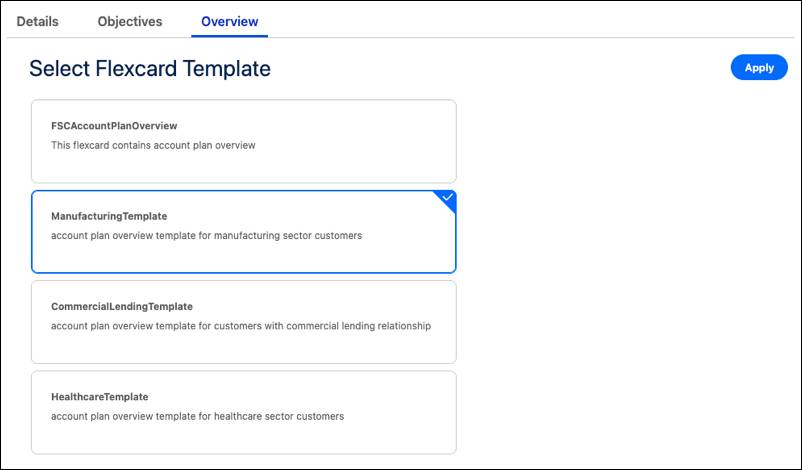
In this example, when a relationship manager creates a plan for a manufacturing client, they select the manufacturing template. Then, the account plan surfaces sector-specific data such as inventory turnover ratio, average payment collection period, and capital expenditure budget.
All of these features work in any sub-vertical, but commercial bankers get the benefit of quick plan creation using the prebuilt Account Plan Lightning page in the Commercial Banking app.
Enhance Business Relationship Plans
To help your relationship managers work more efficiently, add AI Summaries for Business Relationship Plans to provide AI-powered relationship and client meeting summaries.
AI Summaries help your team quickly understand client relationships with generated summaries, streamlining their activities and providing insights.
There are two different summaries available.
-
AI Relationship Summary uses generative AI to provide insights about B2B clients, including details such as won or lost opportunities, factors that contribute to success, and the opportunities and cases in a client pipeline.
-
AI Interaction Summary automatically captures and summarizes interaction details, such as meeting dates, frequently engaged stakeholders, and AI-generated notes from the most recent interactions related to account plan objectives.
These summaries reduce the manual effort to gather and review B2B client information, which helps relationship managers better prepare for client meetings and craft focused business relationship plans. Relationship managers can spend more time working with their clients, building stronger relationships, and driving more revenue.
Manage Account Plan Objectives
While account plans give relationship managers a high-level view of their work with a client, they manage most of the specific tasks using the Account Plan Objective object.
Relationship managers can use this component to create goals and measures in a single guided flow. This helps create alignment and track progress over the life of the plan.
Individual objectives are then assigned to experts and they manage those objectives on individual products or processes. These experts use the account plan objective record to track day-to-day work and plan deviations. On the account plan objective page, they can see all of their work in one place and monitor progress with built-in tools and charts.
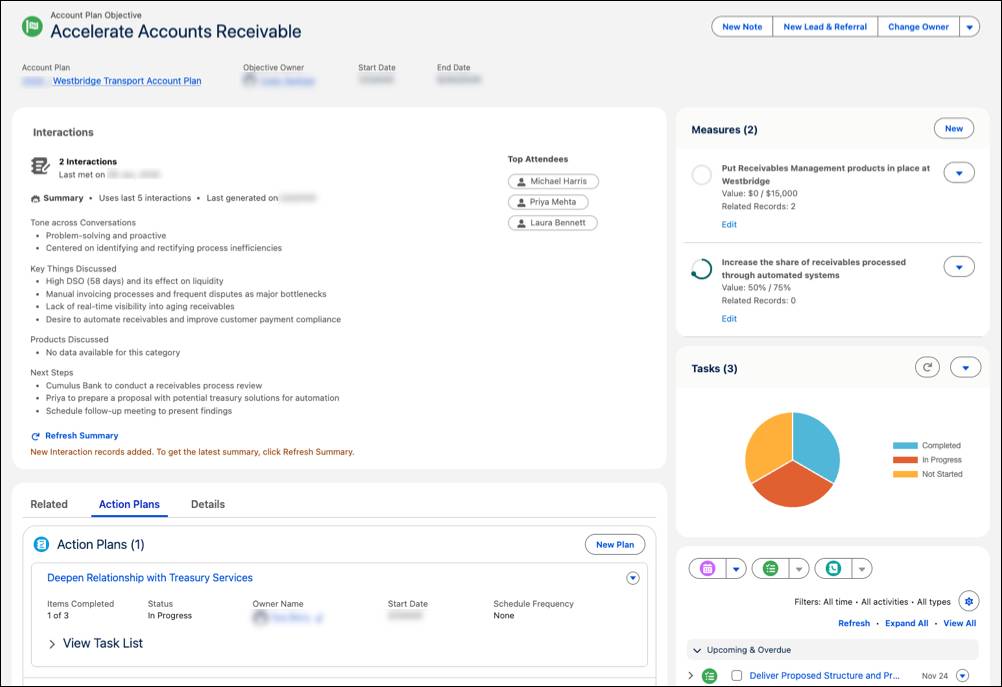
In this example, notice that account plan objectives integrate neatly with action plans so that your team can complete tasks created from action plan templates. This helps ensure your most common, repeatable processes are completed consistently and with accountability.
Track Relationships Over Time
As relationship managers work with B2B clients, they have a suite of other tools to help them capture critical details, manage their work, and build client trust. Here’s a brief review of some of those features, which you can use across your organization with any client type, not just B2B clients.
-
Events and Milestones give relationship managers an at-a-glance view of important business milestones for a B2B client, helping your team identify opportunities and personalize engagement strategies.
-
Financial Deal Management helps deal teams and relationship managers track the lifecycle of financial deals with compliant, role-based data sharing. This leads to improved collaboration for better pipeline management and decision-making.
-
Activity Capture for Agentforce Financial Services automatically syncs client interactions from email and calendar applications to Salesforce. So your data is always current and relationships managers get a full view of their engagement.
-
Action Plans, which you explored earlier in the context of account plans, help your team automate and standardize repeatable tasks. The result? Improved collaboration, productivity, and compliance due to automatic assignment of tasks and deadlines.
-
Tear Sheet Generation helps relationship managers quickly compile summarized client information from multiple objects into a single document. The document provides rapid access to consolidated data for efficient review and decision-making.
For more details about each of these features, see the Help documentation in the Resources section.
Wrap Up
In this unit you learned that Agentforce Financial Services includes Business Relationship Plans, which enhance standard Salesforce Account Plan and Account Plan Objective objects to offer a comprehensive tool for managing and growing B2B financial relationships. You also explored how AI Summaries for Business Relationship Plans can summarize client relationships and meeting details.
Plus, you learned about a few of the other tools that help relationship managers track B2B client relationships over time.
Add these to the other features you learned about in earlier units, such as Business Client Engagement and Integrated Onboarding, and you can see how Agentforce Financial Services can help your institution manage B2B relationships in banking, asset management, insurance, and more.
Now, think about your own organization. How can you apply these tools to help your relationship managers, bankers, and others streamline and grow your B2B revenue?
Resources
- Salesforce Help: Business Relationship Plan
- Trailhead: Account-Based Selling
- Salesforce Help: AI Summaries for Business Relationship Plan
- Salesforce Help: Events and Milestones
- Salesforce Help: Financial Deal Management
- Salesforce Help: Sync Interactions with Activity Capture
- Salesforce Help: Action Plans
- Salesforce Help: Tear Sheet Generation