Set Up a Mobile Worker
Learning Objectives
After completing this unit, you’ll be able to:
- Assign the mobile license permission set.
- Set up sharing for a worker's service resource record.
- Optimize offline priming.
Say Hello to the Connected App Managed Package
You've already been introduced to the Field Service mobile app, and the role it plays in keeping your workers connected in the field. Now it's time to look at what it takes to truly unlock its potential. Out of the box, the app gives workers access to their appointments, job updates, and customer information — but to customize it for your team's specific needs, you need one more important piece: the connected app managed package.
Think of it as the engine under the hood. Without it, some of the most valuable features of the Field Service mobile app simply aren't accessible, and your ability to customize the app for your organization's specific needs is limited. But once you install the connected app managed package, a whole new set of capabilities opens up.
Geolocation services allow dispatchers to see where workers are in real time, making it easier to assign nearby jobs and respond to changes on the fly. Push notifications ensure workers are instantly alerted to schedule updates, new assignments, or urgent messages, which means no more missed communication. And beyond those headline features, the connected app unlocks a range of settings that let you configure the mobile experience to match exactly how your team operates in the field.

Assign Yourself Proper Permissions
Before diving into the setup process, it's important to make sure you have the right permissions in place. The good news is that checking your permissions is quick and straightforward. If you're working in a Trailhead Playground, you're likely already set up with the permissions you need. But it's worth taking a moment to verify:
- Click
 , then select Setup.
- In the Quick Find box, enter
usersand click Users.
- Click your name.
- Under your name, click Permission Set Assignments.
- Look for Field Service Go Admin Permissions.
If you don’t see that permission set in the list, assign it to yourself.
- In the Quick Find box, enter
permission setsand click Permission Sets.
- In the list of permission sets, click Field Service Admin Permissions.
- Click Manage Assignments.
- Click Add Assignments.
- Select the box next to your name and click Assign.
With permissions confirmed, you're ready to start setting up mobile workers and getting them equipped to use the Field Service mobile app.
Create a Service Resource
Before a mobile worker can get started, they need an active Salesforce user account with their password set up. But being a user is just the starting point. The mobile workers also need to be set up as records in the service resources object, and assigned to specific territories. On top of that, they need both a mobile license and a scheduling license to access the mobile app and have their appointments managed by the scheduler.
If you’re following along in a Trailhead playground, you have a limited number of licenses and have to don the hat of both an admin and a service resource. But in the real world, you might need to set up service resources and assign them the right permissions. Let’s see how:
- From the App Launcher, find and open Field Service Admin.
- Click the Field Service Settings tab.
- Click Go to Guided Setup.
- Click Create Service Resources.
- Select the username of your service resource.
- Select the service territory.
- Click both icons to assign Scheduling and Mobile licenses to the service resource.
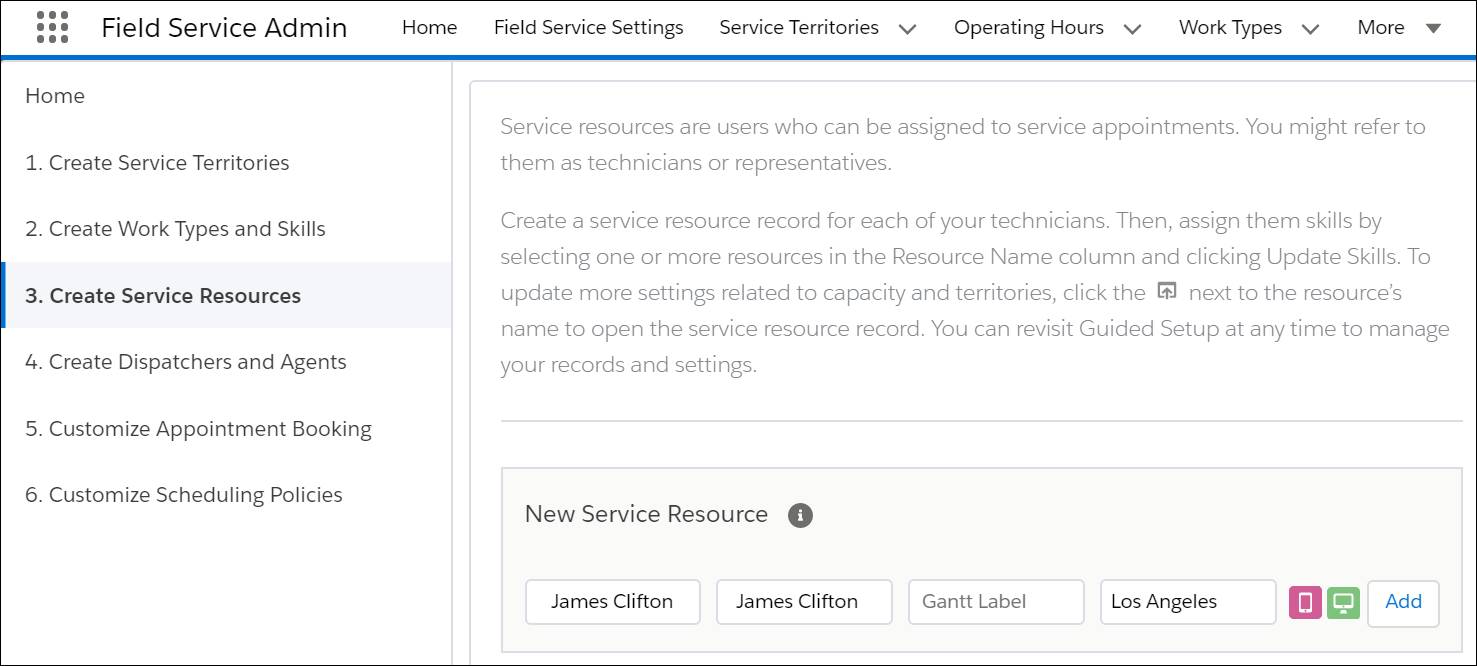
- Click Add.
With the service resource set up and assigned to the right territory, your mobile worker is ready to be scheduled for jobs. Both the worker and their dispatcher can view the schedule from their desktops, but in the field, workers need access on the go. To make that happen, the worker needs to be assigned the correct permission sets:
- Field Service Resource License
- Field Service Resource Permissions
- and FSL Mobile License
These ensure they have the right level of access to do their job effectively. Now only one step remains, giving the mobile worker access to their own service resource record.
Assign Service Record Access
Giving a service resource record access is what connects them to the Field Service mobile app experience. Once this access is granted, the worker can log in to the app on their phone and see everything they need for their day: their upcoming appointments, job details, customer information, and any updates from their dispatcher.
Instead of relying on phone calls or checking in at the office, they have everything in one place, right in the palm of their hand. It's a small but important step that brings the whole setup together and gets your mobile worker truly ready for the field. In your Trailhead playground, sharing is already set up for you as the admin. However, read through the instructions to see how to do it when you have more mobile workers to set up.
- From the App Launcher, choose Service Resources.
- To see all your workers, choose All Service Resources list.
- Select the worker you wish to enable sharing for.
- From the dropdown, choose Sharing.

- In the dialog, choose Read Only.
- Save your changes.
Speed Up Offline Priming
The Field Service mobile app uses offline priming to make sure mobile workers always have access to their data, even when they're working somewhere with no connectivity. Offline priming works by automatically downloading appointment and job data to the device in the background, so everything a mobile worker needs is stored locally and ready to go.
By default, the app is configured to prime the device with all service appointments for 45 days before and after the current date. This creates a 90-day window of data that's available offline. While this broad range ensures that mobile workers have comprehensive visibility into past and upcoming work, it also means there's quite a bit of information to download when someone opens or refreshes the app.
For organizations where mobile workers primarily focus on the immediate past and near future, downloading three months of appointment data might be too time consuming. Longer priming periods mean longer initial load times, which can leave your mobile workers waiting before they can get started with their day.
The good news is that you have full control over this setting. You can adjust the offline priming date range to better match your team's actual needs. This significantly reduces the amount of data being downloaded and speeds up the app's readiness, so let’s see how you can do this:
- Click
 , then select Setup.
- In the Quick Find box, enter
mobile settingsand click Field Service Mobile Settings.
- On the dropdown for Field Service Mobile Settings, select Show Details.
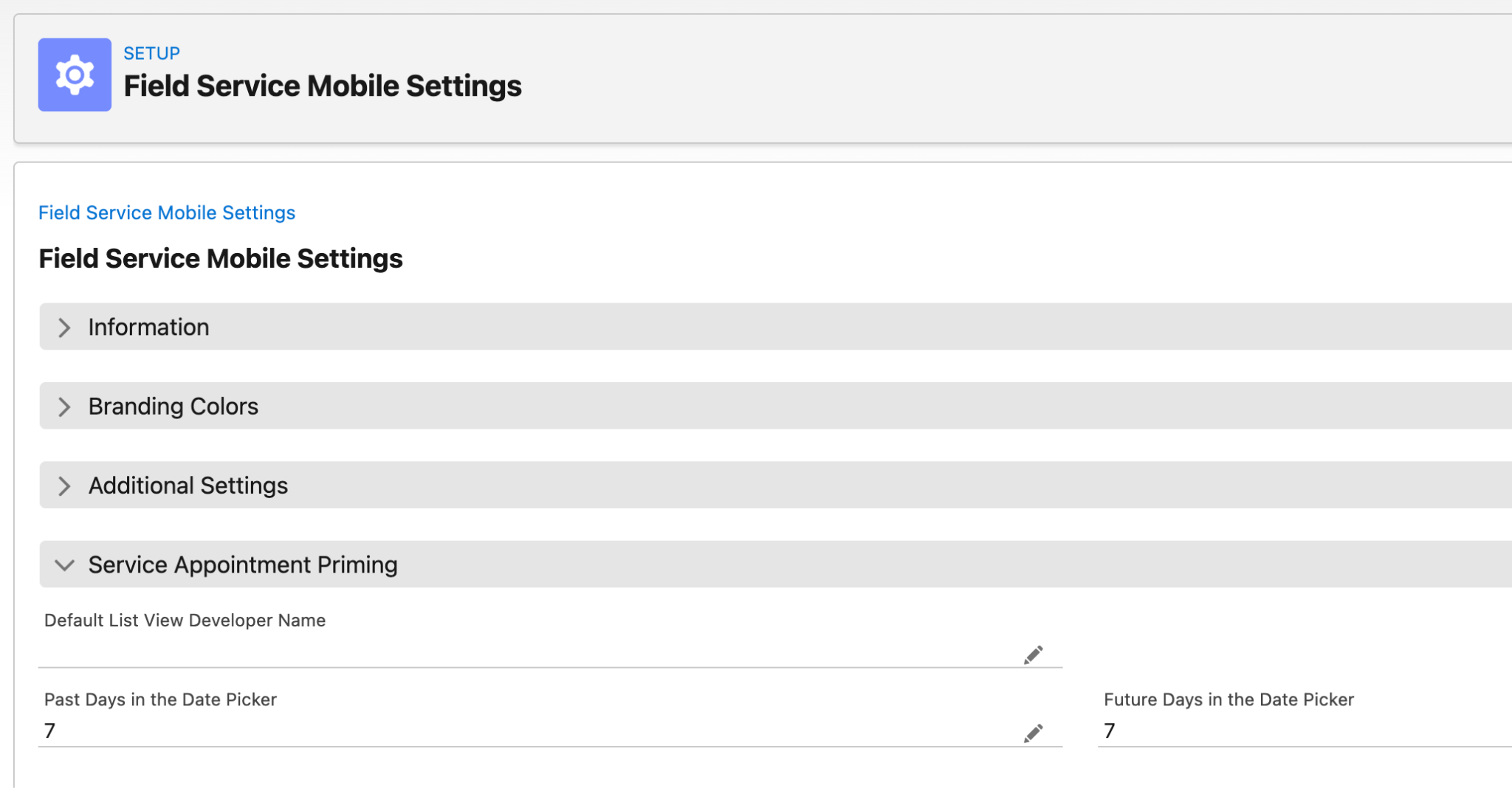
- In the Past Days in the Date Picker field, enter the range as 7.
- In the Future Days in the Date Picker field, enter the range as 7.
- Click Save.
After adjusting the offline priming settings, the app launches much more quickly. The reduced date range means less data to download, which translates to a faster experience for mobile workers.
Adjusting the date range is a great first step toward a faster app experience, but there's another powerful option to go about it. Performance Priming takes a smarter, more targeted approach to keeping the Field Service mobile app ready for the field. Rather than downloading a broad window of appointment data, Performance priming uses offline briefcases to sync exactly the records and metadata each mobile worker's profile needs — and nothing more. The result is a noticeably faster, more efficient app experience that keeps your team focused on the work, not the wait.
With this, you’ve completed the essential setup steps to get your mobile workers up and running with the Field Service mobile app. The foundational pieces are in place, and your mobile workers can start managing their schedules, accessing job details, and completing work in the field.But there's more you can do to make the mobile experience even better. In the next unit, we'll look at how to set up quick actions and flows that streamline common tasks and help your mobile workers work faster and more efficiently in the field.
Resources
- Salesforce Help: Download the Field Service Connected App
- Salesforce Help: Give Users Access to the Field Service Mobile App
- Salesforce Help: Offline Priming in the Field Service Mobile App
- Salesforce Help: Get Started with Performance Priming for the Field Service Mobile App