Get to Know the Salesforce E2E Front Office
Learning Objectives
After completing this unit, you’ll be able to:
- Discuss how the Salesforce customer relationship management system (CRM) has changed.
- Describe how the Salesforce Customer 360 supports the full E2E front-office business process.
- Explain how Agentforce integrates and supports every step of the Salesforce E2E business process.
- Discuss how the Salesforce E2E front-office solution impacts key performance indicators (KPIs).
Investigating the Salesforce Solution
As the Cloud Kicks CIO and IT manager dig into the possibilities of a digital transformation, they first look at the full suite of products Salesforce offers. They learn that the Salesforce CRM, now known as the Customer 360, has evolved through acquisitions and changes to support the full E2E front-office experience.
They also learn that every Salesforce product is deeply integrated around a single source of data, shares metadata across channels, and is powered by an agentic layer called Agentforce to assist and connect employees, customers, and retail partners. This allows leaders to extract AI-powered insights about any segment of Cloud Kicks business. They’re also intrigued by Slack for collaboration and Tableau analytics for reporting.

The Front-End Business Process
Cloud Kicks leaders know that in addition to reducing the number of older systems they maintain, moving to an integrated digital system will trim the time it takes to get from concept to money in the bank. They review their business process to examine each step in getting from concept-to-cash.
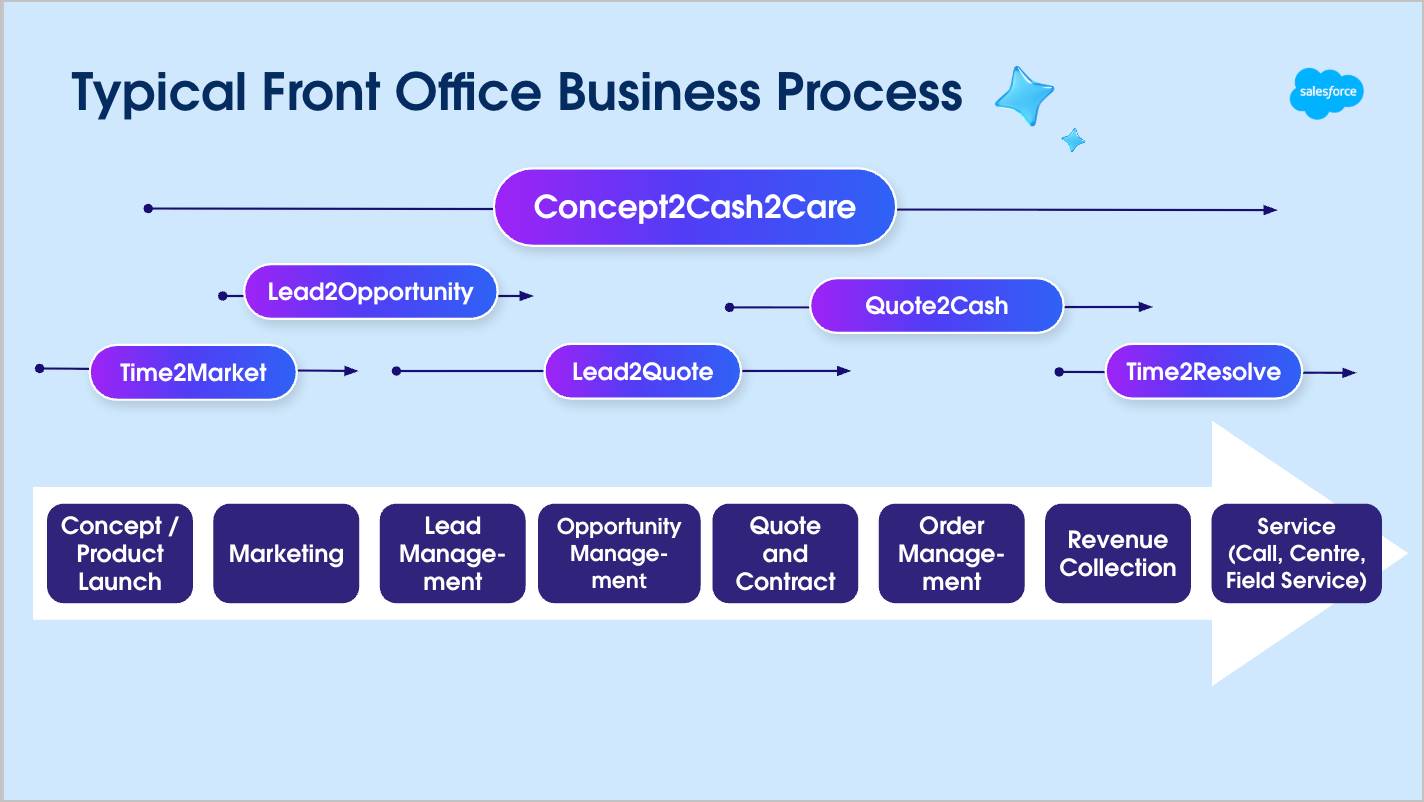
Concept/Product Launch
The first step in getting a new trainer or footwear accessory to market is the product or concept launch. When the Cloud Kicks team begins to develop a new trainer style, they must finalize a number of details. They need to define the product specifications, the timeline, pricing, materials, colors, compatible accessories, suppliers, manufacturers, packaging, and much more. If they’re launching a concept, like a product promotion or seasonal offer, they need to define the details that go along with that, too.
Cloud Kicks’s Current System Mashup |
Salesforce E2E Front-Office Solution |
|---|---|
In Cloud Kicks’s current mashup of systems, concept and product details are siloed in whichever tool the team used to create the detail. |
With a fully integrated front-office system, details defined at the concept/product launch step are automatically available to teams at later steps in the process, considerably reducing the design time.
|
B2B/B2C Marketing
Once a product or concept launches, marketing teams get to work crafting their campaigns.
Cloud Kicks’s Current System Mashup |
Salesforce E2E Front-Office Solution |
|---|---|
Marketing teams look for details in multiple places. Changes to product or concept details from the product side may go unnoticed until it's too late. |
Marketing teams can use all of the facts and data defined in both the product/concept launch phase and any Data 360 data segments to ensure the right sellers and buyers know what they need to know about each product. If a detail changes in the product catalog, the marketing team has immediate access to the new information. Salesforce products: Marketing 360, Commerce 360, Sales 360 |
Leads, Opportunities, Quotes, and Contracts
Marketing generates leads, and leads turn into opportunities. Opportunities move into quotes and contracts.
Cloud Kicks’s Current System Mashup |
Salesforce E2E Front-Office Solution |
|---|---|
|
Quotes at Cloud Kicks are often inaccurate because they use spreadsheets to store pricing data, and these spreadsheets go out-of-date quickly. Sales teams using these spreadsheets often have stale information. Upselling opportunities are often missed due to the lack of visibility of compatible accessories like shoelaces and charms. |
Sales teams have the most current and accurate product details and pricing information at their fingertips so they can both discuss the product and generate accurate quotes that remain valid for the duration of the quote. They’re able to view and act on trainer promotions or see compatible products, like shoelaces, to increase cross-selling and upselling opportunities. If Cloud Kicks chooses to maintain its spreadsheet-based pricing model, Salesforce offers digitization tools like Data Loader or MuleSoft that ingest and update large quantities of spreadsheet data quickly to help keep it current.
Salesforce products: Sales 360, Revenue 360, Data Loader, MuleSoft |
Order Management
Once a contract is signed, order management works to deliver the product on time.
Cloud Kicks’s Current System Mashup |
Salesforce E2E Front-Office Solution |
|---|---|
Cloud Kicks’s inventory system is outdated and sometimes inaccurate, and it is cumbersome to add new products to its inventory. The system also lacks transparency to other parts of the business that could benefit from knowing which trainers or accessories are selling and which aren't. |
Product, marketing, and selling teams would have accurate insight into inventory so they know which trainers and accessories to make more of or to promote or discount. AI insights provide up-to-the-minute details about the sales of each product.
Salesforce products: Sales 360, Revenue 360, Commerce 360, Marketing 360 |
Revenue Collection
Revenue collection creates invoices, bills business customers for larger orders.
Cloud Kicks’s Current System Mashup |
Salesforce E2E Front-Office Solution |
|---|---|
Cloud Kicks’s revenue collection system is cumbersome and is heavily customized to work with its other systems. The customizations make it difficult to update to make use of new capabilities. |
Revenue 360 handles invoicing, billing, and returns. It also notices orders and communicates with back-office solutions like SAP or Oracle to prompt revenue collection from its retail partners. Salesforce products: Revenue 360, Sales 360 |
Aftercare/Customer Service
Customers need fast, friendly, and accurate support for order or product issues.
Cloud Kicks’s Current System Mashup |
Salesforce E2E Front-Office Solution |
|---|---|
Cloud Kicks already uses Service 360 to handle customer support, so the company is off to a good start. However, it’s cumbersome to find order details, sales details, or log product issues because those functions are housed in its legacy systems. The company is also not yet taking advantage of the benefits of letting AI agents handle a percentage of its customer service inquiries. |
Integrating Service 360 with other products in the Customer 360 gives customer service reps the details they need to be successful and handle questions and issues quickly. AI Agents can be built to handle most types of cases and can route more complex cases to customer service reps.
Salesforce products: Service 360 sharing data and insights across the Customer 360. |
Out-of-the-Box Capabilities
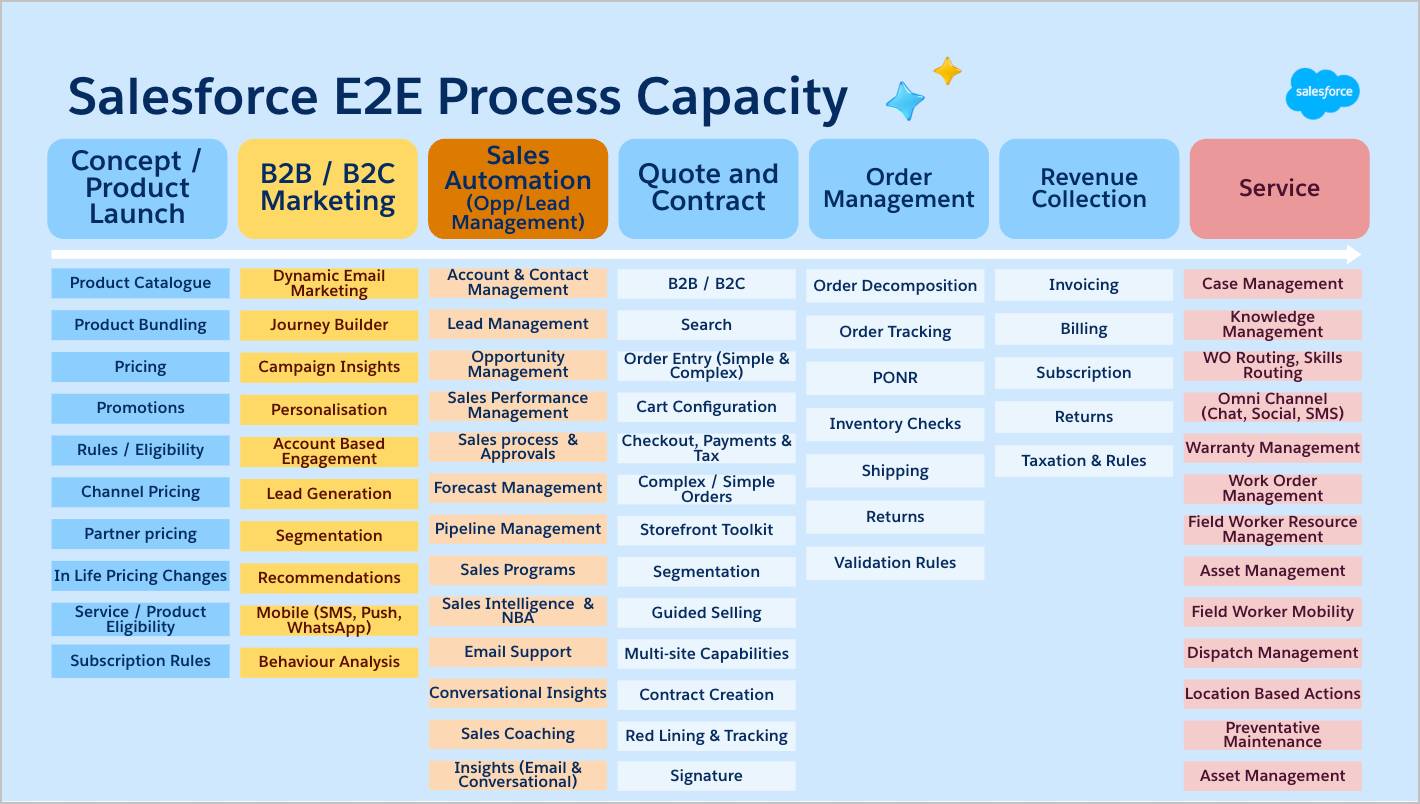
As the Cloud Kicks CIO and IT manager review their business processes, they look at the additional capabilities Salesforce can bring to their business at each step. They see so many opportunities where they can streamline their business.
They know that:
- Each solution works with the very same data across the business.
- Employees from product designers, to sales reps, to customer service agents have this data at their fingertips.
- AI agents increase productivity by helping employees in their jobs.
- Tableau analytics provide the transparency into the business operations that is currently lacking.
- Collaboration across the business increases with the adoption of Slack.
They are impressed that all of these capabilities are available right out-of-the-box with no customizations needed. This eliminates the headaches and bottlenecks the IT team has faced when trying to update their outdated, customized systems.
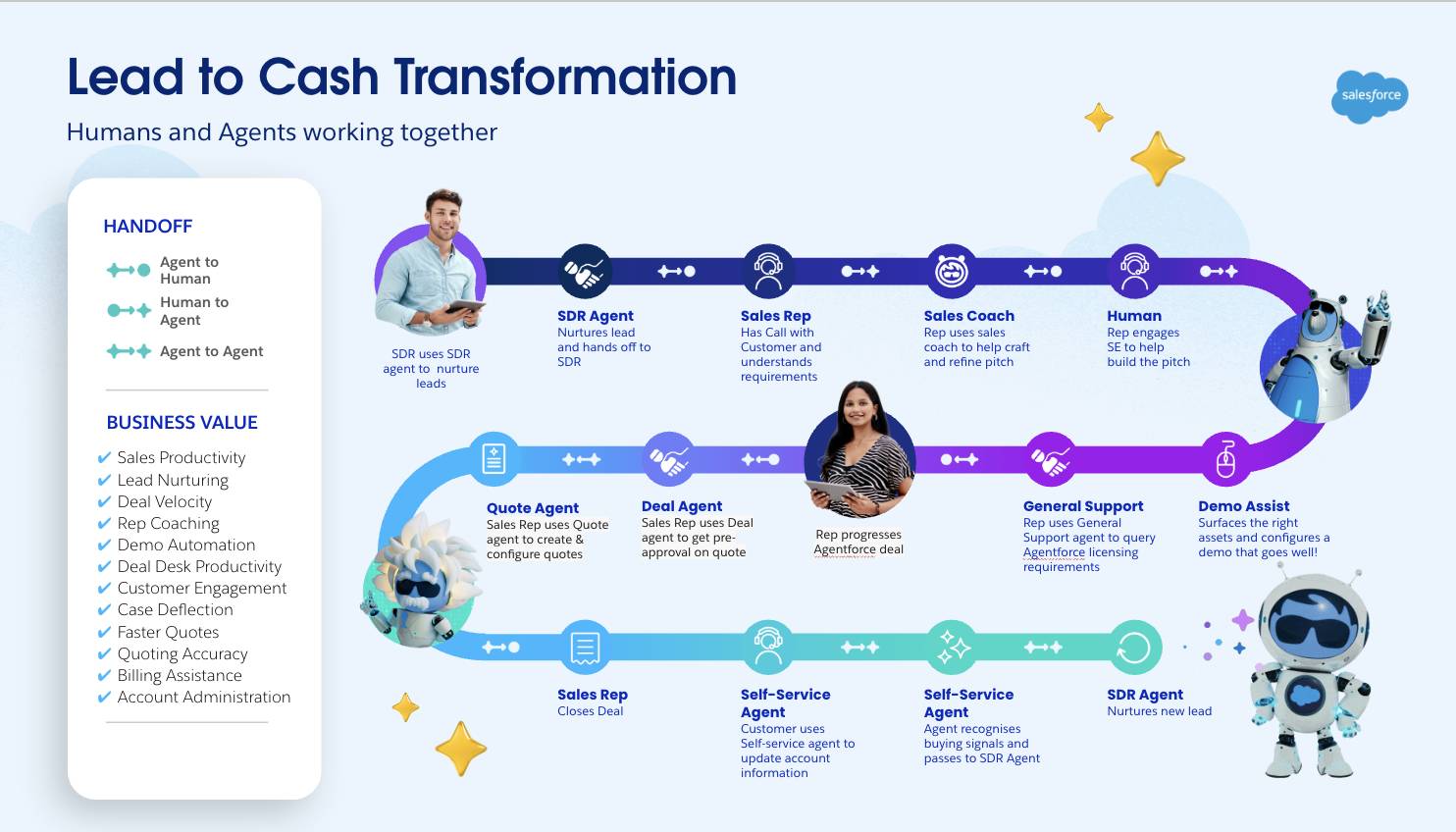
Humans and Agents Working Together
Cloud Kicks leaders want to learn how AI agents can add value across their business, particularly through the selling process. Since Agentforce agents can be granted access to the same data their human counterparts can access, they can assist with jobs like nurturing leads, following up with customers, practicing their pitches, and providing details on products and licensing, so that reps can focus on closing deals.
Evaluating Key Performance Indicators
The IT manager and CIO also look at key performance indicators (KPIs) to evaluate where they think moving to a full Salesforce E2E front-office solution can bring improvements. They determine that:
- Sharing data across the 360 can reduce time-to-market for new products by about 30%.
- Lead-to-quote times can be reduced by 29% by having access to current product, pricing, and customer data.
- Intelligent, data-driven insights can increase upselling and cross-selling of shoes and accessories by 30%.
- IT costs can be reduced by at least 27% without the upkeep of their multiple legacy systems.
- Building AI agents to help customer service requests can bring down their cost of service by 27%.
- Call center productivity can be increased by 30% when reps can quickly access the accurate data they need to resolve a case.
Wrap-Up
After reviewing all of the benefits of moving to a full Salesforce E2E front-end office solution, the IT manager and CIO are eager to present their findings to their leadership team. A move of this type is exactly what Cloud Kicks needs to move into the future and lower its IT costs and time to market.