Editar modelos e criar configurações de slot
Objetivos de aprendizagem
Após concluir esta unidade, você estará apto a:
- Descrever a relação entre modelos de página do B2C Commerce e slots de conteúdo para exibir recomendações de produtos.
- Diferenciar os processos de criação de modelos e configuração de slots nas lojas (virtuais) SFRA, Composable e Site Genesis.
- Configurar um slot de conteúdo no Business Manager para exibir recomendações de produtos.
- Identificar quais tipos de recommender se alinham a contextos específicos de slots e páginas das lojas (virtuais).
Configurar páginas das lojas (virtuais) para exibir recomendações
Com o recommender configurado, é possível configurar as páginas das lojas (virtuais) para exibir as recomendações geradas por ele.
Para criar uma loja (virtual) B2C Commerce, os desenvolvedores utilizam diversas ferramentas. Entre as mais importantes estão os modelos. O B2C Commerce usa modelos para definir como transforma dados e informações de página em páginas web dinâmicas baseadas em HTML que ele renderiza no navegador.
Esta unidade explica como os modelos de página, os slots de conteúdo e os recommenders de produtos do Einstein funcionam em conjunto para criar uma configuração de slot que exibe recomendações personalizadas de produtos aos compradores. Você também aprenderá como colaborar com seu desenvolvedor para criar um modelo de página e como criar um slot de conteúdo no Business Manager.
Criar modelos de página para recomendações
Os modelos desempenham um papel fundamental na implantação de um recommender de produtos do Einstein no B2C Commerce. Eles constituem a estrutura básica para integrar e exibir recomendações personalizadas de produtos em sua loja (virtual).
Os anunciantes e desenvolvedores precisam colaborar para desenvolver modelos para as recomendações de produtos do Einstein no Salesforce B2C Commerce. Os requisitos específicos variam dependendo de como os desenvolvedores do B2C Commerce criam sua loja (virtual) — Storefront Reference Architecture (SFRA), Composable Commerce ou Site Genesis. Vamos examinar cada abordagem e as diferentes tarefas para desenvolvedores e anunciantes.
Lojas (virtuais) SFRA
As lojas (virtuais) SFRA utilizam modelos baseados em ISML, mas seguem uma abordagem modular, com as configurações de slots gerenciadas no Business Manager.
-
Modelos: os desenvolvedores criam modelos baseados na Internet Store Markup Language (ISML) que separam as funções e a lógica da página. Os cartridges e componentes predefinidos da SFRA utilizam lógica de renderização para analisar o modelo. Por exemplo, controladores ou modelos lidam com a lógica de negócios, e não os modelos.
Os desenvolvedores utilizam o cartridgeapp_storefront_basecomo base e o estendem para personalizações.
-
Configurações de slots: os anunciantes criam e gerenciam a configuração dos slots de conteúdo por meio do Business Manager.
Lojas (virtuais) Composable
As lojas (virtuais) Composable funcionam de maneira diferente. Os desenvolvedores utilizam estruturas modernas de front-end para criar e gerenciar modelos.
-
Modelos: os desenvolvedores criam modelos que utilizam estruturas modernas, como React, Angular ou Vue.js. A abordagem Composable separa o front-end do back-end e acessa os dados do recommender e dos slots de conteúdo por meio das APIs do Salesforce Commerce (SCAPI).
-
Configurações de slots: os anunciantes criam e gerenciam a configuração dos slots de conteúdo por meio do Business Manager.
Lojas (virtuais) Site Genesis
Os desenvolvedores gerenciam modelos e slots diretamente por meio de arquivos ISML e do Business Manager.
-
Modelos: os desenvolvedores trabalham diretamente nos arquivos ISML. Eles modificam os modelos existentes para incluir o slot de conteúdo do recommender. Os desenvolvedores utilizam marcas de ISML para definir o conteúdo dinâmico, a lógica de renderização e as configurações de slots.
-
Configurações de slots: os anunciantes criam e gerenciam a configuração dos slots de conteúdo por meio do Business Manager.
Como anunciante, você fornece ao seu desenvolvedor detalhes sobre a lógica de recomendação, incluindo o tipo, a estratégia, a regra e a âncora, para cada abordagem de desenvolvimento da loja (virtual).
Além disso, você também trabalha com o seu desenvolvedor para determinar os principais aspectos relacionados ao slot de conteúdo.
-
Posição: onde exibir as recomendações na página
-
Título: o título das recomendações. Crie o título de forma que ele seja visível para os compradores, relevante para as recomendações e alinhado com o design e o tom do site.
-
Menu suspenso: (opcional) quando um menu suspenso fizer parte do layout de recomendação, inclua detalhes do menu suspenso que estejam alinhados com a estratégia de recomendação.
-
Atributos de exibição: os atributos de exibição dos produtos recomendados. Por exemplo, nome do produto, descrição, preço e classificação.
Um slot de conteúdo é uma localização específica na página, conforme definido em um modelo. No Business Manager, você cria uma configuração de slot de conteúdo que identifica o que é exibido na localização, quando e por quanto tempo. No slot de conteúdo, você pode mostrar produtos, categorias, ativos de conteúdo ou HTML estático. Ativos de conteúdo são elementos da página, como imagens, gráficos de marketing, conjuntos de resultados de pesquisa de produtos, carrosséis de produtos e — quando combinados com um recommender de produtos — recomendações de produtos.
Os recommenders identificam os produtos recomendados que são exibidos no slot de conteúdo com base nos resultados das recomendações de produtos do Einstein.
Utilize slots de conteúdo para exibir recomendações de produtos nas páginas da sua loja (virtual). Consulte Gerenciar e criar configurações de slots para obter informações sobre como configurar slots de conteúdo.
Ao configurar um slot de conteúdo para recomendações de produtos:
- Selecione um slot de conteúdo que tenha um contexto global.
- Defina o campo Content Type (Tipo de conteúdo) como Recommendation (Recomendação).
- Selecione um valor para o campo Recommender.
- Selecione um modelo de renderização adequado na pasta de slots/recomendação.
O campo Recommender contém uma lista nomeada de regras de negócios, chamadas de recommenders, que você pode definir na ferramenta Einstein Configurator (Configurador do Einstein). Essas regras controlam como o Commerce Cloud Einstein gera recomendações de produtos.
Configurar um slot de conteúdo
Você pode configurar slots de conteúdo global e de categoria para exibir recomendações. Veja como os slots de conteúdo mapeiam para as páginas da loja (virtual) e quais tipos de recommender você pode usar em uma página.
Contexto do slot |
Página da loja (virtual) |
Produto a produto |
Produtos em uma categoria |
Produtos em todas as categorias (sem necessidade de âncora) |
Visualizados recentemente (sem necessidade de âncora) |
Complete o conjunto |
|---|---|---|---|---|---|---|
Global |
Página inicial |
✓ |
✓ |
|||
Global |
Página de destino da categoria |
✓ |
✓ |
|||
Categoria |
Página de destino da categoria |
✓ |
✓ |
|||
Global |
Página de detalhes do produto |
✓ |
✓ |
✓ |
||
Global |
Carrinho |
✓ |
✓ |
✓ |
✓ |
|
Global |
Lista de desejos |
✓ |
✓ |
✓ |
✓ |
|
Global |
Checkout |
✓ |
✓ |
✓ |
✓ |
|
Global |
Minha conta |
✓ |
✓ |
|||
Global |
Minhas recomendações |
✓ |
✓ |
|||
Global |
Erro 404 |
✓ |
✓ |
A seguir, saiba como criar uma configuração de slot global para a página de detalhes do produto. As etapas são as mesmas para criar e gerenciar configurações globais ou de categoria.
Vamos supor que seu desenvolvedor já tenha criado um modelo.
- No Business Manager, clique em App Launcher (Iniciador de aplicativos) e selecione Merchant Tools (Ferramentas do comerciante) | Site | Online Marketing (Marketing online) | Content Slots (Slots de conteúdo).

- Selecione o slot home-categories-m.
- Clique em New (Novo) para criar uma nova configuração.
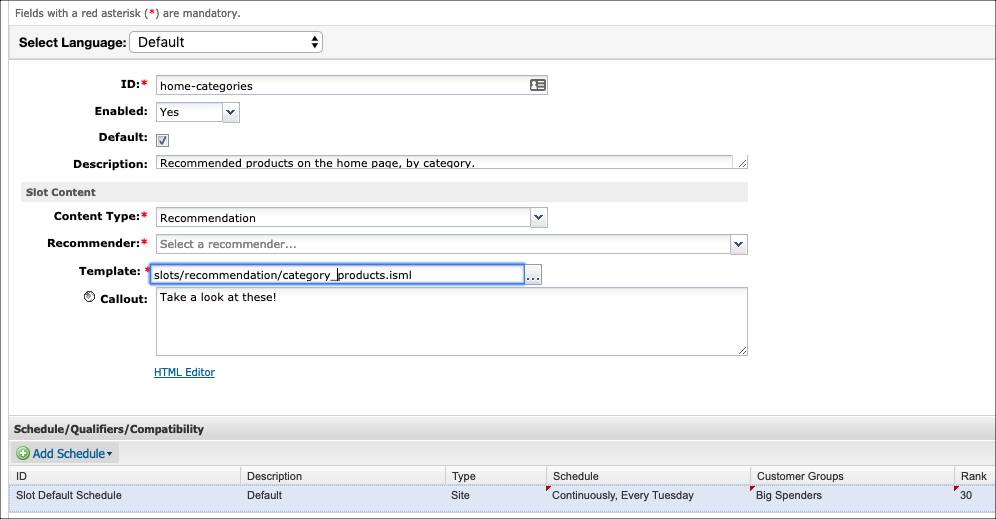
- Habilite a configuração.
- Selecione-a como padrão e insira uma descrição.
- Selecione o tipo de conteúdo: Recommendation (Recomendação).
- Selecione um recommender. (Nota: Você só pode ver recommenders em uma instância de grupo de instância primária (PIG). Uma instância de sandbox não tem as recomendações de produtos do Einstein habilitadas.)
- Selecione o modelo: pdp.isml e clique em Save (Salvar).

- Clique em Adicionar programação e selecione um tipo de programação. Um intervalo de slot não pode ser menor que 1 hora (60 minutos). As condições de horário estão sempre sujeitas a considerações de fuso horário e horário de verão.
- Atribua grupos de clientes: Big spenders (Maiores compradores).
- Clique na coluna Rank (Classificação) para classificar o slot. Essa configuração informa ao B2C Commerce qual o slot a ser exibido quando você tiver programado várias configurações de slot. Se várias configurações de slot tiverem classificações iguais, o B2C Commerce usará a última que foi editada. Quanto menor a classificação, maior a prioridade.
- Clique em Apply (Aplicar).
- Clique no ícone de visualização para ver o slot na loja (virtual).
Finalização
Nesta unidade, você aprendeu a trabalhar com seu desenvolvedor para criar modelos de página para slots de conteúdo. Você também aprendeu a criar um slot de conteúdo e a ativá-lo no modelo e em sua loja (virtual).
Recursos
- Ajuda do Salesforce: Sobre modelos para campanhas da Web
- Desenvolvedores do Salesforce: Modelos
- Desenvolvedores do Salesforce: API do B2C Commerce Einstein