Tell Your Story with Feeling
Learning Objectives
After completing this unit, you’ll be able to:
- Identify your audience in order to tell a story that resonates with them.
- Use a storytelling framework to tell your story.
- Use storytelling techniques to provoke change.
Once Upon a Time…
Congratulations—you’ve made it to the final unit in this module. This is where we pull it all together. It’s storytime!
You’ve done a great job gathering important findings from users. Wouldn’t it be great if that was all you had to do? Just slap the top themes in an email to stakeholders, who would immediately understand the implications of your finding and take swift action. Yup! That would be super . But let’s come back to reality.
Chances are, if you want traction, you’ll need more than that. For example, you might want to:
- Pluck at the heartstrings of those who hold the keys to the budget and the black box of what can and can’t get implemented.
- Tell a story of change and transformation to a happier implementation (or product launch).
- Show how your hard work can get you all from here to there.
By the end of this unit you will have some tools to do just that.
Persuasive Storytelling 101
Memorable experiences are derived from change. No, not the kind of change that rattles in your pocket, a change that’s transformative and that shifts the way you think or behave. Your favorite, or most despised, movie is memorable because it generates an emotional response. You want the findings from your research to do the same—be memorable, effect change, and generate an emotional response.
Good stories generally work with the following elements:
- An audience: This comprises your stakeholders (including their needs and motivations).
- A champion, a problem, a mission, and goals: Your users have a problem to overcome. They (and you) will reap the rewards when they achieve their goals and complete their mission.
- Three stages: A journey has a beginning, a middle, and an end—spoiler alert: not necessarily in that order.
Embedded in the three stages are phases—peaks and valleys of transformations and feelings:
- Transformations: Your main user, or the focus of your story, transforms from what they were to something different(from good to bad, bad to good, or good to bad to good).
- Feelings: Persuasive stories follow one additional rule—they evoke emotion and facilitate engagement. Use all the emotions you have at your disposal to strategically drive points home.

Know Your Audience
Knowing your audience, like knowing your users, helps you frame the story of your research through a lens most meaningful to them.
Ask yourself these five questions:
- Who’ll decide what will get built or changed?
- Who owns the budget?
- Who owns design?
- Who owns development, testing, and deployment?
- Who’ll document and train people on the change?
Your audience is everyone on this list. They all have a stake in the output—some people refer to them as stakeholders. Now that you know your audience, you’ve got to know their needs—sound familiar? Yes, it’s not unlike gathering data for research, and it’s just as important.
You’re interested in what your stakeholders need to hear to either open the dialogue around your recommended changes or persuade them to facilitate these changes. You need to know which levers to pull in order to convince them that your argument is sound.
Here’s a short list of the most common motivations (also known as levers):
- Saving money
- Making money
- Reducing work
- Increasing time on task
- Proving value
- Looking great
If you don’t know their motivations, use your new user research superskills to uncover them.
Your Champion, Your Problem, Your Mission
You’ve got your audience, now for the keys to your story: a champion, a problem, and a mission.
Your Champion
No mystery here—the center of your story is your user. The type of people you interviewed to collect your data, who’ll benefit most directly from the change you want to make. Your champion can also be an archetype of your users—a persona. The more you focus on the users who are most impacted if nothing changes, the more impact your story will have.
Your Problem, Mission, and Goal
A problem without a mission is like a champion without a journey… pretty boring. Your problem is the same one you defined in the first unit of this module. Now you just need to associate it with your audience’s motivations and show that you need to solve for it—that’s your mission!
The problem and the mission set the scene for your story and also clearly depict the ultimate goal of your study. A mission differs somewhat from the problem statement—it defines the actual work you’ve done to get to the root of the problem. Pair your mission with a great call to action. Carla knows that a great example of a mission statement includes your champion, in this case, her sales team and junior sales associate persona:
“Over the past year we’ve seen a dramatic decrease in our product application usage, which is our sales team’s core enablement app. In Sales Ops our core mission is to provide the effective tools to help our sales team drive revenue. To investigate the drop in usage, we interviewed and observed both sales managers and sales associates in their daily work. We looked for ways to improve the app and help our salespeople be more efficient.”
Success! She has clearly stated the problem, evoked strong emotions, and stated the mission of her research.
Armed with her problem, mission statement, and goal, Carla can remind her audience that they’re on this journey together in service to a greater good—for our product, our users, and our company!
The Three Stages of Storytelling
Now that you have that mission and problem statement, you can kick off your three-stage storytelling journey. Let’s break it down.
Stage 1—The Opening
Introduce yourself, your personas or users, and your method of collecting data. It’s OK to bring up recent history—talk briefly about what got you to where you are today. If you have access to data from your users (for example, field usage/usage trends) that can add depth to your story, then weave it into the backstory.
Stage 2—The Cycles of Challenges and Solutions
In the core of your story, you’ll depict a series of pitfalls and incremental solutions.
The pitfalls can be your themed findings or challenges, and you can bring them to life with compelling images or quotes from your participants. You can even use video sound bites of your user expressing concerns, challenges, or difficulties (remember “strategically placed feelings” —here is a good place for them).And always remember to reference your work by citing how you collected your information—your audience might ask.
Balance each of your findings with your proposed solutions—building on them incrementally. Try to present achievable solutions—ideally vetted in advance. Recommendations resonate particularly well when they come from the users themselves or when they come from your audience.
The back and forth between challenge and solution, finding and recommendation, helps build the cadence of your story into a series of positive possibilities. Finding opportunities in every challenge is a great way to showcase mini transformations. These mini transformations are critical in storytelling to keep the gloom and doom at bay. They also inform the storytelling arc and should build to support the ideal outcome.
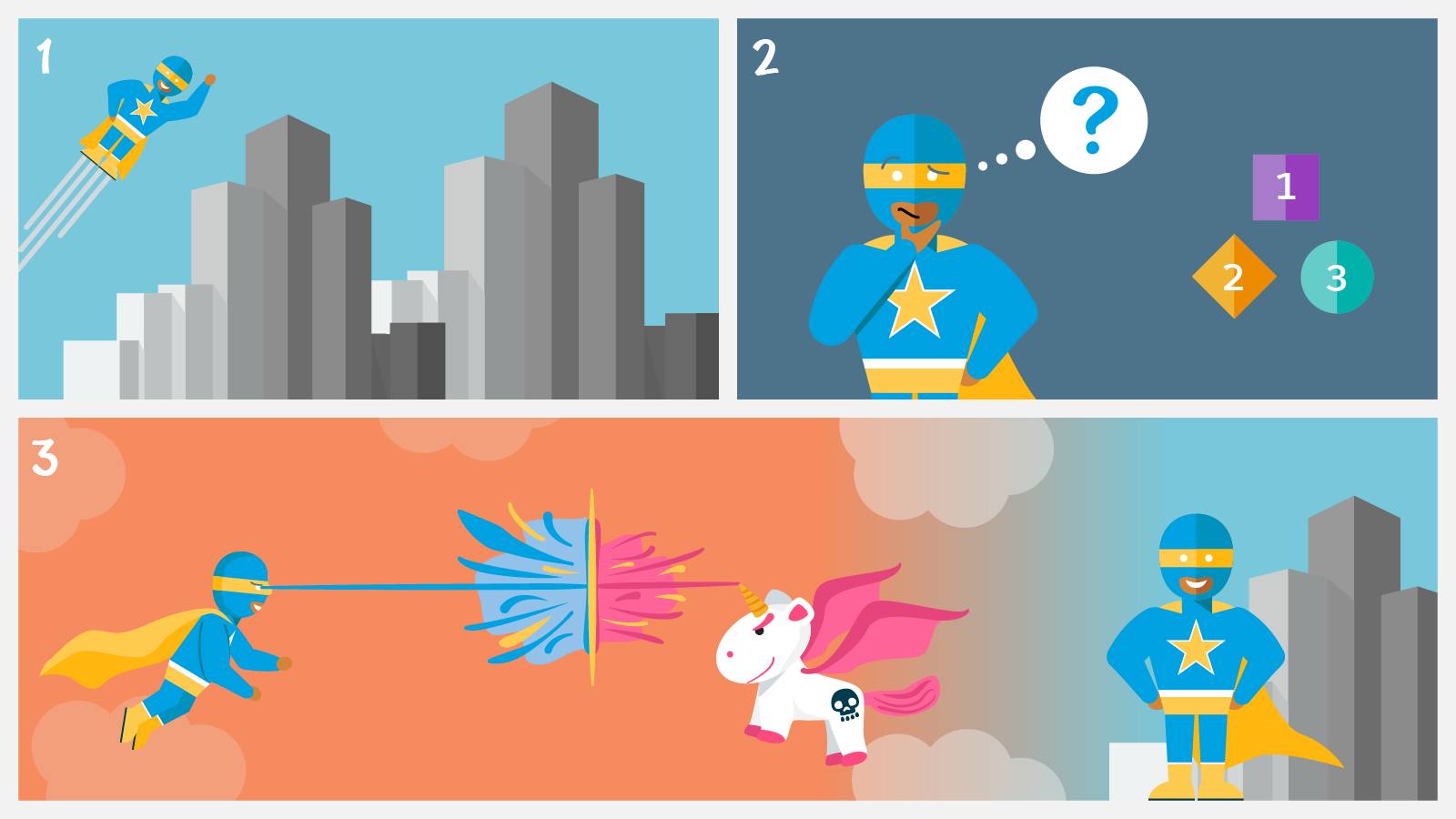
Stage 3—The Positive Conclusion
Once you’ve safely survived all the cycles of challenges and solutions that make up the core of your story, you’re ready wrap things up. Restate your problem clearly.
If you can, create a lightweight vision of a possible future—presentation software is a great way to do this if you don’t have access to fancy graphic design programs. Be sure to touch upon all the work you’ve done and pull out the big finale—your depiction of a future state!
This is your last chance to review the journey you’ve undertaken and to show how your findings, if acted on, will result in a new and better user experience. (And help your small piece of the world.)
Tell It Again (and Again, and Again…)
Huzzah! You’ve painted a happy future where all the challenges have a solution, your users have come out of the journey unscathed, and they’re about to embark upon a future state full of rainbows and ice cream cones.
Your fabulous storytelling will be acted on immediately, right? That would also be awesome, but alas that kind of stuff only happens in fairy tales. What really works is telling the story, again, and again. Make modifications here and there to elicit more “ooohs” and “aaahs,” with every retelling.
Create new lenses for your story to help it resonate with a different type of audience with different motivations. You might wind up with four versions of your story, and that’s OK—as long as you don’t dilute your message.
One day when the time is right, and you’ll know it when it is, you’ll be able to table that story and pat yourself on the back for a job well done. That’s when you know it’s time to restart the journey to discover your users’ new needs. But now that you have all these UX research tools, that should be easy.
So pick up your clipboard, put your researcher cap on, and don’t forget to enjoy the journey!
Resources
- Download the UX Research Basics Pack, including the results PowerPoint template
- Brett Dillingham’s Visual Portrait of the Story (VPS)