Découverte de modèles de données pour la gestion des relations et le service client
Objectifs de formation
Une fois cette unité terminée, vous pourrez :
- Décrire les modèles de données qui aident votre équipe à gérer et à établir des relations avec des clients particuliers et B2B
- Expliquer les modèles de données permettant de gérer les services client et les recouvrements
Gestion des relations et plans
Dans l’unité précédente, vous avez examiné les modèles de données qui prennent en charge le début du parcours client ; ces modèles se rapportent à l’intégration de nouveaux clients, à la vérification de leurs informations et au recueil des données et du consentement dont vous avez besoin pour leur proposer des services de manière responsable. Toutefois, le véritable travail ne s’arrête pas lorsqu’un client a franchi votre porte. Les banques, les assureurs et les sociétés de gestion de patrimoine bâtissent leur réputation sur leur capacité à entretenir des relations et à répondre aux besoins de leurs clients.
Cette unité présente les modèles de données qui rendent cela possible. Ces modèles de données aident vos équipes à saisir les grandes lignes d’une réunion avec un client, à exécuter des processus répétés de manière cohérente et à rester au fait des situations de service sensibles telles que les réclamations, les litiges relatifs aux transactions et les recouvrements.
Le modèle de données Interaction Summaries (Résumés d’interaction)
Le modèle de données Interaction Summaries (Résumés d’interaction) permet aux banquiers et aux conseillers financiers d’enregistrer et de partager des notes relatives aux interactions avec les clients. Cet ERD présente l’objet Interaction Summary (Résumé des interactions) et la manière dont il est relié à d’autres objets.
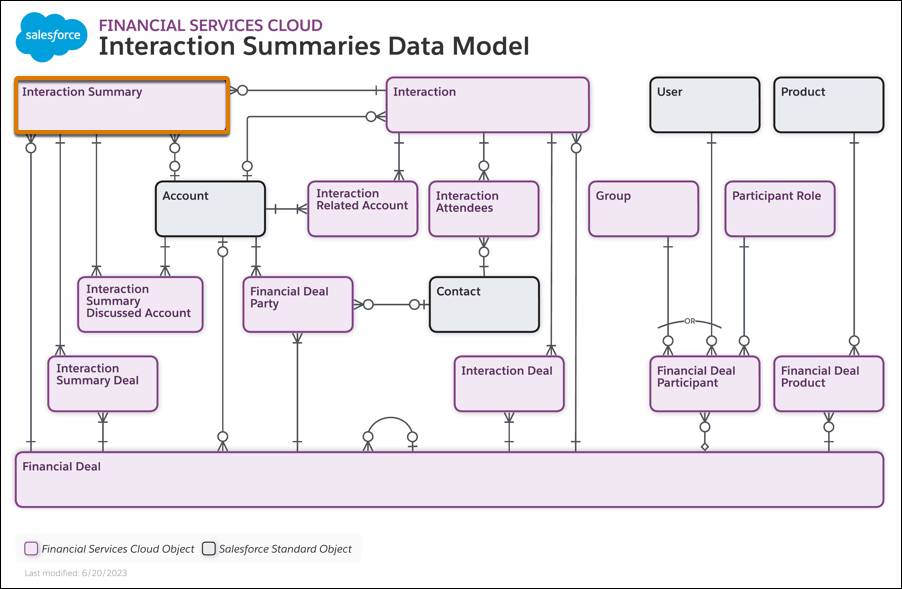
Interaction Summary (Résumé des interactions), l’objet clé du modèle de données, stocke les notes de réunion de manière à ce qu’elles puissent être partagées en toute conformité. Par exemple, voici une capture d’écran d’un résumé des interactions lors d’une réunion d’analyse et d’évaluation des besoins d’un compte.
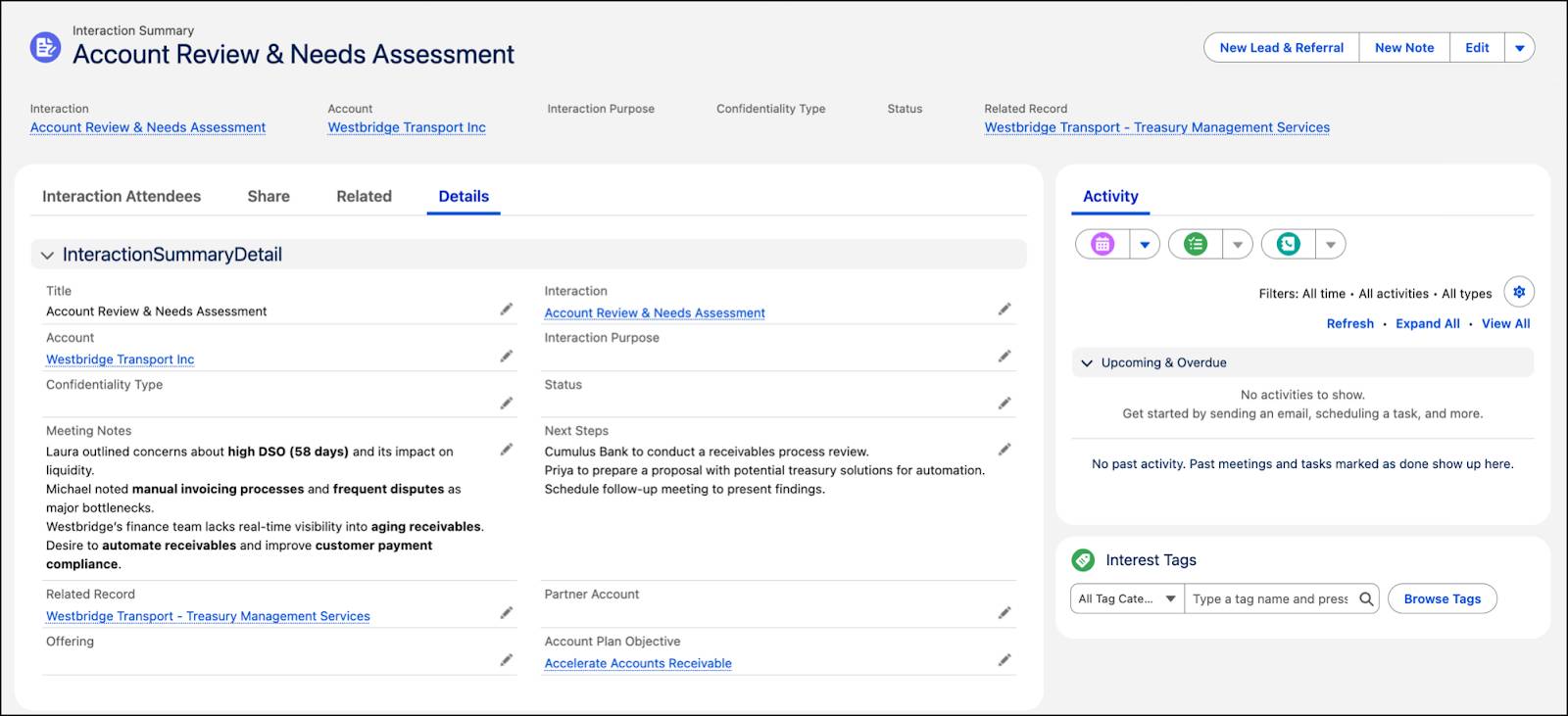
Ce résumé des interactions est lié à un compte, comme vous pouvez le voir dans l’ERD. Vous pouvez également l’utiliser pour prendre des notes sur les opportunités et les objectifs du plan de compte, comme le montre l’image précédente. Vous pouvez associer des résumés d’interactions à tout autre enregistrement pour lequel il est utile d’avoir des notes sécurisées. L’objet enfant Interaction permet de suivre les participants et les détails d’une réunion, tels que le lieu et l’heure.
Ces informations vous permettent de disposer d’un enregistrement conforme, sécurisé et permanent de vos interactions avec les clients, de sorte que toute personne affectée à un compte puisse rapidement comprendre les besoins de ce client et son historique au sein de votre institution.
Le modèle de données Action Plan (Plan d’action)
Le modèle de données Action Plan (Plan d’action) aide les utilisateurs à créer des modèles d’ensembles de tâches et à documenter des exigences grâce à l’objet Action Plan Template (Modèle de plan d’action). Vos utilisateurs peuvent utiliser ces modèles pour créer des enregistrements de plans d’action détaillés qui attribuent automatiquement des responsables de tâches et des échéances pour des missions spécifiques concernant les clients. Cela permet à votre équipe de normaliser des processus communs.
Voici comment ces objets sont reliés entre eux, de l’étape de définition jusqu’à l’étape d’exécution.
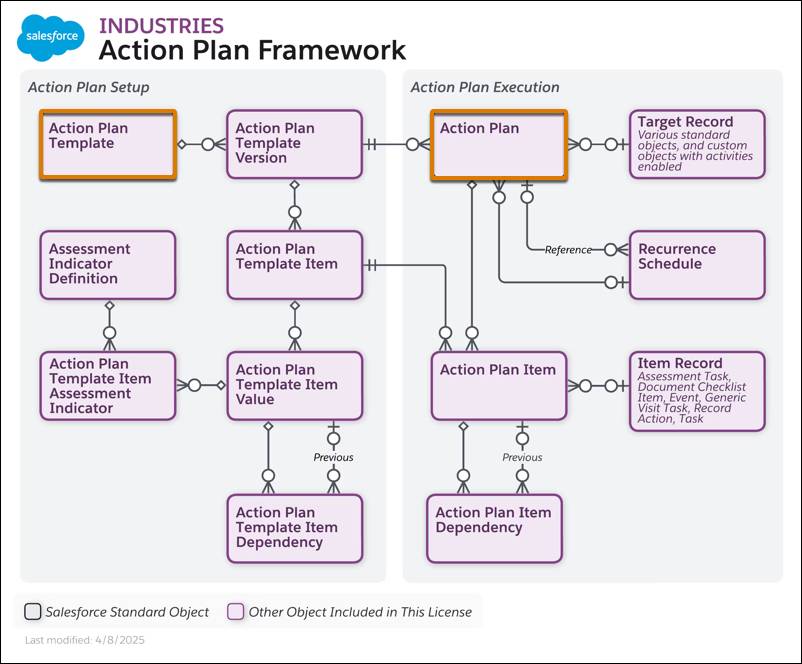
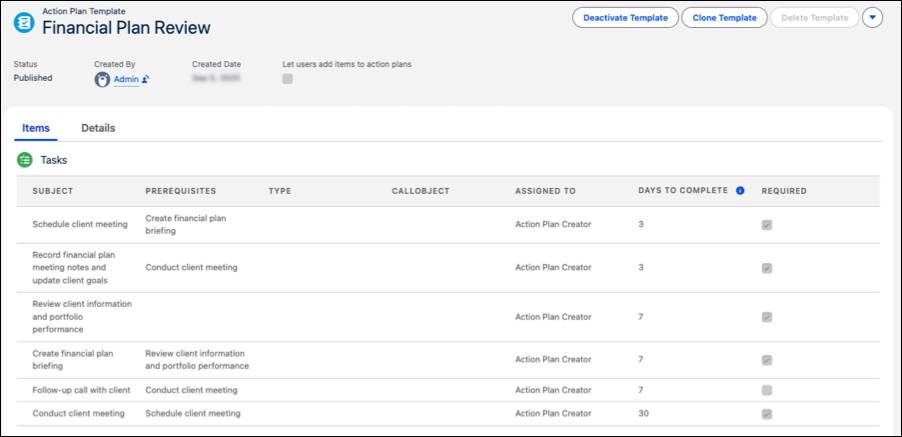
Par exemple, vous pouvez créer un modèle de plan d’action pour les réunions d’évaluation du plan financier avec les clients et y associer des tâches. L’objet Action Plan Template Item (Élément du modèle de plan d’action) relie les tâches au modèle.
Lorsque les gestionnaires de patrimoine doivent organiser une réunion d’évaluation avec leurs clients, ils peuvent créer un plan d’action à partir du modèle. Toutes les tâches définies dans le modèle sont créées dans le nouveau plan d’action concernant cette réunion spécifique avec le client. Chaque tâche est reliée au plan d’action avec l’objet Action Plan Item (Élément du plan d’action).
Le modèle de données Action Plan (Plan d’action) est une fonctionnalité partagée par de nombreux produits Salesforce dédiés à différents secteurs d’activité. Reportez-vous à la page Plans d’action dans l’aide Salesforce pour obtenir plus d’informations.
Le modèle de données Business Relationship Plan (Plan de relations commerciales)
Le modèle de données Business Relationship Plan (Plan de relations commerciales) enrichit l’objet Salesforce Account Plan (Plan de compte) de manière à permettre le suivi d’informations relatives aux besoins d’un client B2B à l’aide de résumés d’interactions, de plans d’action et d’autres objets.

Par exemple, vous pouvez créer un plan de compte pour le projet d’un client B2B visant à financer l’expansion de ses activités de production. Le plan de compte devient un espace unique permettant de suivre le travail et les progrès de votre équipe avec ce client, notamment en ce qui concerne les affaires financières, les opportunités de nouvelles ventes, les mesures prises pour atteindre les objectifs du client, et bien plus encore.
Service client et gestion des requêtes
Dans Salesforce, vous suivez le service client à l’aide de l’objet Case (Requête) standard. Toutefois, les institutions de services financiers comme la vôtre ont des besoins spécifiques qui vont au-delà du fonctionnement par défaut des requêtes. Agentforce Financial Services inclut des modèles de données permettant de développer les capacités d’une requête, qu’il s’agisse de suivre les plaintes des clients, les transactions contestées ou les opérations de recouvrement.
Le modèle de données Complaint Management (Gestion des plaintes)
Le modèle de données Complaint Management (Gestion des plaintes) aide les représentants de service à recueillir, soumettre et suivre les plaintes des clients. Pour ce faire, il utilise deux objets utiles : Public Complaint (Plainte publique) et Case Participant (Participant à la requête).
Public Complaint (Plainte publique) permet de suivre les litiges clients liés à des transactions financières. Il simplifie l’ajout de champs à l’objet Case (Requête) standard en enregistrant les informations relatives aux plaintes dans un objet spécifique. Cette capture d’écran présente une plainte publique qui suit un problème lié aux services bancaires en ligne.
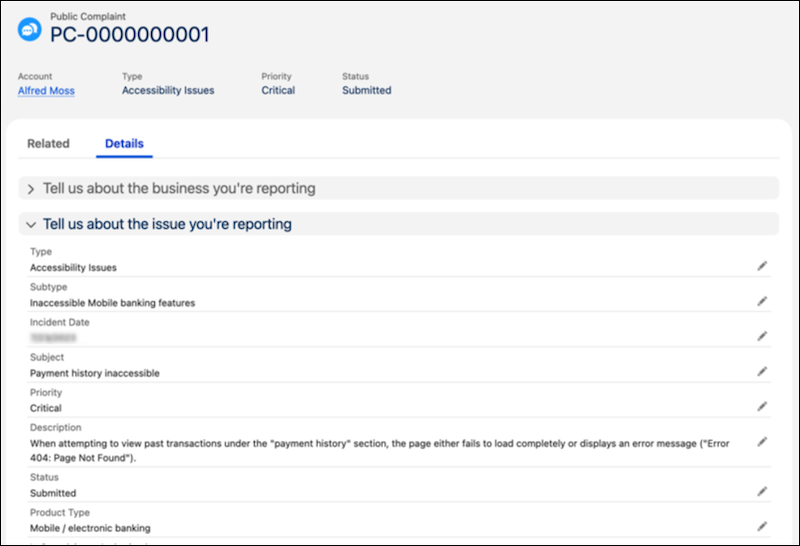
L’objet Case Participant (Participant à la requête) permet de définir le rôle d’une personne dans le cadre d’une plainte publique telle que celle-ci. Par exemple, les enregistrements de participant à la requête permettent de savoir si un particulier est le plaignant direct ou un représentant du client. Ils recueillent également les préférences en matière de communication et les informations d’autorisation pour chaque participant.
Le modèle de données Transaction Dispute Management (Gestion des litiges de transaction)
Le modèle de données Transaction Dispute Management (Gestion des litiges de transaction) aide les utilisateurs à recueillir, soumettre, suivre et résoudre les litiges des clients liés aux transactions financières.
L’objet Dispute (Litige) recueille les détails d’un litige, et l’objet Dispute Item (Élément de litige) associé suit les détails d’une transaction financière litigieuse unique. Les litiges sont également associés à l’objet Case (Requête), afin de suivre les processus de gestion des requêtes.
Ce modèle de données et ses objets s’intègrent à l’outil Service Process Studio (Studio de processus de service) pour permettre une configuration rapide du processus de service, ce qui offre aux utilisateurs une expérience guidée et détaillée pour résoudre rapidement les litiges.
Modèle de données Collections (Recouvrements)
Le modèle de données Collections (Recouvrements) utilise l’objet Case (Requête) ainsi que d’autres objets pour vous aider à rationaliser les processus de recouvrement, à réduire les impayés et à maintenir les relations avec les clients. L’objet Collection Plan (Plan de collecte) occupe une place centrale dans ce modèle de données.
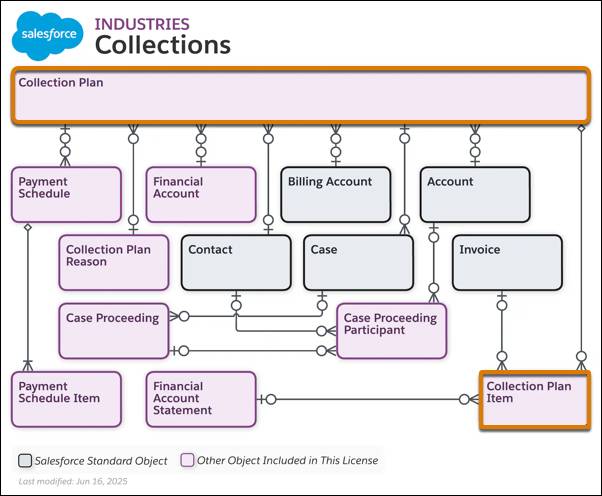
Collection Plan (Plan de collecte) contient des informations générales sur les soldes impayés d’un client et peut être lié à un compte financier, à des comptes de facturation, à des requêtes, à des contacts et à des comptes. En utilisant le champ de référence Financial Account (Compte financier), il est facile de savoir à quel compte financier un plan de collecte est associé.
L’objet enfant de Collection Plan (Plan de collecte), Collection Plan Item (Élément du plan de collecte), permet de suivre les informations relatives à des factures particulières qui sont impayées ou à des relevés de comptes financiers spécifiques indiquant un défaut de paiement. Utilisez ces objets et d’autres pour établir des priorités en matière de recouvrement et recueillir des accords de promesse de paiement afin d’amener les clients à payer l’argent qu’ils doivent.
Par exemple, si un client présente un retard de paiement relatif à sa carte de crédit, créez un plan de collecte pour le montant impayé. Utilisez le champ de référence Financial Account (Compte financier) pour relier le plan de collecte au compte financier de la carte de crédit. De même, si un client a trois factures impayées, créez un plan de collecte avec trois éléments de plan de collecte, un pour chaque facture due.
Si un plan de collecte répond aux critères de priorité élevée de votre institution, vous pouvez lui attribuer une priorité spécifique au sein d’une file d’attente

Et maintenant ?
Dans cette unité, vous avez découvert d’autres modèles de données dans Agentforce Financial Services qui prennent en charge la gestion des relations et le service client. Voilà qui était plutôt intéressant, n’est-ce pas ?
Toutefois, ce qui est vraiment intéressant, c’est d’intégrer les données de l’ensemble de votre organisation dans les modèles de données que vous avez découverts jusqu’à présent.
Dans l’unité suivante, vous découvrirez des moyens d’exploiter vos données à partir de systèmes disparates et cloisonnés, et d’utiliser tous les modèles de données que vous avez découverts dans ce module.