Manage a Slack Swarm
Learning Objectives
After completing this unit, you’ll be able to:
- Set up swarming with Salesforce Go.
- Create a swarm from a case and find experts for your swarm team.
Set Up Swarming with Salesforce Go
In the past, configuring cross-platform collaboration was a manual, multistep process. Today, Agentforce Service simplifies this with Salesforce Go. Admins can now enable swarming with just a few clicks.
To start, click  and select Salesforce Go from the dropdown menu. Next, type
 Swarming in the search field and click Keep Going.
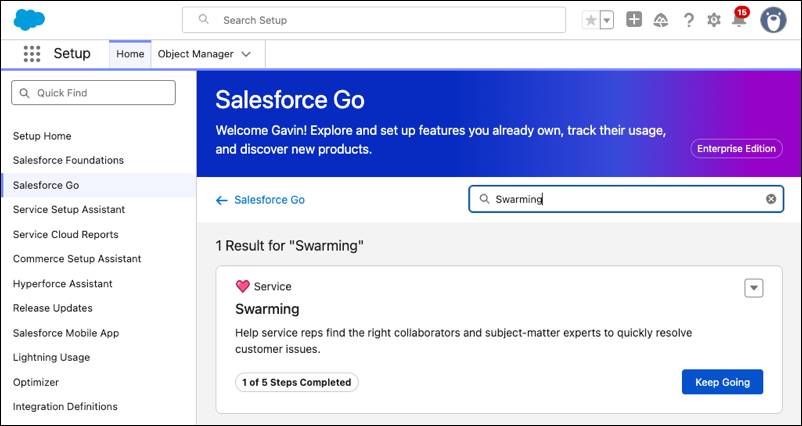
From here, you can let Salesforce Go:
- Set up service console apps for swarming.
- Turn on swarms and let users swarm on records.
- Deploy swarming on case flows and assign users the right permissions.
- Set up Expert Finder to ensure the right experts are added to swarms.
- Measure swarming engagement with your own reports or prebuilt standard reports.
Once swarming is set up for your org, you’re ready to go. Next, see how a team swarms on a case.
Start a Swarm from a Case
Ada, an experienced product support specialist at Ursa Major Solar, takes a call from a customer named Chris. Chris recently installed Ursa Major’s commercial solar system. Everything worked fine until one of the T-1138 solar panels caught fire. Chris wants to get the panels fixed or replaced immediately.
Ada has handled many cases, but she’s never heard of a solar panel catching fire. And no knowledge articles surfaced about fires. She’s stumped.
Instead of putting Chris on hold to find an expert or manager, she clicks Begin Swarming in the Actions & Recommendations component on the case. (She could start a swarm from Slack, but that’s not where she is right now.)
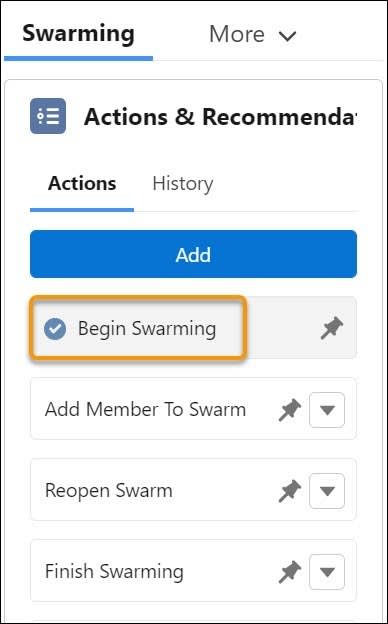
Ada needs a new Slack channel where she can pull together people with T-1138 expertise, so she selects New Channel. She uses the case number to name the swarm channel, which is #swarm-case-00005246. Ada leaves the channel as public for visibility, and she enters the help she needs: T-1138 solar panel fire risk.
Ada sets up her swarm team. She describes the help she needs by entering: Info about why a T-1138 solar panel would catch fire. Then, she adds members to the swarm.
She chooses Expert Finder because she wants to work with the expert on T-1138 solar panels. Under Skills, she selects Solar Panels, English, and Commercial Installers. Agentforce analyzes availability in Omni-Channel and suggests the best experts.
Omni-Channel routes an invitation to the best available user with the specified skills. In this case, that expert is James Clifton. He accepts the request and is automatically added to the swarm.
To stay compliant with service contacts, Ada realizes that she should add the customer’s account manager to the swarm. She clicks Add another swarm member, and selects Add a specific team member to choose Chris’s account manager.
Back on the swarming panel of the case, Ada views the swarm and swarm members. She sees that the account manager and T-1138 expert James Clifton have both joined the swarm.
Solve the Problem and Finish the Swarm
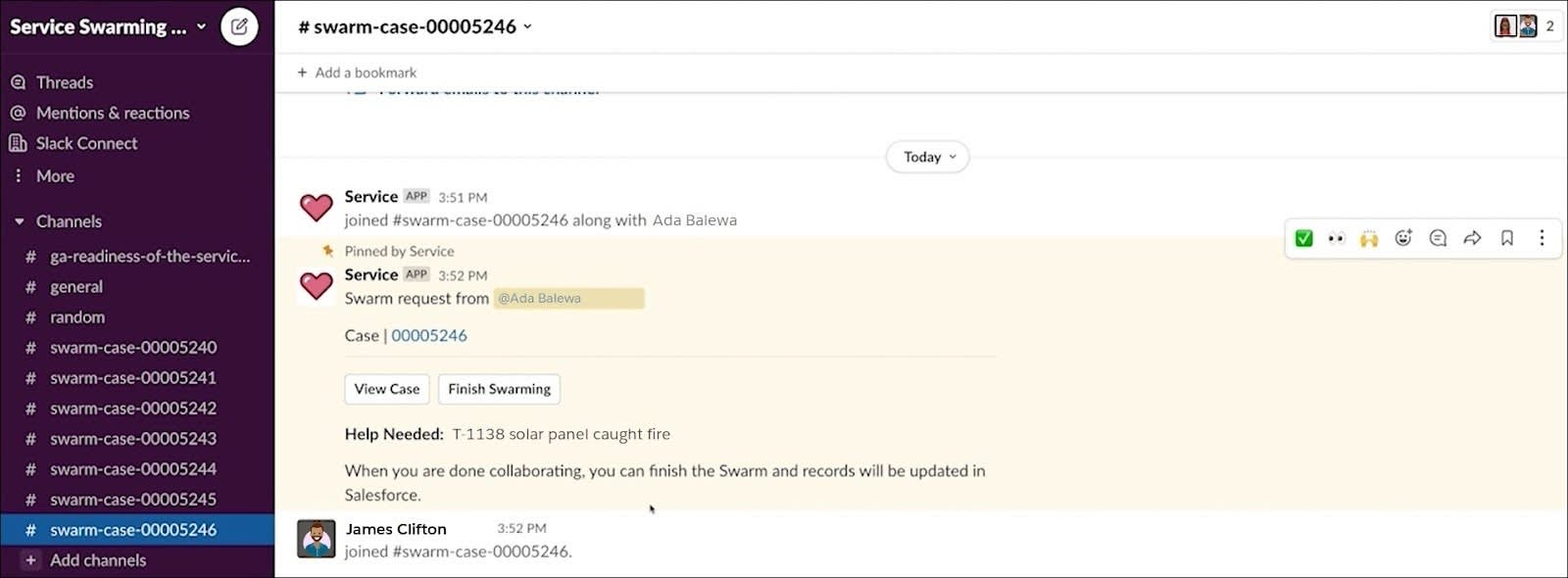
Ada heads to the newly created #swarm-case-00005246 Slack channel. Her swarm includes herself, the account manager, and James Clifton.
In the first post, Ada sees where swarm members can view the AI-summarized case details in Slack to understand the problem. James announces that he’s read the summary and suggests a huddle with Ada and Chris so they can talk about the problem live.
Because Ursa Major uses Slack Connect, Ada can add Chris to the channel. After a person is added to the channel, they see all the posts. Sometimes, it makes sense to have two separate swarms: one for internal-only discussions and one for the swarm team and the customer.
Ada decides to bring in Chris, the customer, right away and gets admin approval.
Then, Ada starts the huddle. At the bottom of the left navigation column, she clicks the headset icon. (If you don’t see this icon, it may not be enabled in your workspace.)
James and Chris join Ada on the huddle. James says he’s heard of T-1138s catching fire, but it’s rare. It only happens 0.01 percent of the time. He asks if anyone has been up on the roof, and Chris mentions there was a company party on the roof recently.
James suspects something got bumped or damaged on the roof. He sets up an emergency appointment to find and replace the damaged panel.
An AI agent summarizes the conversation and automatically writes a knowledge article. Now, other service reps will know what to do when a similar call happens.
Later, Ada hears the emergency visit fixed the problem. In Slack she hovers over the message where a resolution was discussed, and she clicks Send to Salesforce. Information about the resolution is added to the case.
The message appears on the case with a link back to the Slack channel in case a future service rep needs more context.
Now that Ada updated the case, she clicks Finish Swarming on the case or Slack post and then closes the case.
If necessary, Ada can always reopen the swarm from the Slack channel or case record.
To see a swarm on a case in action, watch this video.
Track Swarming Results
After a few weeks of using Slack swarming, Ada wants to know if it’s improved case resolution times and customer satisfaction (CSAT).
Even though Ada can build her own reports on swarms, she uses prebuilt reports installed by her admin from an AgentExchange app: Service Cloud Swarming Reports and Dashboards. Ada opens the Swarming Impact Dashboard.
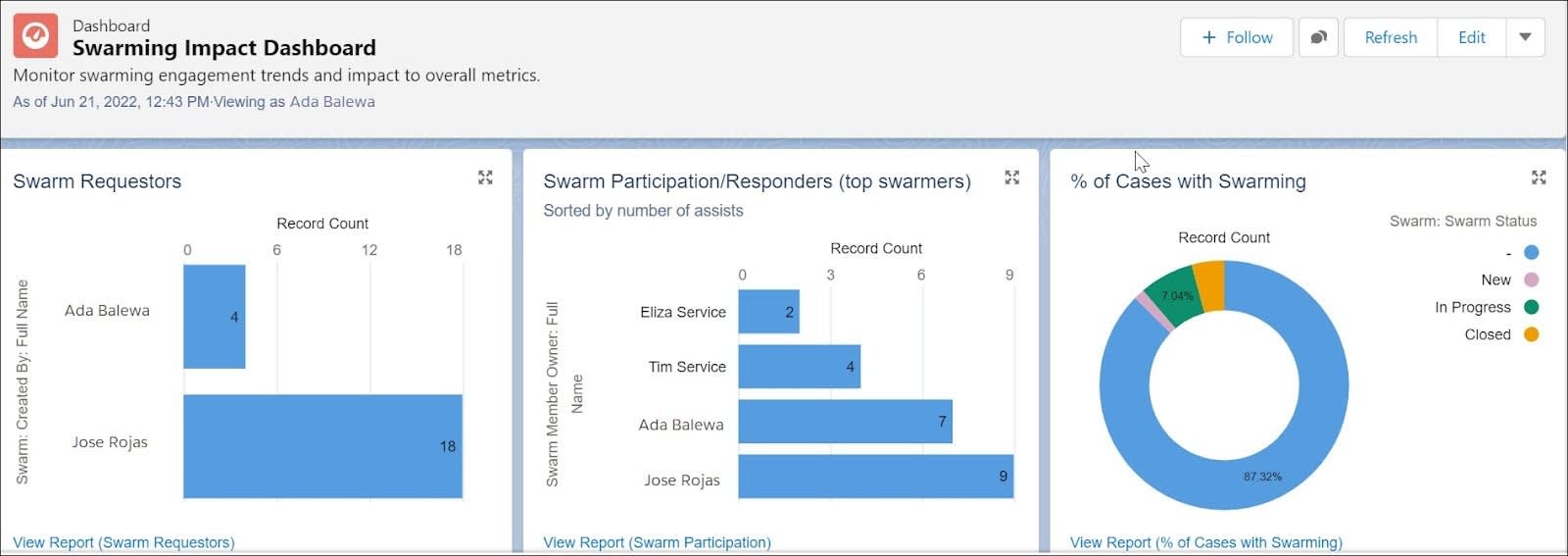
Ada notices that she and her colleagues Jose, Eliza, and Tim are the top swarm requestors and responders. She also sees the percentage of cases using swarming. She can drill down into the report to see more details.
Next, she opens the Swarming Operational Dashboard.
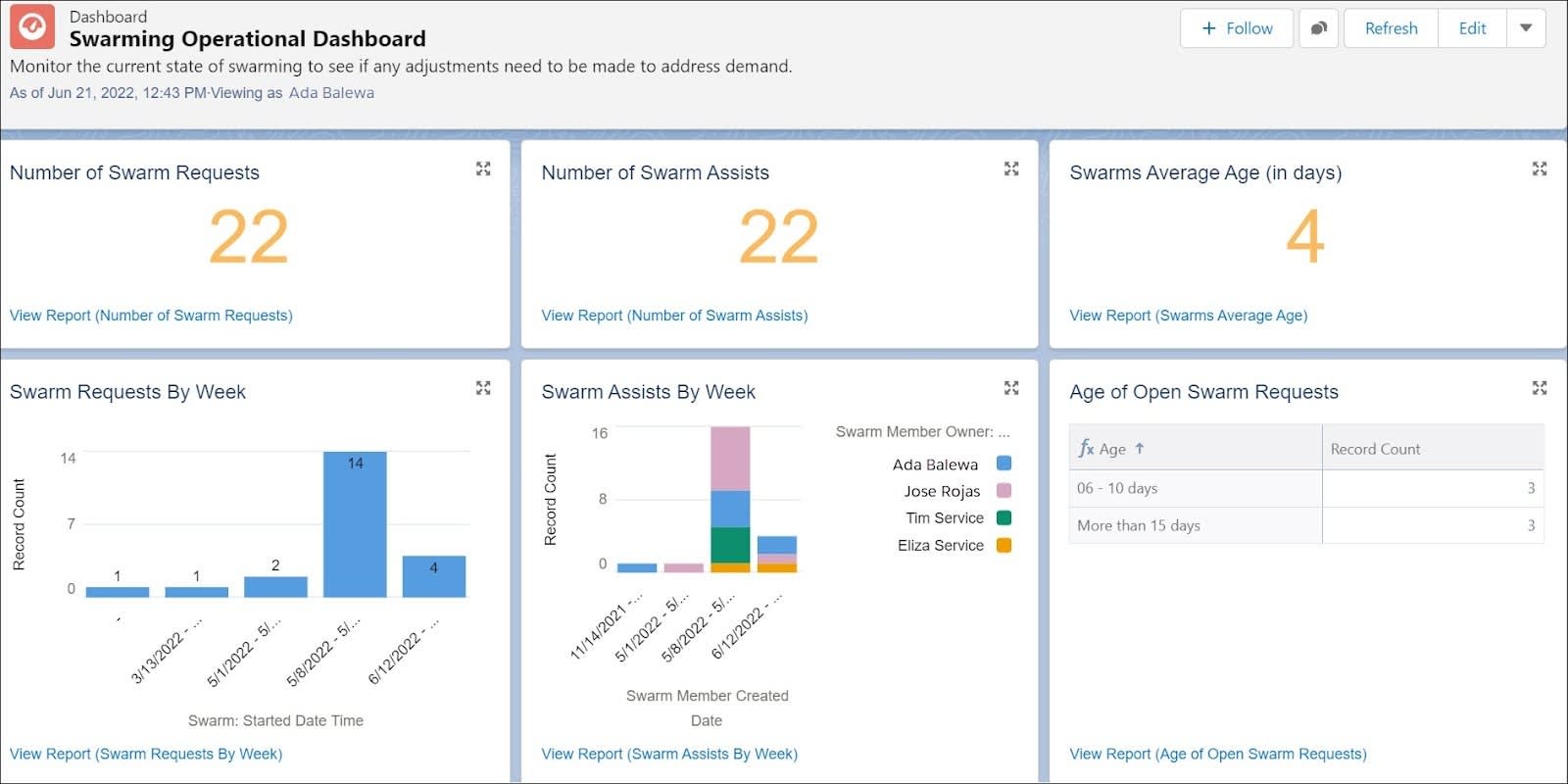
The number of swarm requests is low compared to case volume. This number makes sense because Ursa Major just started Slack swarming.
Ada is happy to see that team members are jumping in to assist whenever they’re asked. The average age of swarmed cases is less than cases that escalated when they used the traditional, tiered support model.
After reviewing the reports, Ada concludes customers with complex problems are helped more quickly than ever before.
Wrap It Up
In this unit, you learned how to set up and start Slack swarms, invite experts to swarm teams, and review swarm metrics. Now, you’re ready to start swarming.