Experience Unified Agentforce Commerce for B2C
Learning Objectives
After completing this unit, you’ll be able to:
- Explain how merchandising tools, such as Geolocation and Dynamic Customer Groups, personalize the storefront experience for first-time visitors based on location data.
- Explain how Einstein Recommendations and predictive sort optimize product discovery by prioritizing relevant items and resolving terminology differences.
- Describe the role of Agentforce Guided Shopping in answering specific customer inquiries regarding product details and store policies by using generative AI.
- Explain how a unified commerce strategy connects Order Management, Point of Sale, and Data 360 to create a consistent, cross-channel shopper profile.
Make Agentforce Commerce for B2C a Unified Commerce Experience
To meet digital customer expectations, increase growth, and lower the cost of ownership, ecommerce businesses are adopting a unified commerce approach. Unified commerce means all sales channels, touchpoints, and back end systems work as one. Agentforce Commerce is a leading unified solution that combines Agentforce Commerce for B2C, Order Management (OM), and Retail Cloud POS (POS) on a single platform, centralizing everything from ecommerce to inventory.
Unified commerce lowers the cost of ownership by connecting digital commerce, POS, and OM to enable consistent customer experiences online, in-store, and on mobile. Agentforce Commerce is the only unified platform that stitches these elements together. It’s a complete system for the management of digital storefronts with Agentforce Commerce for B2C, while OM and POS connect backend operations and physical stores. The result is a centralized, real-time view of all products, orders, and customer interactions.
Add Agentforce Guided Shopping
Boost conversion rates and reduce service costs with a seamless, data-backed conversational commerce experience, fully secured by the Salesforce trust layer. Agentforce Guided Shopping empowers you to provide a 24/7 personal shopping assistant, helping customers find products and make purchases faster using natural language on your storefront or messaging apps.
When you add Guided Shopping to your Agentforce Commerce for B2C experience, you can offer shoppers timely assistance and ensure connected interactions throughout their customer journey on your B2C storefront. Guided Shopping uses the Salesforce Commerce API (SCAPI) to retrieve product information from your Agentforce Commerce for B2C store. In addition, the agent combines natural language processing (NLP) with Data 360 and your Agentforce Commerce for B2C data to provide a personalized “in-store shopping experience” for the online realm.
Customers benefit from convenience and personalized attention, including assistance with product search, product recommendations, promotion highlights, frequently asked questions, product discovery, and secure checkout. For your business, this translates to increased sales and satisfied customers.
Integrate Agentforce Commerce with Data 360, Agentforce Marketing, and Agentforce Service
When you integrate Agentforce Commerce with data from Data 360, Agentforce Marketing, and Agentforce Service, you get a single, shared view of each customer. Withthis view, you can deliver personalized, connected experiences across multiple touchpoints.
Data 360 and Agentforce Commerce
Salesforce Data 360 for Agentforce Commerce for B2C gives you a complete, integrated 360-degree view of your customers. It unifies, analyzes, and activates customer data to create personalized shopping experiences. Integrating Agentforce Commerce for B2C with Data 360 gives the storefront access to real-time data. Use data for orders, engagement events, and shopper profiles to enable real-time tracking of interactions, enhanced personalization, and near real-time segmentation.
Agentforce Marketing and Agentforce Commerce
Connecting Agentforce Commerce and Agentforce Marketing unifies commerce and marketing data. The unified data enhances the 360-degree customer view. With a 360-degree view of customer data, commerce and marketing functions can create consistent, relevant messaging and deliver personalized customer engagements across all touchpoints. Unifying commerce and marketing data increases both operations efficiency and customer satisfaction.
Agentforce Service and Agentforce Commerce
Connecting Agentforce Commerce and Agentforce Service gives service representatives a full, real-time view of the customer across both commerce and service. Service reps gain capabilities such as viewing the full product catalog and real-time inventory, accessing product recommendations, and placing orders on behalf of customers. This connected approach also transforms customer service into a shopping channel. Reps can use customer data to co-browse, view carts, add products, and complete transactions for shoppers, which create cross-selling and upselling opportunities.
Experience Unified Commerce
To experience how Agentforce Commerce for B2C features and capabilities engage shoppers, build brand loyalty, increase average order value (AOV), and ultimately lower the cost of ownership, follow along with Gabby as she experiences a Agentforce Commerce for B2C storefront and unified commerce experience.
The Setup
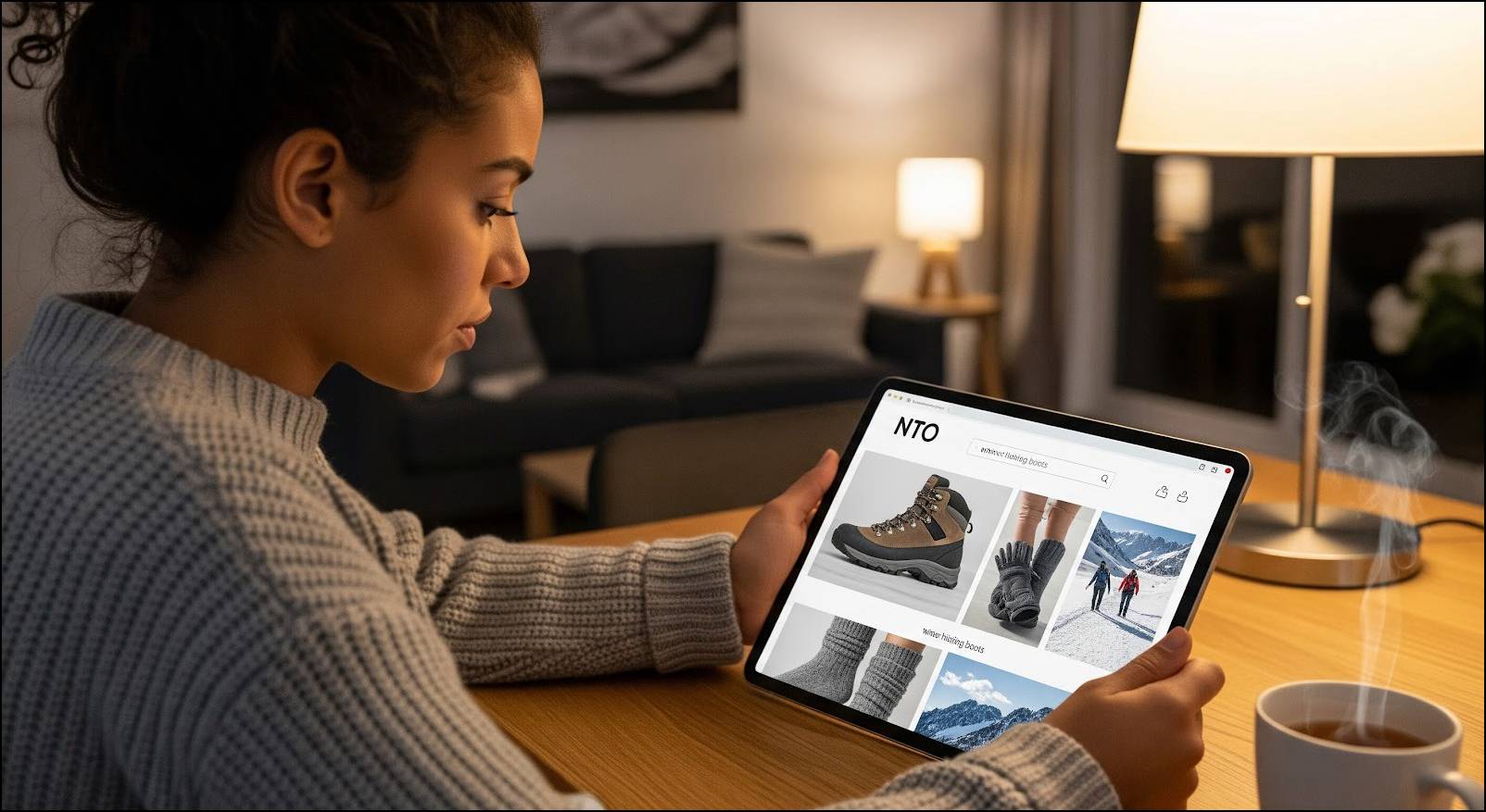
Gabby, an outdoor enthusiast from the northern US, sees an ad on Facebook for Northern Trail Outfitters (NTO), a new outdoor gear and outfitter retailer. She’s planning a series of winter dayhikes and wants a new pair of winter hiking boots. When shopping for outdoor gear, Gabby prioritizes functionality and quality. Her browsing habits focus on relevant, premium products that capture her attention.
NTO Platform Configuration
-
Ecommerce platform: Agentforce Commerce for B2C
-
Unified commerce apps: Agentforce Commerce for B2C, OM, and POS for their physical store locations
NTO Salesforce Integrations
- Data 360
- Agentforce Marketing
- Agentforce Service
Gabby’s Shopping Experience
Gabby clicks the site link in Facebook and goes to the Northern Trail Outfitters website. Because this visit to NTO is Gabby's first, NTO has no profile data specific to Gabby. As Gabby browses the site, Data 360 starts building a unified profile for her.
As the NTO site loads on Gabby’s device, the geolocation feature identifies her IP address as originating in a northern US region. Before site launch, the Salesforce admin configured dynamic customer groups to segment visitors based on this location data. Applying this data, the content slot on the homepage shows a hero image of snow-covered peaks and winter gear rather than warm-weather scenes and gear. The NTO site merchandisers and graphic design teams designed this visual layout by using Page Designer, dragging components to build a seasonal story without needing developer code.
Gabby types “winter boots” into the search bar. Einstein search recommendations immediately provide personalized term completion, helping her find items faster. The merchandiser previously configured Einstein search dictionaries to ensure terms like “snow boots” and “insulated footwear” act as synonyms, ensuring Gabby finds relevant products regardless of her specific phrasing.
On the search results page, predictive sort arranges the results based on predictive intelligence, placing the most relevant, high-quality boots at the top of the list. To narrow her options further, Gabby selects Waterproof and Insulated from the sidebar. These filters appear because the merchandiser configured search refinement definitions based on specific product attributes.
As Gabby browses the site, Einstein recommendations analyze her real-time browsing behavior such as the categories and products she explores. Einstein recommendations use this data to refine product recommendations dynamically during her session. Merchandisers designed the site to show her similar products, options to add to cart, and recently viewed products based on her real-time browsing history. This guides Gabby toward relevant products and reminds her of items that she liked. It also improves her first-time site experience.
Gabby finds a pair of boots but has questions about their warmth rating, sizing, and the site’s return policy. She opens the chat window and engages with Agentforce Guided Shopping. Powered by generative AI, guided shopping answers her specific questions about insulation, size, and returns. It also suggests that if she has the time, she can try on the boots at a local store. Satisfied knowing that she can return the boots if they don’t fit, she starts to place an online order.
Before placing her order, she notices Complete the Set suggestions on the product detail page which features high-quality wool socks and traction cleats. Einstein recommendations power these suggestions by analyzing data to predict what accessories a winter hiker needs. Merchandisers configured this specific recommender to show complementary items.
Gabby adds the boots to her cart but isn’t sure about the socks and traction cleats. When she goes to the checkout page, the marketing promotion engine shows her personalized promotional offers for seasonably-appropriate gear such as waterproof hiking boots, socks, and traction cleats. This promotion offer adds personal relevance to Gabby's experience and encourages conversion. The promotion is part of a campaign targeted specifically at new visitors to encourage that first purchase and build brand loyalty. Gabby decides to take advantage of the promotion, and adds the socks and traction cleats to her order.
In-Store Pickup with Unified Commerce
NTO pairs Agentforce Commerce for B2C with OM and POS. This combination delivers a world-class unified commerce solution that creates consistent customer experiences across online, in-store, and mobile channels.
While completing the checkout process, Gabby selects in-store pickup at the store which was recommended by Agentforce guided shopping. When Gabby arrives to pick up her order, an associate uses POS to access her unified profile, where they can view her order, online purchase history, and preferences. This unified commerce strategy connects Agentforce Commerce for B2C, OM, and POS, creating a consistent experience across touchpoints and strengthening brand loyalty. After Gabby completes the transaction for her boots, socks, and traction cleats, OM tracks the order in real-time, providing transparency to shoppers and service reps.
Connect the Entire Shopper Journey
NTO integrates Agentforce Commerce with Data 360, Agentforce Marketing, and Agentforce Service. The NTO marketing and commerce teams use the data from this integration to continue building brand loyalty with Gabby after her order is complete. By using Data 360, NTO manages a data segment for new customers. The new customer segment now includes Gabby’s profile. NTO uses data segmentation to support various marketing campaigns and commerce promotions. A few days after picking up her order, NTO sends Gabby a personalized email featuring a discount on winter gloves, an accessory relevant to Gabby’s recent order.
Months later, Gabby’s shopper journey continues as she contacts support with a question about boot care. Because the NTO Agentforce Commerce for B2C instance integrates with Agentforce Service, the service rep can view her complete order history. This service connection helps the rep resolve Gabby’s issue quickly and builds brand loyalty.
Gabby’s experience with NTO demonstrates the platform's ability to personalize every step of the shopping journey.
Wrap Up
In this unit, you followed Gabby's experience to learn how Agentforce Commerce for B2C features and tools help site admins and merchandisers build and manage an ecommerce website that engages shoppers from the moment they visit a website. You also discovered how unified commerce promotes a consistent experience across all channels—online, in-store, and mobile—by integrating Agentforce Commerce for B2C, OM, and POS. In addition, you experienced how unified Agentforce Commerce for B2C—integrated with Data 360, Agentforce Marketing, and Agentforce Service—creates a comprehensive 360-degree customer view of the shopper journey.