Give the Gift of Feedback Across Your Company
Learning Objectives
After completing this unit, you’ll be able to:
- Give multi-directional feedback across your company.
- Reflect on your biases when giving feedback.
- Lead by example when giving feedback.
Feedback That’s Multidirectional — Given Up, Down, and Across
Earlier we talked about transparency as one of our Salesforce Ohana values. That means:
- Communicating openly and honestly
- Being open and receptive to feedback
- Empowering employees to voice ideas and opinions
And, it’s not just a one-way street, in addition to managers providing feedback to their direct reports, transparency calls for:
- Directs giving UPWARD feedback to their managers
- Peers giving LATERAL or “across” feedback to each other
- Cross functional employees giving UPWARD, DOWNWARD, and LATERAL feedback to each other
 Think about giving and receiving feedback like playing football (that’s soccer to you Americans!). When you play football, you pass the ball around to different players on the team. The ball can come from any direction. You might need to pass it upfield to a striker, laterally to a midfielder, or even backwards to a defender. Throughout all this passing up, laterally, and downward, the players all have the same goal in mind—get the ball past the opposing goalkeeper as many times as possible to win the game.
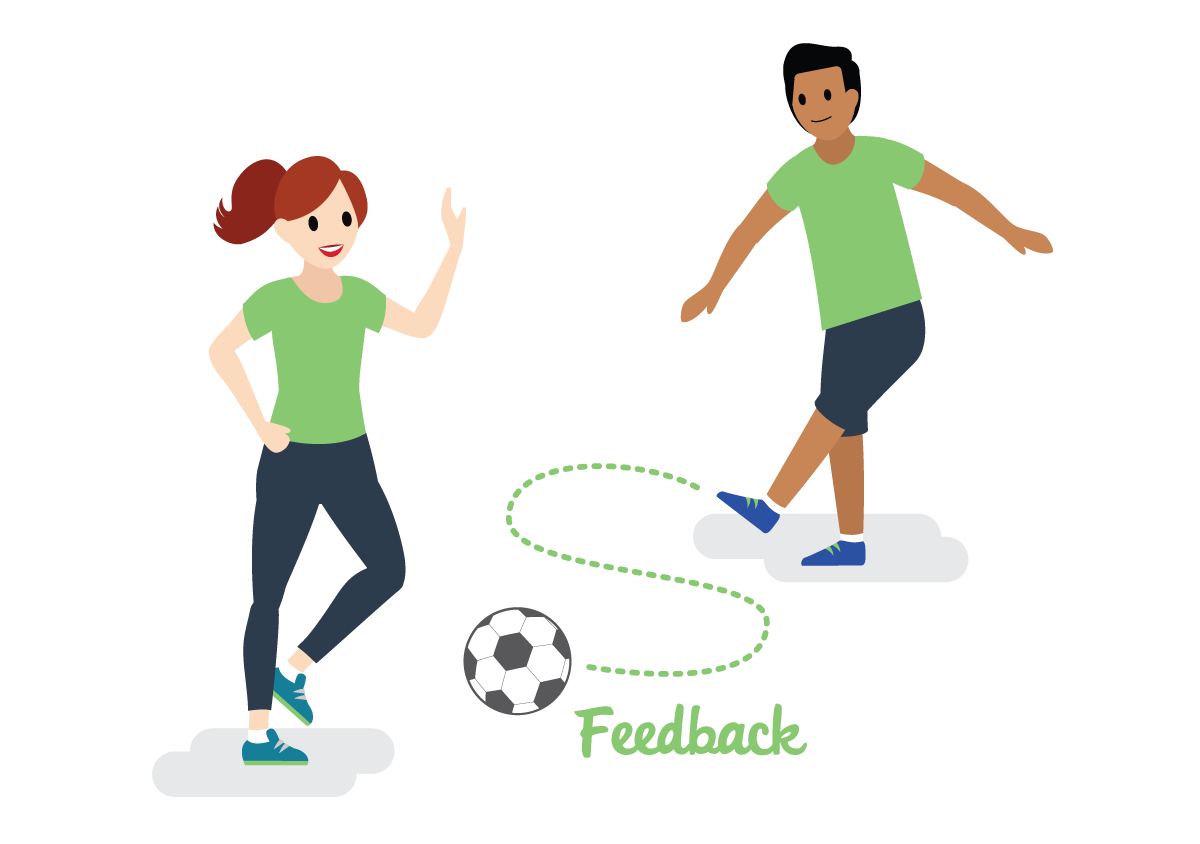
At Salesforce, we’re all “playing football” on the same team and trying to score goals. We’re looking to pass the ball all over the field, and striving to get more comfortable receiving the ball from any of our teammates. Like a winning football team, we’re spending time in practice to improve our ball handling, passing, teamwork, and ultimately our overall offensive scoring capability. All this to say, we’re working hard at providing feedback upward, downward, laterally, cross-functionally, and globally.
We’ve talked a lot about providing feedback downward here and within our Giving and Receiving unit in the Coaching & Feedback module. But what about tips for upward and lateral feedback?
Giving |
Receiving |
|
|---|---|---|
Upward |
|
|
Lateral or Across |
In addition to the tips above:
|
In addition to the tips above:
|

Feedback That Keeps Biases in Check
We all have biases. “Who me?” Yes, even you!
“Wait, what’s a bias again?” Google it! You’ll see it’s “prejudice in favor of or against one thing, person, or group compared with another, usually in a way considered to be unfair.”
So what’s this have to do with giving and receiving feedback? Well, as you can imagine, it’s pretty important to think about whether the feedback you’re giving—or receiving—is influenced by biases, even unconscious biases (being biased without even intending or realizing it). Most people don’t want to let bias affect how they deliver feedback—and you don’t either.
So how can you keep bias in check when it comes to giving feedback? Consider these suggestions.
Think About |
Consider |
|---|---|
Language you use |
For example, being conscious of "slang" that may not translate when you’re writing or speaking.
For example, instead of saying "You really hit it out of the park!" say "Excellent job in your presentation to the customer!" |
Your Identity in relation to the giver or receiver |
For example, is your approach different when giving feedback to someone who graduated from the same university as you, or to someone who grew up in the same home town?
For example, unconsciously showing favorable bias towards your co-worker Jim (like granting him leeway on his deadlines or letting it go altogether when he misses one) because you know that he’s coaching his daughter’s soccer team and you can relate to him as a parent. |
Assumptions you make |
For example, Jodie has been arriving late to her morning meetings. You’ve been making the assumption that she is not committed to her role when in reality she’s late because she’s taking care of a sick parent.
For example, checking in with your teammate to understand the situation, "I noticed in yesterday’s meeting that you were a kind of quiet when we talked about getting the team together for volunteering next week. What are your thoughts on the plans?"
For example, using SBI or the "Generalizations vs. Behavior" model you’ll learn about when you finish reading this chart! |
Your Agenda |
For example, giving feedback that someone you work with cross-functionally did not complete their piece of the project thoroughly, when in fact, you could have been better at communicating the needs, scope, deadlines of the project. |
Woah! That was a pretty intense list of questions to reflect on before giving feedback. It can be mind boggling to think that sometimes the feedback we intend to give is actually a reflection of some unconscious or self motivation.
Sometimes our biases can come out in some pretty common day-to-day observations or declarations about people. One of the big bias traps we sometimes fall under is making broad generalizations about people, including labeling and making assumptions. More often than not these generalizations are based on perceptions rather than on the specific, observable, objective behaviors.
How does this play out? Check out the generalizations on the left and the observable and objective behaviors on the right in the table below.
Generalizations |
Observable/Objective Behavior |
|---|---|
“He’s always late.” |
He was late to the last three team meetings. |
“She’s a workaholic.” |
She worked around the clock on the last project and turned things in ahead of the deadline. |
“She’s difficult to work with.” |
She rescheduled Tuesday’s meeting at the last minute, and then was annoyed when people couldn’t make the new time. |
“He’s not a team player.” |
On the Apex project, he made a last minute call on the budget without consulting with the other team members. |
What do you notice about the difference between the generalizations on the left and the behaviors on the right? On the left, it’s a focus on who the person is. On the right, it’s a focus on the behavior.

Check your biases!
"He is always late!" Is he? Or was he late just the last three times?
"She’s difficult to work with." Is she? Or is she just under stress right now and having a hard time managing her schedule?
"He’s not a team player!" Is that true overall? Maybe he had to make this decision without consulting others for a legitimate and justifiable reason?
You see how that works? Not only can you check your own biases, but you can also call out others when they make these broad abstraction generalizations. Not only does this help uncover bias and misperception, it helps people gain more clarity on what’s truly going on so that feedback on these issues can be grounded in the specific and observable behaviors.
Feedback Where Managers Are Leading by Example
At the end of the day, creating a feedback culture only goes as far as managers walking the talk.
An article published by the Harvard Business Review emphasizes the role that managers play in creating a culture that’s open to giving and receiving feedback.
“Developing a culture where people feel comfortable admitting mistakes needs to start at the top, because employees watch their leaders for clues on acceptable behavior and etiquette. One of the most valuable things that a manager can teach her staff is the ability (no matter how embarrassing) to show fallibility, admit wrongdoing, listen to tough feedback, and persevere through the corrective action toward the next challenge.”
That just about encapsulates it. It’s all about:
- Proactively asking for and giving feedback
- Demonstrating vulnerability
- Acknowledging and discussing mistakes, shortcomings, and development opportunities
- Taking to heart and practicing all the elements of the feedback culture discussed within this unit
 At Salesforce, we’re working towards our vision of a feedback culture, including making “being open and honest in giving and receiving feedback” one of our top company goals.
For us, this goal looks like:
- Making giving and receiving feedback a norm
- Engaging in courageous conversations
- Using feedback as a way to support each other, help us all learn, grow, and do the best work of our lives
Without doubt you’re now convinced that giving honest feedback has a tremendous impact on employee engagement and performance. And you now see the risk that not providing feedback has on your employees.
So ask yourself:
- Which elements of a feedback culture can you bring into your day-to-day interactions that can help you and your team succeed?
- How can you build your courage to engage in difficult or challenging conversations?
- How can you get better overall at giving and receiving feedback?
Getting better at anything requires dedication, effort, and the right growth mindset. Start today and ask people who know you well, what can I do even better?
Resources
- The Best Gift Leaders Can Give: Honest Feedback
- Why Is It So Hard for Us to Admit Our Mistakes?
- Radical Candor
- Having a Difficult Conversation with Someone from a Different Culture