Manage B2B Relationships
Learning Objectives
After completing this unit, you’ll be able to:
- Explain how Agentforce Financial Services helps business-to-business (B2B) financial institutions work with clients.
- Describe the foundational components for managing business client relationships.
Before You Start
Before you start this module, consider completing this recommended content.

The Complexity of B2B Relationships
B2B financial services are complex. That complexity starts with the financial products that businesses need to grow and expand. On top of that, add complicated hierarchies and ownership structures, which are critical to map for successful B2B relationships.
Fortunately, Agentforce Financial Services includes capabilities specifically built for B2B financial services.
In this badge, you learn about those features designed to support B2B relationships, including Business Client Engagement, Integrated Onboarding, Business Relationship Plans, and more.
Let’s get started!
Meet Agentforce Financial Services B2B Solutions
No matter the type of clients you work with, Agentforce Financial Services helps you build trust by unifying customer experiences and information across channels, geographies, and lines of business. That’s true with B2B relationships, as well.
Agentforce Financial Services’s B2B features work in any vertical, such as banking, asset management, and insurance, to manage complex business relationships and needs.
These features automate the manual processes that, too often, dominate B2B relationship management. For example, client onboarding and business relationship planning involve many detailed steps, and relationship managers and onboarding teams spend a lot of time on these tasks.
These B2B solutions simplify onboarding and relationship planning through partner integrations and reliable AI tools, reducing manual workloads. This empowers relationship managers to focus more time on building more effective sales strategies, advising clients, and driving revenue.
Plus, because these features are built on the strong foundation of Salesforce and Agentforce Financial Services, you can go further and find turnkey partner solutions in AgentExchange to further expand your capabilities.
Before diving deep into these features, explore the basics of what’s included in Agentforce Financial Services.
Explore B2B Features
In Agentforce Financial Services Basics, you learned about the breadth of features that you can combine to meet your institution’s needs.
Your B2B team uses many of those same features to serve the needs of relationship managers and the businesses they work with. For example, check out how Agentforce Financial Services features work together to manage the entire commercial banking value chain.
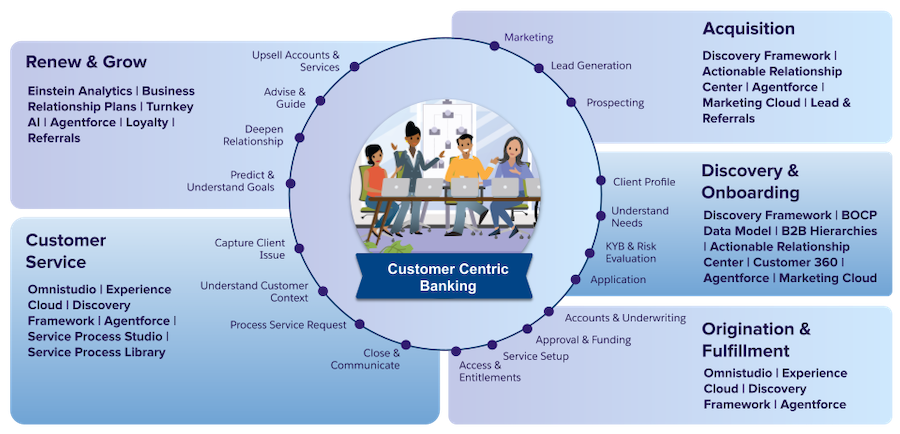
At the acquisition stage, you have tools for marketing, lead generation, and prospecting. When it’s time to onboard a customer, other tools help you understand a client, their needs, and the risks in servicing them. During origination and fulfilment, you have tools to monitor accounts, underwrite loans, and provide services and entitlements. As you work with your B2B clients, use the strong customer service tools to capture issues, understand context, and quickly resolve requests. Finally, your relationships managers have the tools they need to renew and grow your business with each B2B client.
These tools help manage the whole value chain from acquisition to renewal in one system, all while keeping the customer central to the processes. Cool, isn’t it?
In this module, you learn primarily about these B2B-specific features.
-
Business Client Engagement helps you understand your business clients with the Onboarding and Know Your Business (KYB) data models. It provides tools such as prebuilt Actionable Relationship Center (ARC) graph templates to visualize complex business relationships and key stakeholders. It works with Integrated Onboarding to enable the capture of crucial details such as beneficial owners, controlling parties, and business structure.
-
Business Relationship Plans provide a strategic and collaborative approach to B2B client planning, capturing essential account details so you can prepare objective-driven plans. It extends the Salesforce Account Plan feature for B2B financial services clients and integrates AI-powered summaries and tools to visualize progress to deepen client relationships.
While both features work across business lines, they also integrate with solutions for specific personas. For example, these features work with the Relationship Manager Console for commercial banking.
What’s Next
In this unit you learned that Agentforce Financial Services offers specific capabilities to manage the complexities of working with B2B clients, including Business Client Engagement, Integrated Onboarding, and Business Relationship Plans. These features automate manual processes, streamline onboarding, and simplify relationship planning, helping you build trust and manage your B2B client relationships across verticals.
Now that you know the basics, it’s time to dive deeper. In the next unit, learn about Business Client Engagement and Integrated Onboarding.